
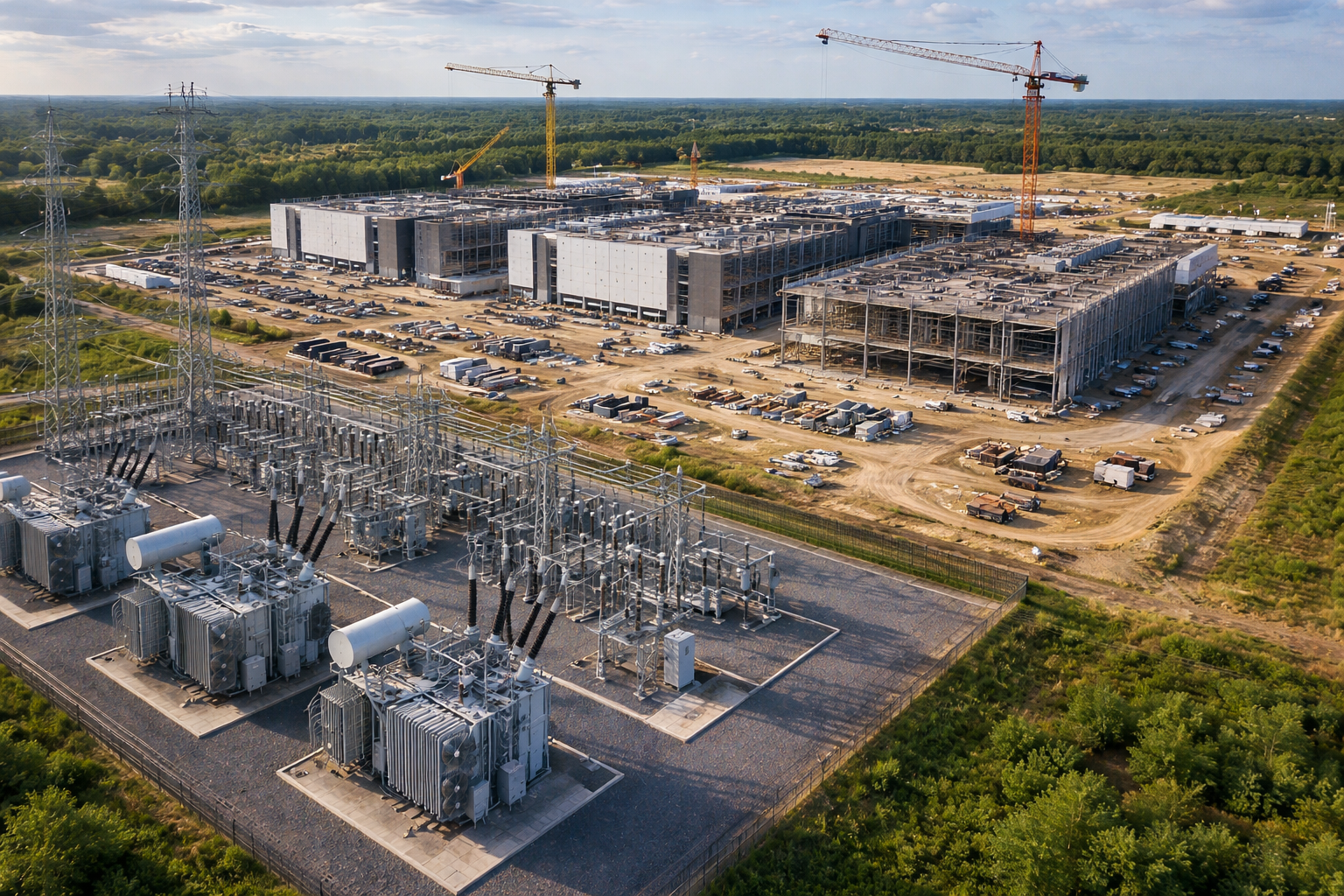
Data center site selection once followed a familiar logic. Developers sought locations with strong fiber connectivity, low latency to end users, competitive real estate costs, and stable regulatory environments. These criteria shaped the geography of digital infrastructure for two decades, concentrating capacity in well-known corridors like Northern Virginia, Singapore, and Amsterdam. That logic has not disappeared, but it no longer leads. Artificial intelligence infrastructure operates at power densities and scale that earlier generations of compute never approached, and the constraints that now govern where data centers get built reflect that transformation. The rules of site selection have changed, and the developers who understand the new hierarchy are building faster and more strategically than those still following the old playbook.

Power Availability Has Replaced Connectivity as the Primary Filter
The first filter in modern AI data center site selection is no longer fiber access or latency proximity. It is power availability, specifically the ability to access large quantities of reliable electricity within a timeline that aligns with construction schedules. AI workloads run at significantly higher rack densities than traditional enterprise computing, and the aggregate power requirements of a single hyperscale AI campus now rival those of small industrial facilities. Locations that cannot demonstrate a credible path to delivering hundreds of megawatts within a defined window simply do not advance past the initial screening phase. This shift has reoriented the entire site selection process around energy infrastructure rather than digital connectivity.
Grid interconnection timelines have emerged as one of the most consequential variables in this new hierarchy. Utility queues in high-demand markets across the United States, Europe, and parts of Asia now stretch for years, creating a situation where securing grid access has become a competitive advantage in its own right. Developers that move early to lock in interconnection agreements effectively remove a major execution risk from their pipeline. Those that wait face timelines that can delay project delivery significantly, regardless of how efficiently everything else proceeds. Power access has become the gating factor that either enables or blocks AI infrastructure at scale.
Land Control Has Become a Strategic Infrastructure Asset
Beyond power, land control has emerged as a second-order constraint that shapes competitive positioning in the AI infrastructure market. Hyperscale AI campuses require large, contiguous parcels capable of supporting phased expansion over multi-year horizons. These parcels must sit within reach of grid infrastructure, meet zoning requirements for industrial use, and offer sufficient buffer from residential areas to manage noise and visual impact concerns. Finding land that satisfies all of these criteria simultaneously has become significantly harder as competition for suitable sites has intensified. Early movers that secured strategic parcels before the AI demand wave have built structural advantages that later entrants cannot easily replicate.

The behavior of major infrastructure developers now reflects this reality. Crusoe, Adani Group, and other vertically integrated operators have moved toward securing land banks well ahead of confirmed construction timelines. This approach locks in optionality and prevents competitors from accessing the same locations, while also allowing developers to engage with utilities early on capacity planning. In markets like India, where land acquisition intersects with complex regulatory and permitting frameworks, early engagement with state authorities has become a prerequisite for competitive positioning. Land that once represented a passive input to infrastructure projects now functions as a strategic asset in its own right.
Behind-the-Meter Generation Changes the Location Calculus
The rise of behind-the-meter power generation has introduced a new dimension to site selection that was largely absent from the previous era of data center development. Developers pursuing energy independence through on-site generation must now evaluate sites not only for their proximity to the grid but also for their suitability as generation locations. Solar irradiance, wind resources, natural gas pipeline access, and available land for generation equipment all factor into decisions that were previously irrelevant to digital infrastructure planning. A site that scores poorly on traditional connectivity metrics may still be highly attractive if it offers abundant land, favorable renewable resources, and a regulatory environment that supports co-located generation.
Crusoe’s campus in Abilene, Texas illustrates how this logic plays out in practice. The location does not sit at the center of a major metropolitan market, but it offers access to land, proximity to renewable generation, and a favorable energy environment that supports behind-the-meter power delivery at gigawatt scale. Microsoft‘s decision to anchor its AI infrastructure expansion at this site signals that proximity to power has become more strategically important than proximity to population centers for certain categories of AI workload. This pattern will repeat across other markets as developers increasingly treat energy access as the primary site selection criterion and connectivity as a secondary consideration.
Regulatory Environment Now Shapes Speed-to-Market
The regulatory environment surrounding land use, environmental approvals, and utility coordination has become a significant differentiator in site selection decisions. Markets that offer streamlined permitting processes, pre-approved industrial zones, and constructive engagement from state utilities attract disproportionate investment because they reduce execution uncertainty. Developers operating under pressure to deliver capacity quickly have little tolerance for regulatory ambiguity that extends timelines unpredictably. States and countries that recognize this dynamic and respond with proactive policy frameworks gain a competitive advantage in attracting AI infrastructure investment over those that rely on legacy approval processes designed for a slower-moving era.
This dynamic has prompted some governments to create designated infrastructure zones with pre-cleared environmental and zoning approvals specifically aimed at accelerating data center development. Andhra Pradesh in India has pursued this approach, as have several European jurisdictions seeking to capture AI infrastructure investment before it flows to more permissive markets. The competitive pressure between geographies to attract this capital has introduced a new dimension to site selection where government engagement and policy responsiveness factor meaningfully into developer decisions. Regulatory speed has joined power and land as a core variable in the infrastructure planning equation.
The Geography of AI Compute Is Being Redrawn
The cumulative effect of these shifts is a fundamental redrawing of the geography of AI compute infrastructure. Markets that dominated earlier generations of data center development are losing ground to locations that offer better combinations of power access, land availability, and regulatory support. Northern Virginia faces grid saturation. Singapore confronts land scarcity and power constraints. Amsterdam has implemented moratoriums on new construction due to infrastructure pressure. New corridors are emerging in Texas, the American Midwest, parts of Scandinavia, and select locations in India and Southeast Asia where the new site selection criteria align more favorably.
For data center operators, cloud providers, and AI infrastructure developers, understanding this geographic shift is not optional. Capital deployed in locations that cannot scale due to power or land constraints will underperform relative to capital placed in markets where the new criteria are met. The developers and investors who internalize the new hierarchy of site selection priorities are building the infrastructure foundation on which the next phase of AI development will run. Those still optimizing for the previous generation of constraints are building in the wrong places, often without realizing it yet.











