
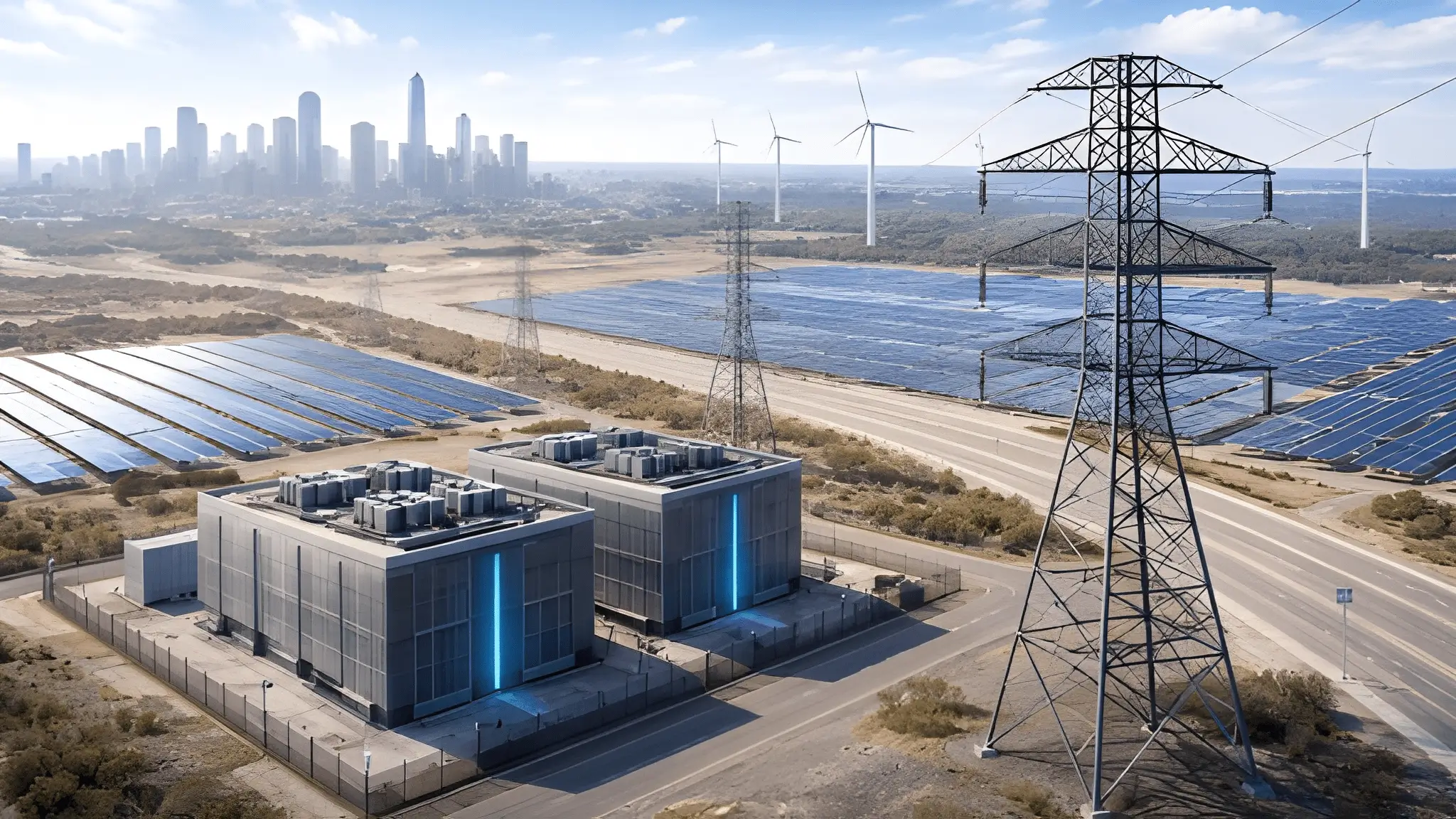
India’s data center expansion is increasingly being shaped not by capital availability or demand growth, but by the pace at which transmission infrastructure can support new capacity across key corridors. Developers continue to complete large-scale facilities across markets such as Mumbai, Chennai, and Hyderabad, yet a growing number of these assets remain unable to draw contracted power at commissioning. This mismatch stems from the lag between substation upgrades, transmission line expansion, and final grid synchronization processes that operate on longer regulatory and engineering timelines. As a result, energization timelines can extend beyond construction completion when transmission infrastructure upgrades do not progress at the same pace, leading to underutilized capacity despite physical readiness. The issue reflects conditions where available generation capacity cannot always be delivered efficiently to end-use sites due to transmission constraints within the grid. Consequently, the industry now faces a structural decoupling between physical readiness and electrical activation.

Transmission projects in India often require multi-layered approvals spanning environmental clearances, land acquisition, and inter-state coordination, which extend project timelines beyond those of private data center builds. Grid expansion follows a planned approach governed by national and regional load forecasts, while data center investments respond to market-driven demand signals that shift more rapidly. This divergence has created a timing gap where transmission capacity trails behind actual consumption clusters emerging in urban hubs. Operators increasingly encounter delays in securing firm connectivity even after fulfilling all technical and financial prerequisites. The resulting idle infrastructure introduces both operational inefficiencies and financial strain, particularly for facilities designed for hyperscale tenants. In effect, the synchronization problem has become a defining constraint in India’s digital infrastructure expansion.
Renewable Corridors Are Colliding with Data Center Demand Clusters
India’s renewable energy buildout has concentrated heavily in regions such as Rajasthan, Gujarat, and parts of southern Tamil Nadu, where solar and wind resources offer optimal generation efficiency. These zones are geographically distinct from primary data center markets, which are typically concentrated around major metropolitan regions driven by connectivity and enterprise demand. TThis spatial distribution requires reliance on long-distance transmission networks to deliver power from generation regions to consumption hubs. The increasing congestion along these corridors reflects a growing competition between industrial demand, urban consumption, and digital infrastructure loads. Renewable energy integration further complicates grid stability due to intermittency, requiring additional balancing mechanisms that place further pressure on transmission systems. Therefore, the challenge extends beyond availability to the logistics of delivery across constrained pathways.
Developers pursuing green energy procurement strategies through open access or captive models must navigate transmission constraints that can limit the viability of such arrangements. Even when renewable capacity exists in surplus, evacuation bottlenecks can prevent effective utilization by distant data center facilities. This condition introduces variability in power sourcing strategies, as operators balance sustainability goals with the practical realities of grid access. In several cases, reliance on conventional grid supply persists despite renewable commitments due to transmission uncertainties. The friction between renewable geography and demand clusters continues to reshape procurement models and infrastructure planning decisions. Consequently, transmission emerges as the critical bridge between India’s clean energy ambitions and its digital expansion.

State-Level Grid Fragmentation Is Creating Uneven Power Realities
India’s power sector operates through a federal structure where states retain significant control over distribution networks, regulatory policies, and infrastructure investments. This decentralization has led to varying levels of grid readiness across regions, resulting in uneven power deliverability for data center operators. States such as Maharashtra and Tamil Nadu have invested more aggressively in transmission and distribution upgrades, while others continue to face capacity constraints and reliability challenges. These disparities influence site selection decisions, as developers prioritize regions with more predictable grid performance. However, even within advanced states, localized bottlenecks can disrupt expected timelines and service levels. The outcome is a landscape where national capacity metrics do not always translate uniformly into site-level power delivery conditions due to regional variations.
Policy differences across states also affect open access regulations, cross-subsidy charges, and approval timelines, adding complexity to power procurement strategies. Operators must tailor their infrastructure and contractual frameworks to align with state-specific conditions, increasing both operational overhead and planning uncertainty. Grid fragmentation introduces risk factors that extend beyond technical constraints into regulatory and financial domains. This dynamic complicates the scaling of standardized deployment models across multiple regions. Instead, each project requires localized optimization, which slows down overall expansion velocity. Therefore, the perception of India as a unified infrastructure market increasingly diverges from operational experience.
The Shift from Capacity Planning to Pathway Planning
Data center developers historically evaluated sites based on the quantum of power available within a given region, relying on macro-level capacity indicators to guide investment decisions. This approach has become less reliable in environments where transmission constraints play a significant role in determining actual power deliverability. Operators now place greater emphasis on understanding how electricity can be transmitted from source to site within existing grid conditions. This shift introduces a new dimension of risk assessment centered on transmission routing, substation proximity, and corridor congestion levels. Planning teams must engage more deeply with utilities and grid operators to map out end-to-end power flows. As a result, infrastructure strategy has evolved from static capacity evaluation to dynamic pathway analysis.
Transmission planning increasingly involves detailed assessment of grid conditions, including capacity availability and network constraints. Grid operators and planning authorities routinely evaluate line loading, congestion levels, and network stability to ensure reliable power delivery. This level of analysis was previously reserved for large industrial projects but has now become standard in data center planning. The integration of transmission risk into early-stage decision-making reflects the sector’s maturation and its growing dependence on reliable power delivery. However, it also extends development timelines and increases upfront costs. Thus, transmission considerations have moved from a secondary factor to a primary determinant of project feasibility.
Deferred Load Activation Is Reshaping Revenue Models
The inability to immediately activate full load capacity upon completion has begun to alter the financial frameworks underpinning data center investments. Developers now face scenarios where significant portions of installed capacity remain idle while awaiting transmission readiness. This delay impacts revenue realization, particularly in hyperscale environments where contracts depend on timely power availability. Operators have started to adopt phased activation strategies that align capacity rollout with grid readiness milestones. Such approaches help mitigate financial exposure but introduce additional complexity in project execution and tenant management. The traditional model of synchronized build and activation no longer reflects operational realities.
Delays in transmission readiness have been shown to impact project economics in sectors such as renewable energy, where revenue realization depends on timely grid connectivity.. These conditions illustrate how grid availability can influence financial outcomes by affecting the utilization of installed capacity. Investors and lenders now evaluate transmission readiness as a critical factor in project viability. This shift influences deal structuring, valuation models, and partnership agreements across the ecosystem. The emergence of idle capacity as a systemic issue underscores the importance of aligning infrastructure development with grid evolution. Therefore, financial strategies are adapting in parallel with technical and operational changes.
The Grid Edge, Not Generation, Will Gate India’s Next Capacity Wave
India’s power generation capacity has expanded significantly over the past decade, creating a perception of energy abundance that supports industrial and digital growth. However, the constraints emerging at the transmission and distribution levels reveal a more nuanced reality where deliverability defines actual usability. The next phase of data center expansion will depend less on adding megawatts to the grid and more on ensuring that existing capacity can reach end users efficiently. Grid-edge infrastructure, including substations, last-mile connectivity, and distribution networks, will determine the pace and scale of future deployments. This transition marks a shift in focus from generation-centric planning to delivery precision across the entire power value chain. Consequently, infrastructure alignment will shape the trajectory of India’s digital economy.
The evolving landscape demands coordinated action between policymakers, utilities, and private sector participants to address transmission bottlenecks proactively. Strategic investments in grid modernization, coupled with regulatory reforms, can help bridge the gap between capacity and deliverability. Operators must continue refining planning methodologies to incorporate transmission dynamics as a core variable. The interplay between renewable integration, regional disparities, and infrastructure constraints will define the operational environment in the coming years. As the sector adapts to these challenges, transmission will remain the central factor influencing growth outcomes. Ultimately, the ability to move power efficiently will determine how far and how fast India’s data center industry can scale.











