
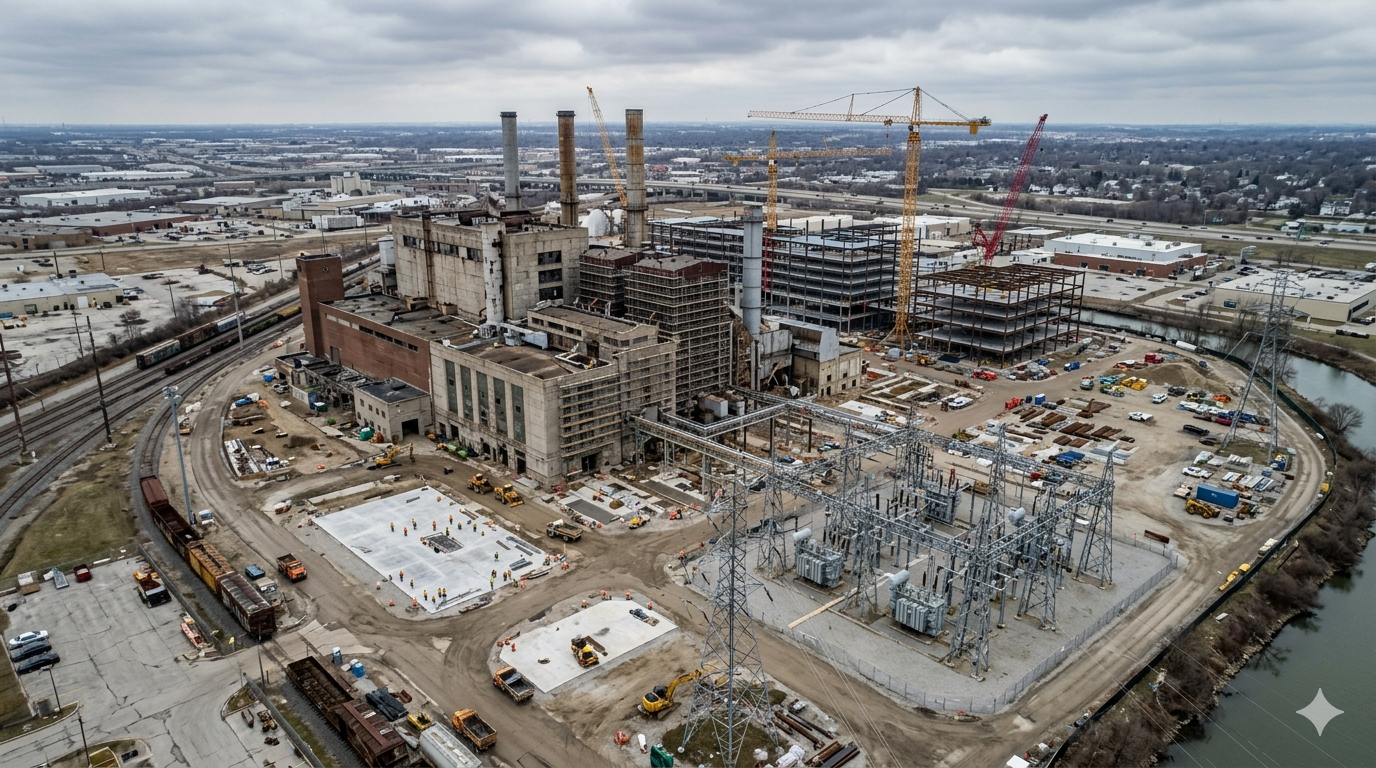
The power infrastructure that industrial economies built over the past century to serve demand patterns that no longer exist represents one of the least discussed opportunities in AI infrastructure development. Retired coal plants, decommissioned manufacturing facilities with dedicated substations, former military installations with independent power systems, and industrial sites whose primary tenants have relocated all share a characteristic that the current AI infrastructure market values highly: existing grid connections with significant capacity that the interconnection queue process does not require them to re-establish from scratch. These stranded power assets sit outside the conventional data center site selection framework, which historically prioritized proximity to population centers, fiber density, and established operational ecosystems. They are attracting serious attention from AI infrastructure developers who have concluded that the conventional framework’s primary input, grid access, is no longer available in conventional markets at the timelines that commercial development requires.

The concept of a stranded power asset has historically referred to generation capacity whose economic value eroded as market conditions changed. Coal plants became stranded assets as natural gas and renewables undercut their operating economics. Nuclear plants in deregulated markets became stranded when wholesale electricity prices fell below their operating costs. The stranded asset concept in the AI infrastructure context is broader and refers to any power infrastructure whose original purpose has diminished but whose grid connection, substation equipment, and electrical infrastructure retain value for a new class of large load customer. That value is not theoretical. The interconnection queue position that a retired industrial site’s substation represents can translate directly into development timelines that are years shorter than anything a greenfield site in a constrained market can offer.
What Makes a Power Asset Strategically Valuable for AI
Not every retired industrial facility with electrical infrastructure qualifies as a strategically valuable AI infrastructure site. The characteristics that determine whether a stranded power asset can support AI data center development include the voltage level and capacity of the existing substation, the condition of transmission infrastructure connecting the site to the broader grid, the available land area for facility construction and potential renewable energy development, water access for cooling systems, and fiber connectivity or the feasibility of establishing it within commercially viable timelines. Sites that score well across all of these dimensions are genuinely rare, which is why the developers who have identified and secured them are treating those positions as competitive advantages rather than simply opportunistic acquisitions.
Substation voltage level matters because AI data centers operating at the density that current and near-future GPU hardware requires need power delivery at transmission voltage levels rather than distribution voltage. A site with a distribution-level connection that was adequate for a light manufacturing operation does not offer the same strategic value as a site with a transmission-level substation that previously served a heavy industrial load. The capacity headroom available within the existing substation equipment also determines how much of the site’s potential the developer can access without triggering the upgrade requirements that push development timelines into multi-year territory. Sites where existing substation capacity matches the planned data center load profile allow developers to proceed with minimal grid impact study requirements, which is precisely the timeline advantage that makes stranded asset development attractive relative to greenfield interconnection.

The Geography of Stranded Power Opportunity
The geographic distribution of stranded power assets does not align with the established data center development corridors, which is simultaneously the source of their value and the primary challenge their development presents. Former industrial regions in the American Midwest and Southeast, post-industrial areas of the UK and continental Europe, and regions where natural resource extraction industries have declined all hold concentrations of stranded power infrastructure that the conventional data center site selection process would not have identified as primary targets. Developing AI infrastructure in these locations requires building or extending fiber connectivity, establishing operational support ecosystems, and in some cases overcoming community perceptions shaped by decades of industrial decline rather than technology investment.
The fiber connectivity gap is the most commonly cited obstacle to stranded power asset development, but it is also among the most tractable. Long-haul fiber routes have expanded considerably over the past decade, and the economics of extending connectivity to a site with secured grid access and confirmed hyperscaler demand are fundamentally different from the economics of speculative fiber extension to an undeveloped location. Developers who secure sites before announcing hyperscaler partnerships find fiber extension negotiations more difficult than those who can present a confirmed anchor tenant whose traffic requirements justify the investment. The sequencing of site acquisition, hyperscaler engagement, and fiber negotiation therefore matters considerably for the economics of stranded asset development, and developers who have worked through that sequence successfully are building playbooks that distinguish them from opportunistic acquirers who have not thought through the full development pathway.
Repowering as a Development Strategy
The most sophisticated approach to stranded power asset development involves not just utilizing existing grid connections but actively repowering sites by adding renewable generation that transforms a legacy grid connection into a renewable-powered AI infrastructure platform. A former coal plant site that retains its transmission interconnection but has decommissioned its generation equipment represents a unique development opportunity: the grid connection exists, the land area for renewable generation is often substantial, and the local community may actively support a development that brings new investment and employment to replace what the industrial closure removed.
Repowering strategies require coordinating the retirement of legacy generation equipment, the permitting and construction of replacement renewable capacity, and the development of data center facilities within a single integrated program that manages dependencies between each component. This coordination is organizationally complex and capital-intensive, requiring developers to manage power sector permitting processes, renewable energy procurement, and data center construction simultaneously. The developers who have built teams capable of managing this complexity are accessing development opportunities that simpler organizations cannot replicate, and the barriers to entry that this complexity creates are themselves a source of competitive advantage for those who have cleared them. Stranded power assets will not remain undiscovered or undervalued indefinitely, but the window during which sophisticated developers can secure the best positions ahead of broader market recognition remains open and is narrowing faster than most industry observers currently appreciate.
Risk Factors That Stranded Asset Developers Must Navigate
The advantages of stranded power asset development come with risk factors that greenfield development in established markets does not present in the same form. Environmental liability from prior industrial use is the most consequential, as sites that hosted heavy industry often carry contamination histories that require remediation before construction can proceed and that create ongoing liability exposure that data center operators accustomed to clean industrial sites are not equipped to manage. Due diligence on environmental conditions at former industrial sites requires specialized expertise and more time than conventional real estate assessments, and the cost of remediation can eliminate the economic advantage of the grid connection if it is not accurately scoped before acquisition.
Regulatory complexity at former industrial sites often involves multiple agencies and legacy permits whose modification requirements are not always predictable in advance. A former power generation site may carry air quality permits, water discharge permits, and land use designations that were designed around its original use and that create unexpected obstacles to data center development even when the site’s physical characteristics are otherwise suitable. Developers who build relationships with state and local regulatory agencies before committing capital to site acquisition reduce their exposure to these surprises, but they cannot eliminate it entirely. The stranded power asset opportunity is real and growing, and the developers who approach it with the technical depth, environmental expertise, and regulatory sophistication it requires will find it among the most durable competitive positions available in the current AI infrastructure market.











