X-Energy Builds a Reactor Designed to Redefine Nuclear Safety
The future of nuclear energy no longer lives only inside vast concrete domes rising along coastlines and rivers. Instead, it begins inside a graphite sphere no larger than a billiard ball, packed with microscopic layers of engineered protection. Across continents, governments weigh energy security against climate commitments, and the stakes feel higher than ever. Advanced reactor companies now race to reshape a sector that already powers millions yet faces persistent scrutiny. Within this momentum, one Maryland-based developer has taken a path that challenges long-held assumptions about nuclear risk. X-Energy has set out to design a Generation IV reactor that it says eliminates the very conditions that lead to a meltdown. This momentum now centers on X-Energy Xe-100 Gen IV reactor development as a defining chapter in advanced nuclear engineering.
Around the world, nuclear energy supplies roughly nine percent of commercial electricity generation, anchoring grids that demand reliability at scale. More than 440 reactors operate across over 30 countries, forming one of the largest sources of low-carbon baseload power available today. Construction crews continue work on at least 70 additional reactors, signaling that interest in nuclear capacity has not faded. At COP28 during the World Climate Action Summit in 2023, over 20 nations spanning four continents signed a declaration to triple nuclear energy by 2050. Policymakers framed that pledge as a practical step toward achieving net-zero targets while strengthening energy independence. Yet ambition alone cannot deliver expansion unless reactor safety clears the highest possible bar.
A Global Nuclear Reset Focused on Safety and Scale
Energy strategies increasingly reflect a dual urgency driven by decarbonization timelines and geopolitical volatility. Nations want electricity systems that remain stable even when fuel markets fluctuate or extreme weather events disrupt supply chains. Nuclear energy already offers long-duration generation without direct carbon emissions during operation, which gives it strategic weight in climate planning. However, past accidents continue to shape public perception and regulatory expectations around reactor safety. Expanding nuclear fleets at triple the current scale would demand designs that directly address the root causes of severe accidents. Therefore, advanced reactor developers now focus not only on efficiency but also on structural resilience that functions without complex intervention.
Within this landscape, advanced designs labeled as Generation IV represent a departure from traditional light-water reactor technology. These concepts emphasize inherent safety features, simplified systems, and flexible deployment models that can adapt to different grid sizes. Rather than relying heavily on active emergency systems, they aim to integrate passive characteristics that manage heat under extreme scenarios. Engineers believe such characteristics can reduce the probability of severe accidents to unprecedented levels. Developers also pursue modular construction methods that shorten timelines and allow incremental capacity additions. Consequently, the conversation has shifted from whether nuclear can expand to how safely and efficiently it can do so.
X-Energy’s Vision for a Different Reactor Core
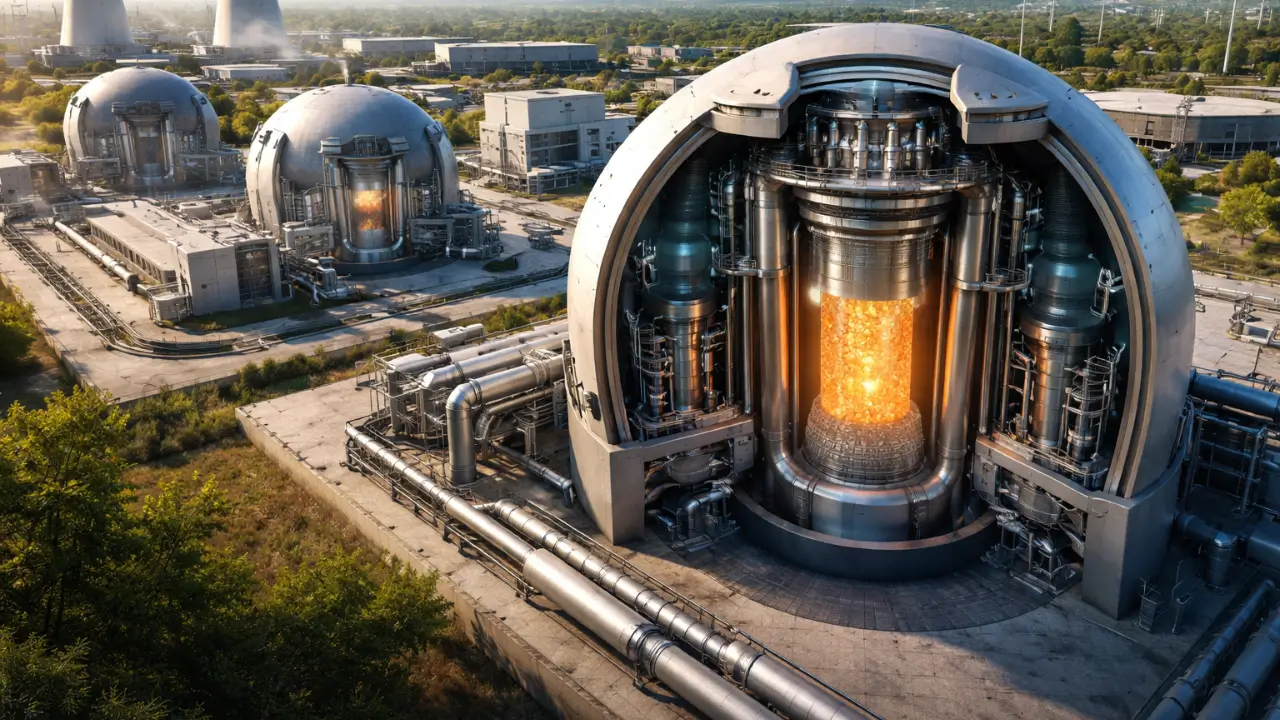
X-Energy has concentrated its efforts on a design known as the Xe-100, a high-temperature gas-cooled reactor that belongs to the Generation IV category. The company positions the reactor as a modular unit capable of delivering approximately 76 to 80 megawatts of electricity per module. Instead of adopting the long fuel rods submerged in water typical of conventional plants, the Xe-100 relies on thousands of graphite pebbles. Each pebble resembles a billiard ball and serves as a compact fuel container filled with microscopic particles. These particles, called TRISO fuel, form the heart of the system’s safety architecture. By rethinking the core at a microscopic level, X-Energy aims to redefine how nuclear fuel behaves under stress.While the compact design expands siting flexibility, any deployment near industrial or population centers would still require comprehensive regulatory review, environmental assessment, and licensing approval before construction could proceed.
Every TRISO particle contains a small uranium kernel surrounded by multiple protective layers made from ceramic and carbon-based materials. These layers create a miniature containment system around each grain of fuel, effectively isolating fission products. Engineers designed the coatings to withstand extreme temperatures without failing, which forms the basis of the reactor’s safety claim. Even if external systems falter, the fuel itself retains radioactive byproducts within its layered structure. That microscopic resilience supports the company’s position that the design is structured to prevent the type of core damage associated with conventional meltdown scenarios. In effect, safety becomes embedded in the material composition rather than relying solely on engineered backup systems, although regulatory assessments will ultimately determine how those safety characteristics are classified under operating and extreme conditions.
The Architecture of a Modular Power Plant
Each Xe-100 module generates roughly 80 megawatts of electricity, creating a building block that utilities can deploy individually or combine. X-Energy envisions grouping four modules into a single plant configuration capable of delivering about 320 megawatts. This modular approach allows energy planners to scale projects based on demand rather than committing to massive gigawatt-scale installations from the outset. Construction can proceed in phases, reducing financial risk and potentially accelerating deployment timelines. Smaller footprints also open possibilities for siting closer to industrial facilities that require both power and high-temperature heat. Consequently, the reactor design aligns with modern infrastructure strategies that prioritize flexibility and incremental growth.
Unlike water-cooled reactors that depend on pressurized systems, the Xe-100 uses helium gas as its primary coolant. Helium does not react chemically with fuel or structural materials, which reduces the risk of corrosion or unwanted reactions. Additionally, helium does not become radioactive under standard operating conditions, simplifying aspects of plant management. Engineers circulate the gas through the pebble bed, where it absorbs heat generated by nuclear fission. The heated helium then transfers energy to a steam generator, which drives turbines to produce electricity. Because helium does not change phase like water, the system avoids pressure fluctuations associated with boiling.
Continuous Refueling and Operational Stability
The reactor operates with a continuous refueling model that differs significantly from conventional nuclear plants. Operators introduce fresh fuel pebbles at the top of the core on a regular basis while older pebbles exit from the bottom. Each pebble remains inside the core for a little more than three years and passes through the active region multiple times. This circulation process allows the fuel to achieve full burnup without shutting down the reactor for large refueling outages. According to the US Department of Energy, pebbles can cycle through the core up to six times before final discharge. As a result, the reactor maintains steady output while optimizing fuel utilization. That operational rhythm supports grid stability in systems that increasingly integrate intermittent renewable sources.
After completing its lifecycle within the core, spent fuel does not require complex active cooling systems. Instead, operators can place discharged pebbles directly into dry storage casks on-site. This approach eliminates the need for interim wet storage pools that demand ongoing cooling and monitoring. By reducing reliance on active safety mechanisms, the design simplifies post-operation fuel management. The structural integrity of the TRISO particles continues to contain radioactive materials even after removal from the reactor core. Therefore, waste handling aligns with the same philosophy that guides the reactor’s in-core safety strategy. Each stage of the fuel cycle reflects an emphasis on passive resilience rather than mechanical intervention.
Passive Heat Dissipation as a Safety Backbone
Safety claims surrounding the Xe-100 center on how the reactor handles extreme scenarios. Traditional meltdown events occur when cooling systems fail and the reactor core overheats to the point that fuel rods lose structural integrity. X-Energy asserts that its fuel design and thermal characteristics prevent such conditions from escalating in the same manner. Even in the event of helium coolant loss, the reactor can dissipate heat through conduction, convection, and natural thermal processes. The geometry of the core and the materials used allow heat to move away from fuel particles without requiring powered pumps. Consequently, the reactor does not depend on emergency water injection systems to maintain fuel integrity.
High operating temperatures form another defining characteristic of the design. The reactor can reach temperatures suitable not only for electricity generation but also for industrial heat applications. Industries such as hydrogen production, refining, and chemical manufacturing often rely on fossil fuels to achieve required thermal levels. By providing high-temperature heat directly from nuclear reactions, the system opens pathways for decarbonizing those sectors. This capability extends the reactor’s relevance beyond grid electricity into broader industrial transformation. Energy planners therefore view such designs as potential anchors for integrated clean energy hubs. In that context, nuclear technology becomes both a power source and an industrial enabler.
Positioning Advanced Reactors in a Decarbonizing World
Global commitments to triple nuclear capacity by mid-century create both opportunity and responsibility for advanced reactor developers. Meeting net-zero goals by 2050 requires dependable low-carbon power that complements renewables rather than competing with them. Solar and wind capacity continues to grow, yet grids still require firm generation during periods of low sunlight or calm winds. Advanced nuclear reactors can supply that stability without direct carbon emissions during operation. However, public trust remains inseparable from demonstrable safety performance. Designs that incorporate intrinsic safety at the fuel level attempt to address that challenge head-on.
X-Energy’s approach reflects a broader shift within the nuclear sector toward smaller, more adaptable systems. Rather than replicating the scale and complexity of traditional plants, developers now emphasize repeatable modules and factory-based construction techniques. This shift could shorten project timelines and reduce cost uncertainties that have historically burdened nuclear builds. At the same time, regulatory frameworks must adapt to evaluate technologies that differ fundamentally from earlier generations. Collaboration between industry, regulators, and governments will determine how quickly such designs move from demonstration to widespread deployment, as licensing approvals, financing structures, and construction milestones remain contingent on regulatory review and market conditions rather than fixed guarantees.
As nations pursue cleaner energy portfolios, the technical details of reactor cores suddenly matter far beyond engineering circles. Decisions made inside laboratories and design studios ripple outward into grid reliability, industrial competitiveness, and climate trajectories. X-Energy’s Xe-100 enters this conversation not as a theoretical concept but as a concrete proposal for how nuclear safety can evolve. By embedding containment within each microscopic fuel particle and relying on passive heat dissipation, the company challenges conventional narratives about meltdown risk. The modular structure further aligns with infrastructure strategies that value flexibility and phased growth. Whether these design principles translate into large-scale deployment will depend on regulatory approval, financing, and sustained political support, but the technological direction signals a decisive step in the ongoing reinvention of nuclear power.