
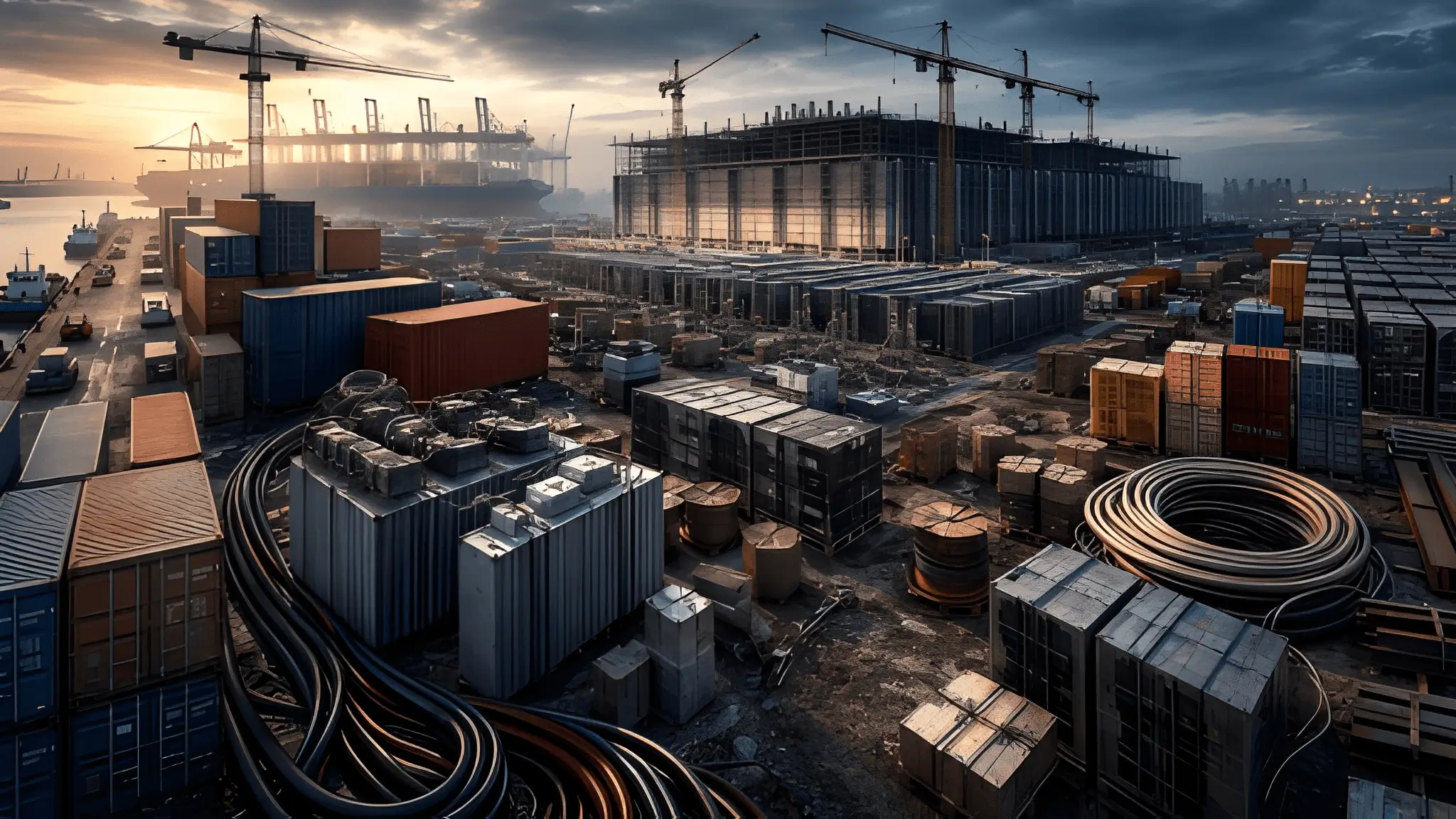
For the past two years, the story of artificial intelligence in the United States has been told like a law of nature: demand goes up, infrastructure follows. Bigger models. Bigger clusters. Bigger data centers rising out of deserts and exurbs like physical manifestations of exponential graphs.

But something has started to feel off.
Projects that looked inevitable on paper are slipping in reality. Timelines stretch. Costs drift. Entire builds stall, not because anyone lost interest, but because something far more mundane didn’t show up. A transformer. A switchgear unit. A shipment of GPUs. The kind of components that never make headlines, until they become the reason everything stops.
What’s emerging isn’t a slowdown in AI. It’s a collision between digital ambition and physical constraint.

The Weakest Link Is Now the Whole System
Modern data centers are often described as feats of engineering. Increasingly, they look more like feats of coordination. Every facility depends on a tightly sequenced choreography of parts sourced from different suppliers, regions, and timelines.
However, that choreography is breaking down.
When one component slips, everything downstream absorbs the delay. A nearly completed facility can sit idle because a single piece of electrical equipment hasn’t arrived. The economics don’t matter at that point. The demand doesn’t matter. The roadmap doesn’t matter.
So the problem isn’t just fragility. Instead, it’s absence.
AI Didn’t Outgrow Compute. It Outgrew Logistics
For years, the industry assumed infrastructure would scale alongside demand. Cloud computing reinforced that belief by abstracting complexity and accelerating deployment.
Now, that assumption is under pressure.
AI hasn’t just increased demand—it has exposed how many industries must move in sync to support it. Manufacturing, logistics, energy, and construction all operate on different clocks. Meanwhile, GPUs remain constrained, cooling systems require specialization, and electrical infrastructure comes with long lead times.
The Grid Is the New Gatekeeper
If silicon is the brain of AI, electricity is its bloodstream and right now, that system is under strain.
Securing power for large-scale data centers has become one of the slowest parts of deployment. It’s not just about generating electricity; it’s about delivering it reliably, at scale, through infrastructure that wasn’t designed for this level of concentrated demand.
Transformers and switchgear, unremarkable, unglamorous have become critical bottlenecks. Their production timelines stretch far beyond typical construction schedules. Grid interconnections require layers of coordination, approvals, and upgrades.
The result is a strange inversion: buildings are ready before they can be turned on.
Engineers Are Spending More Time Waiting Than Building
Inside infrastructure teams, the nature of the work is quietly changing.
Design still matters. Optimization still matters. But increasingly, progress depends on access , who can secure GPUs, who can lock in power capacity, who can get priority in a constrained supply chain.
In that environment, engineering starts to blur into negotiation.
Decisions that once revolved around performance now orbit availability. Systems are designed not just for efficiency, but for what can realistically be sourced and deployed within unpredictable timelines. The constraint is no longer theoretical, it’s operational.
A Global Supply Chain With Local Consequences
The components that power AI infrastructure don’t come from a single place. They move through a global network shaped by specialization, cost efficiency, and geopolitical realities.
That network is under pressure.
Key components rely on limited suppliers. Manufacturing capacity can’t expand overnight. Trade dynamics introduce friction. Logistics disruptions ripple across continents. What looks like a delay in one region often originates halfway across the world.
The industry optimized for speed in a stable environment. It now operates in one defined by uncertainty.
The Timeline Gap Is Getting Wider
There’s a growing mismatch between how fast AI evolves and how fast infrastructure can keep up.
Model development moves in months. Infrastructure deployment moves in years. That gap is starting to matter.
When new capabilities emerge, they assume the existence of compute that may not yet be operational. Enterprises plan adoption around capacity that isn’t fully online. Startups build for scale that depends on infrastructure still waiting for critical components.
Innovation hasn’t slowed, but its realization has.
Logistics Is Becoming the Real Advantage
The AI race is often framed as a contest of ideas, talent, and capital. Increasingly, it looks like a contest of execution.
Who can secure components early.
Who can navigate supply constraints.
Who can align construction, power, and hardware timelines without slippage.
These are not traditionally glamorous advantages. But they are becoming decisive ones.
In a constrained system, the ability to deliver on time is as valuable as the ability to design something new.
Rethinking How AI Infrastructure Gets Built
The industry is adjusting—but not without friction.
Developers are moving toward modular builds and phased deployments. They are also working more closely with suppliers to improve visibility into timelines. In some cases, teams are redesigning systems to allow for substitution when delays occur.
Still, these changes don’t eliminate constraints. Instead, they reflect a new reality: infrastructure cannot scale infinitely or instantly.
The Future of AI Will Be Decided Offline
AI still feels like a digital revolution. Models evolve. Capabilities expand. Breakthroughs continue.
However, the direction of that progress increasingly depends on something else entirely.
Factories produce the components.
Ports move the shipments.
Power grids deliver the energy.
Together, they determine what actually comes online.
Because in the end, the biggest constraint on AI isn’t imagination.
It’s delivery..











