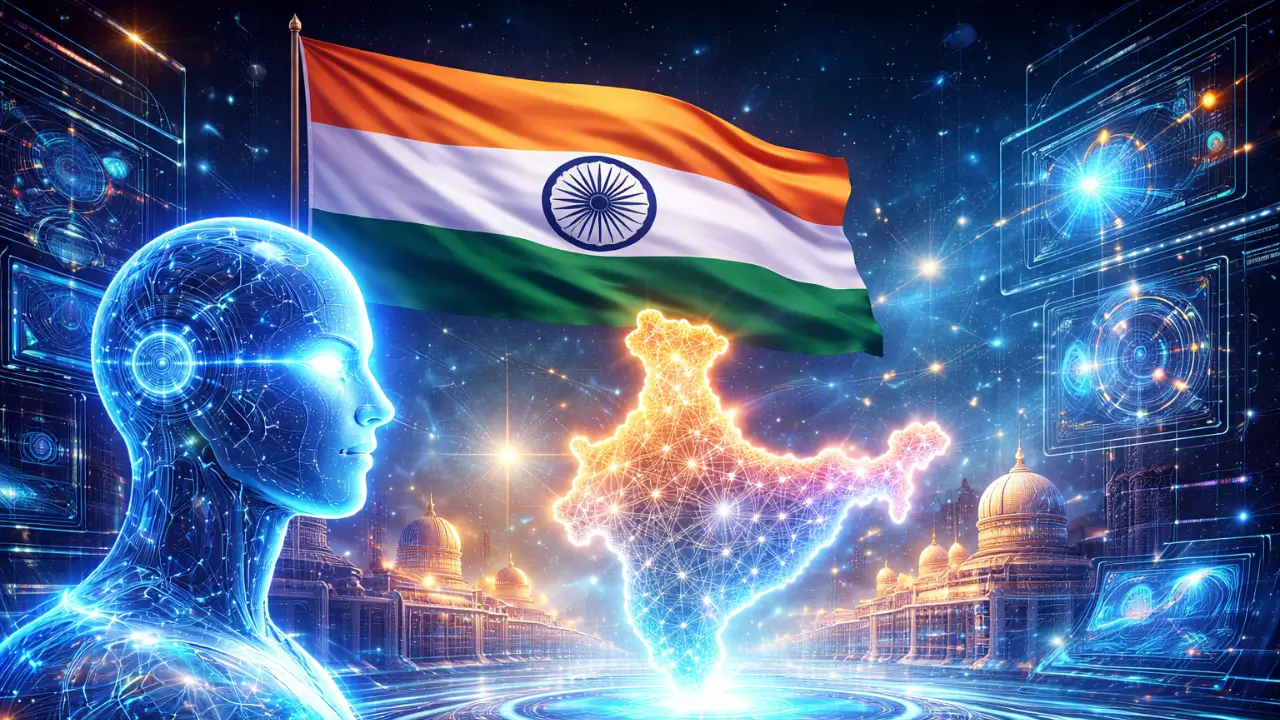
India has formally entered the sovereign large language model race. On February 18, at the India AI Impact Summit in New Delhi, the government unveiled three domestically developed artificial intelligence systems as part of its expanding national compute strategy.
The announcement marks a structural pivot. Rather than depending on global AI infrastructure controlled by Big Tech, India is accelerating its own ecosystem through subsidised compute, coordinated research and startup-led innovation. Bengaluru-based Sarvam AI, conversational AI firm Gnani.ai, and the IIT-Bombay-led consortium BharatGen each introduced models built, trained and governed entirely within India.
Momentum had already been building. In late 2024 and early 2025, the government operationalised GPU subsidies and opened applications for compute support. Since then, more than Rs 100 crore has been disbursed for high-performance GPUs, and over a dozen companies have secured participation under the mission.
“The developer energy I find in India is second to none. Recently, the work Sarvam has done developing local AI models, what you’re talking about is actually happening. India is very well positioned,’ Google CEO Sundar Pichai said at the India AI Impact Summit.
The subtext is clear: sovereignty in AI now extends beyond regulation. It includes ownership of compute, training data, inference economics and model governance.
Sarvam AI Targets Population-Scale Intelligence
Sarvam AI delivered the Summit’s most closely watched reveal. The startup launched two large language models, a 30-billion-parameter system and a 105-billion-parameter system both trained from scratch in India.
The company said the larger model outperforms global systems such as DeepSeek R1 and Google’s Gemini Flash on several benchmarks, while using a mixture-of-experts architecture to reduce inference costs. Rather than competing solely on parameter scale, Sarvam is focusing on deployment efficiency. The models target complex reasoning, programming and agentic AI workloads, with cost-effective inference positioned as a national scalability lever.
“Sovereignty matters much more in AI than building the biggest models,” said Sarvam co-founder Vivek Raghavan, at the Summit. That framing signals a strategic shift. India’s AI narrative increasingly centers on control, affordability and population-level accessibility not headline parameter counts.
Gnani.ai Introduces Multilingual Voice Infrastructure
While LLMs dominated headlines, voice AI took a parallel leap. Gnani.ai unveiled Vachana TTS, a text-to-speech system capable of cloning human voices across 12 Indian languages using under 10 seconds of reference audio. The company said the model preserves voice characteristics such as tone, pitch and speaking style, while allowing the same voice to operate across languages.
Built for low-bandwidth conditions and high-volume usage, Vachana TTS targets government services, customer support systems and enterprise-scale deployments. Crucially, the company hosts all data and models within India. This positions voice infrastructure as a sovereign layer of digital public services, especially in a multilingual nation where language access determines digital inclusion.
BharatGen Open-Sources a 17B Multilingual Foundation
The IIT Bombay-led consortium BharatGen introduced BharatGen Param2 17B MoE, a 17-billion-parameter multilingual foundational model optimised for Indic languages. Param2 17B uses a Mixture-of-Experts (MoE) architecture and focuses on governance, education, healthcare, agriculture and enterprise AI applications.
BharatGen will release the open-source model, documentation and post-training workflows through its Hugging Face repository. This approach allows developers, startups and enterprises to fine-tune and deploy India-centric AI applications without relying on external systems. With Rs 900 crores in funding from the IndiaAI Mission, BharatGen stands as the largest beneficiary of the government’s sovereign LLM initiative.
Compute as National Infrastructure
Collectively, Sarvam AI, Gnani.ai and BharatGen reflect a deeper policy architecture. India is not merely funding startups; it is constructing a domestic AI stack spanning GPUs, foundational models, voice systems and open ecosystems.
As global AI competition intensifies, infrastructure sovereignty now shapes economic resilience. India’s February 18 rollout signals that the country intends to define its own AI trajectory with domestic compute, local governance and multilingual intelligence at its core.