
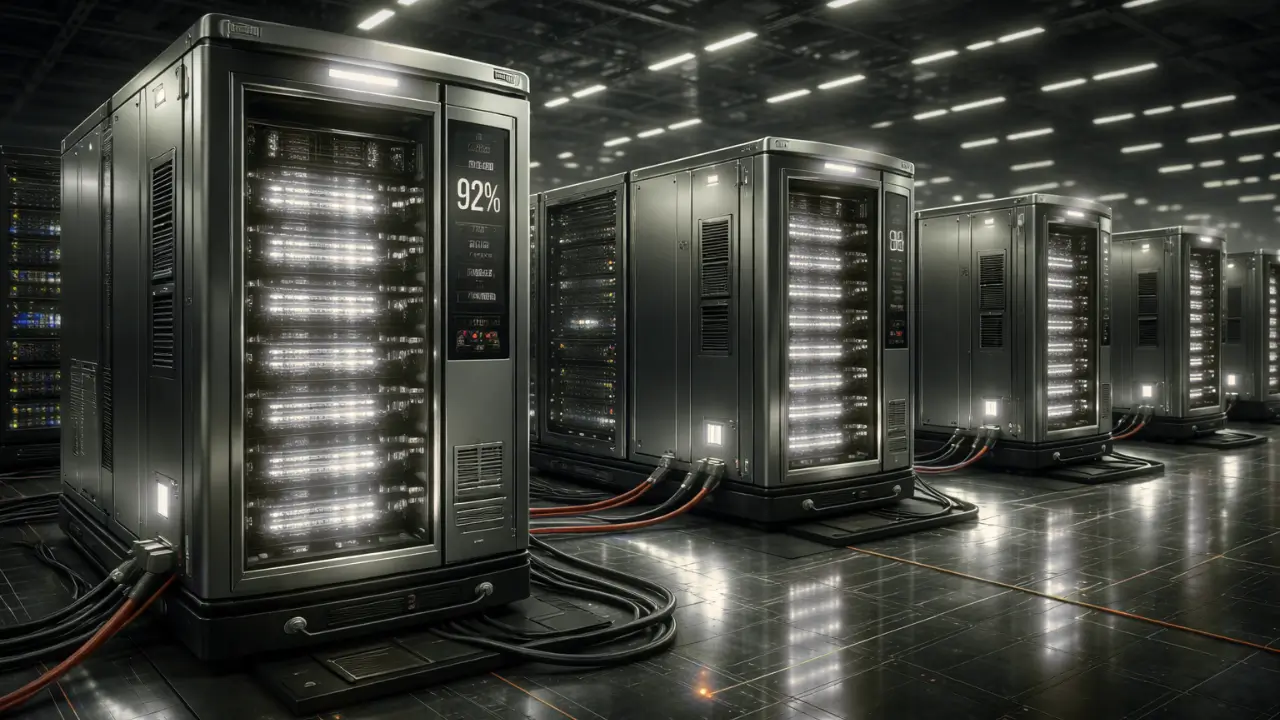
The explosive growth of AI, cloud computing, and digital services is reshaping the power demands of modern infrastructure. Facilities that once consumed tens of megawatts now require hundreds. In regions such as North America and Europe, aging transmission networks and protracted interconnection processes are struggling to keep pace. New or expanded data centers can face multi-year delays while awaiting substation upgrades or transmission expansions.

To move faster and operate more reliably, developers and utilities are increasingly turning to Battery Energy Storage Systems (BESS). Far from serving as simple backup, today’s storage installations provide operational flexibility, grid services, and renewable integration. In doing so, they are redefining the role of data centers within the broader energy ecosystem.
Unlocking Growth by Solving Interconnection Bottlenecks
One of the most immediate challenges facing data center operators is grid interconnection. In congested regions, connection queues can stretch beyond five years, effectively slowing digital infrastructure growth.
In the Pacific Northwest, Aligned Data Centers partnered with Calibrant Energy to deploy a planned 31 megawatt / 62 megawatt-hour BESS at a campus site. By supplying peak load locally and managing ramp rates, the system enables phased expansion years ahead of traditional grid upgrades, including substation and transmission work. Rather than waiting for infrastructure to catch up, the facility can move forward while remaining aligned with long-term utility planning.

This approach is gaining traction in other constrained markets. On-site storage reduces reliance on costly and time-intensive upgrades and gives operators greater control over construction timelines and power availability.
Moving Beyond Diesel: Storage as Primary Backup
Battery systems are also reshaping backup strategies. Historically, diesel generators served as the backbone of data center resilience and were designed to bridge grid outages. Modern BESS installations, however, can match and in some cases surpass diesel reliability while eliminating emissions, noise, and complex maintenance requirements.
At Microsoft’s Stackbo data center in Gävleborg, Sweden, four containerized lithium-ion units provide approximately 80 minutes of full backup power. Developed in partnership with Saft, the system is designed to replace diesel capacity entirely while meeting European grid code requirements for safety and performance.
Google’s facility in St. Ghislain, Belgium offers another example. Since 2020, a 2.5 megawatt-hour battery installation has operated as a pilot replacement for diesel generators. During a recent utility outage, the system maintained uninterrupted operations, demonstrating that batteries can safeguard mission-critical uptime without combustion-based backup.
Pairing Storage with Renewable Energy
The strategic value of BESS expands further when paired with renewable generation. Solar and wind resources introduce variability. Storage transforms that variability into dispatchable power.
In Arizona, one of the largest planned storage projects supporting a data center is designed to pair with a major solar installation to supply 100 percent renewable energy to a Meta campus. The system captures excess generation during peak sunlight hours and discharges when demand rises or solar output declines, aligning sustainability objectives with round-the-clock reliability.
Across Europe, similar hybrid models are emerging. Large solar parks and battery farms are being co-located with data centers to create semi-autonomous energy islands. These sites are engineered not only to power AI workloads but also to provide grid services such as frequency regulation while alleviating local transmission constraints.
In India, initiatives like the Pugal Solar Park in Rajasthan, featuring a 5,000 megawatt-hour BESS, illustrate how utility-scale solar-plus-storage infrastructure can stabilize regional grids. While not dedicated to a single data center, projects of this scale lay the groundwork for accommodating future hyperscale growth with predictable, low-carbon power.
From Backup to Active Grid Resource
As conventional generators retire and renewable penetration increases, grids face heightened exposure to frequency fluctuations and ramping challenges. In this environment, large-scale batteries offer capabilities that extend well beyond emergency backup.
Advanced grid-forming controls enable coordinated BESS installations to inject power within milliseconds during disturbances, stabilize voltage, and provide reactive power support traditionally supplied by synchronous generators. Research simulations using real grid models have shown that coordinated battery fleets at data center campuses can maintain stable operation even under partial grid disconnection scenarios.
In effect, storage allows data centers to evolve from passive consumers into active stabilizing assets that support both their own loads and the wider network.
Strengthening the Economic Case
Declining battery costs and evolving market structures are reinforcing the business rationale for deployment. Beyond reliability, BESS can reduce peak demand charges, enable participation in ancillary service markets, and hedge against congestion pricing and energy volatility.
Private energy providers are responding with tailored solutions for hyperscale clients. Energy Vault, for example, has partnered with RackScale Data Centers on plans for a 2 gigawatt battery installation designed to deliver firm power to future campuses. Such initiatives reflect a broader trend in which storage is being engineered specifically around AI-scale loads and marketed as integrated energy infrastructure rather than generic capacity.
Lessons from Broader Grid Applications
Outside the data center sector, battery storage has already demonstrated its value. South Australia’s Dalrymple ESCRI battery provides frequency control services and can operate as a near-autonomous renewable microgrid during transmission outages. In Queensland, the Western Downs Green Power Hub pairs a 540 megawatt / 1080 megawatt-hour battery with substantial solar generation to absorb variability and dispatch power during peak demand.
These projects underscore a principle that is directly relevant to hyperscale facilities. Storage enhances flexibility, resilience, and the usable capacity of renewable energy systems.
Looking Ahead
As data centers grow more energy-intensive, their relationship with the grid is shifting. What was once a model of passive consumption is evolving into active participation. By deploying BESS strategically, operators can accelerate capacity growth, mitigate grid constraints, integrate renewables, and contribute to overall system stability.
The grid of tomorrow will require close coordination among utilities, planners, and large energy users. Integrating substantial storage resources at data center campuses will be central to managing variability, supporting decarbonization, and maintaining reliability under rising electrical demand.
In this emerging landscape, data centers will no longer be defined solely by their consumption. Through large-scale battery deployment, they are poised to become critical actors in shaping a more flexible, resilient, and sustainable energy system.











