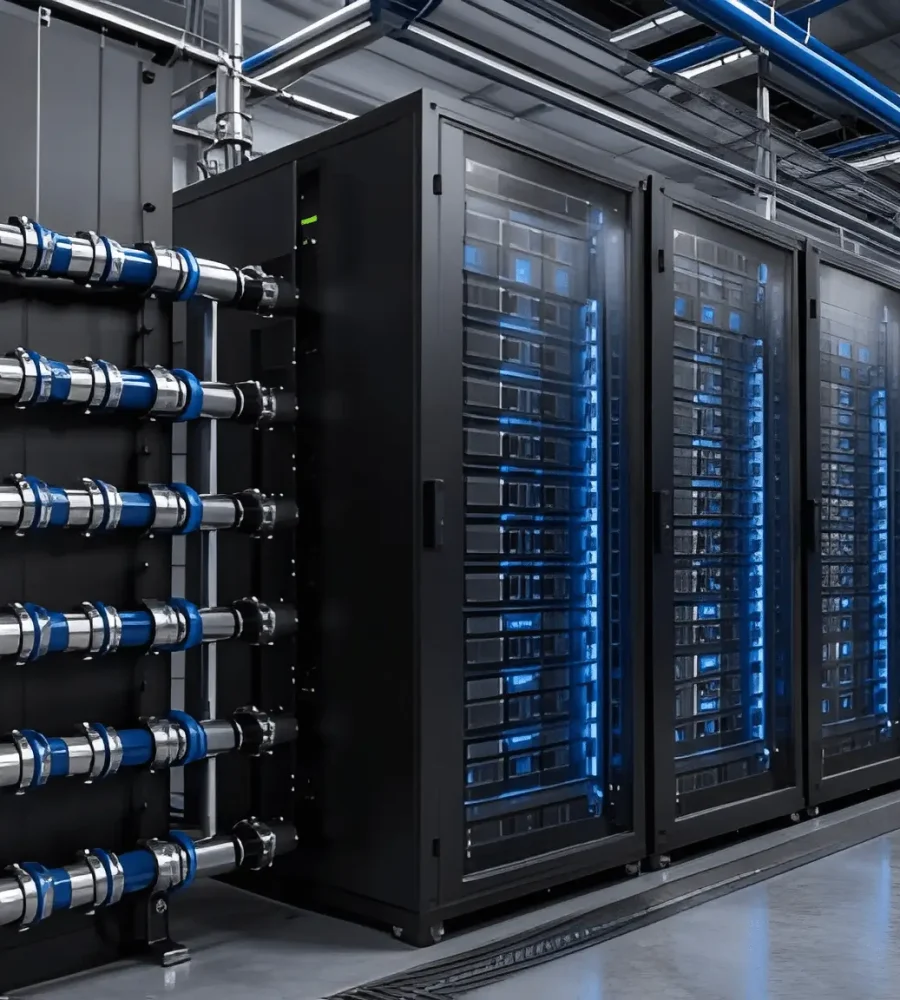

Across global data center markets, capacity expansion is often framed in terms of land availability, power access, cooling efficiency, and compute density. Yet behind these visible constraints, a quieter and increasingly consequential limitation is taking shape inside the white space itself. Interconnection density, the concentration of cabling, cross-connects, and internal network pathways is emerging as a structural bottleneck that directly influences scalability, reliability, and long-term operational flexibility.
As workloads grow more distributed and east-west traffic becomes dominant, internal connectivity has shifted from a secondary design consideration to a primary architectural determinant. Traditional assumptions that interconnection can scale linearly alongside racks and power are being challenged by physical limits, operational complexity, and signal integrity constraints. In many modern facilities, network density is no longer keeping pace with compute density, creating friction points that are difficult and expensive to resolve post-deployment.
The root of this issue lies in how data center architectures have evolved over the past decade. Early enterprise facilities were built around relatively static north-south traffic patterns, where data primarily moved between servers and external networks. Cabling systems were designed for predictability, modest port counts, and long refresh cycles. Hyperscale and cloud architectures disrupted this model, introducing massive east-west traffic flows driven by virtualization, microservices, distributed storage, and now AI-driven workloads. Each of these shifts increased the number of connections required per rack, per row, and per hall.
Today, a single high-density rack can support hundreds or even thousands of individual fiber connections, particularly in environments optimized for low-latency workloads. Spine-leaf architectures, while efficient from a logical networking standpoint, have dramatically increased physical cabling requirements. Every leaf switch must interconnect with every spine switch, multiplying fiber runs as capacity scales. When combined with redundancy requirements, diverse routing paths, and multi-tenant segmentation, the physical layer becomes densely packed long before floor space or power is fully utilized.
Cross-connect density further compounds the challenge. In colocation and interconnection-focused facilities, meet-me rooms and distribution frames have become strategic assets. These spaces must accommodate growing numbers of customer cross-connects, cloud on-ramps, carrier interconnections, and private network links. Each additional service adds ports, patch panels, and fiber trays, all of which compete for limited physical space. Unlike compute hardware, which can often be refreshed or replaced with denser alternatives, cross-connect infrastructure is constrained by mechanical clearances, bend radius limitations, and human-access requirements for maintenance.
Operational complexity rises sharply as interconnection density increases. High-density cabling environments are inherently harder to manage, document, and troubleshoot. Even with rigorous labeling and digital infrastructure management systems, the risk of human error grows as pathways become congested. Moves, adds, and changes take longer to execute, increasing service delivery times and operational costs. In worst-case scenarios, accidental disconnections or mispatching can lead to cascading outages that are difficult to isolate in densely packed network environments.
Thermal and airflow considerations add another layer of constraint. Dense cable bundles can obstruct airflow beneath raised floors or within overhead containment systems. As facilities push toward higher rack power densities, maintaining consistent cooling becomes more challenging when cabling infrastructure interferes with designed airflow patterns. Unlike servers or switches, cabling does not generate heat but can indirectly exacerbate thermal hotspots by disrupting cooling efficiency. This interaction is often overlooked during initial design phases and only becomes apparent once utilization ramps up.
Signal integrity and performance limitations also play a role in defining practical interconnection density limits. As data rates increase to 400G and beyond, tolerance for signal degradation narrows. Cable length, routing complexity, and connector quality all influence achievable performance. High-density environments increase the likelihood of tight bends, microbends, and stress on fiber, which can degrade signal quality over time. Copper-based interconnections face even stricter limitations, making fiber management not just an operational concern but a performance-critical one.
The growth of AI and accelerated computing is intensifying these pressures. AI clusters rely on high-bandwidth, low-latency interconnects between GPUs, often requiring specialized fabrics and tightly coupled topologies. These environments can demand significantly more internal connections per unit of compute than traditional enterprise workloads. As a result, network density is becoming a gating factor for AI scalability within existing data center footprints. In some cases, facilities with sufficient power and cooling are unable to support new AI deployments due to cabling and interconnection constraints.
Geographic and regulatory factors further influence how interconnection density challenges manifest globally. In mature markets with dense interconnection ecosystems, such as major metropolitan hubs, legacy facilities often struggle to retrofit for modern density requirements. Conversely, in emerging markets, greenfield developments have the opportunity to design for higher interconnection densities from the outset but face higher upfront costs and uncertainty around future networking standards. This creates a tension between overbuilding connectivity infrastructure and risking underprovisioning that limits future growth.
Industry responses to these challenges are evolving but remain fragmented. Structured cabling standards are being revisited to accommodate higher fiber counts and modular deployment models. Prefabricated cabling assemblies and factory-tested harnesses are gaining adoption to reduce installation errors and improve consistency. Digital infrastructure management tools are becoming more sophisticated, offering real-time visibility into physical connectivity. However, these solutions address symptoms rather than the underlying structural issue: the physical layer is increasingly misaligned with the pace of logical network and workload evolution.
Architectural strategies are also shifting. Some operators are rethinking meet-me room designs, distributing interconnection points closer to demand rather than centralizing all connectivity. Others are exploring alternative topologies that reduce cabling complexity, though these often involve trade-offs in flexibility or redundancy. There is growing recognition that interconnection density must be treated as a first-class design parameter, alongside power density and cooling capacity, rather than as an afterthought.
Interconnection density has implications that extend beyond technical design. Facilities constrained by internal networking limits may experience reduced asset longevity or require costly retrofits to remain competitive. In colocation environments, the ability to deliver rapid, reliable cross-connects is directly tied to revenue potential. As customers demand more connectivity options and faster provisioning, operators with constrained interconnection infrastructure may find themselves at a disadvantage despite ample physical capacity.
Ultimately, interconnection density represents a convergence point where physical infrastructure, network architecture, and operational processes intersect. Its growing importance reflects a broader shift in how data centers’ function, not merely as repositories of compute and storage, but as highly interconnected platforms enabling digital ecosystems. As data flows become more complex and workloads more distributed, the hidden bottleneck of internal connectivity is moving into plain sight.
Addressing this challenge will require coordinated changes across design standards, deployment practices, and long-term planning assumptions. While no single solution can eliminate the constraints imposed by physics and space, recognizing interconnection density as a strategic limitation is a critical first step. In an era defined by rapid digital expansion, the ability of data center to grow may increasingly depend not on how much power they can deliver, but on how effectively they can connect everything inside.