Amazon Web Services has secured fresh planning approval for three data centers in north Dublin, reviving a large-scale infrastructure project that has faced prolonged regulatory review. The decision was issued by An Coimisiún Pleanála, clearing a key hurdle for one of Ireland’s most closely watched hyperscale developments.
The ruling ends a three-year planning process that began with an application filed by an Amazon affiliate. Local authorities granted approval in 2023, but third-party appeals escalated the matter to the national level. Those appeals focused on environmental impact, energy demand, and grid capacity, themes that now dominate Ireland’s data center policy debate.
Project Clears Appeals but With Conditions
The planning authority rejected the appeals and allowed the project to proceed, while attaching strict energy-related conditions. The regulator concluded that the development would not create an unacceptable environmental impact, although it acknowledged potential greenhouse gas emissions linked to operations.
To address this risk, the approval requires AWS to secure a corporate power purchase agreement with a renewable energy provider. The agreement must match or exceed the total electricity demand of the three facilities. This condition places energy sourcing at the center of project compliance rather than treating it as a secondary commitment.
The decision reflects a regulatory approach that favors mitigation over restriction. Instead of blocking new capacity, authorities continue to approve projects that demonstrate credible alignment with national climate and energy objectives.
Site Layout and Facility Scale
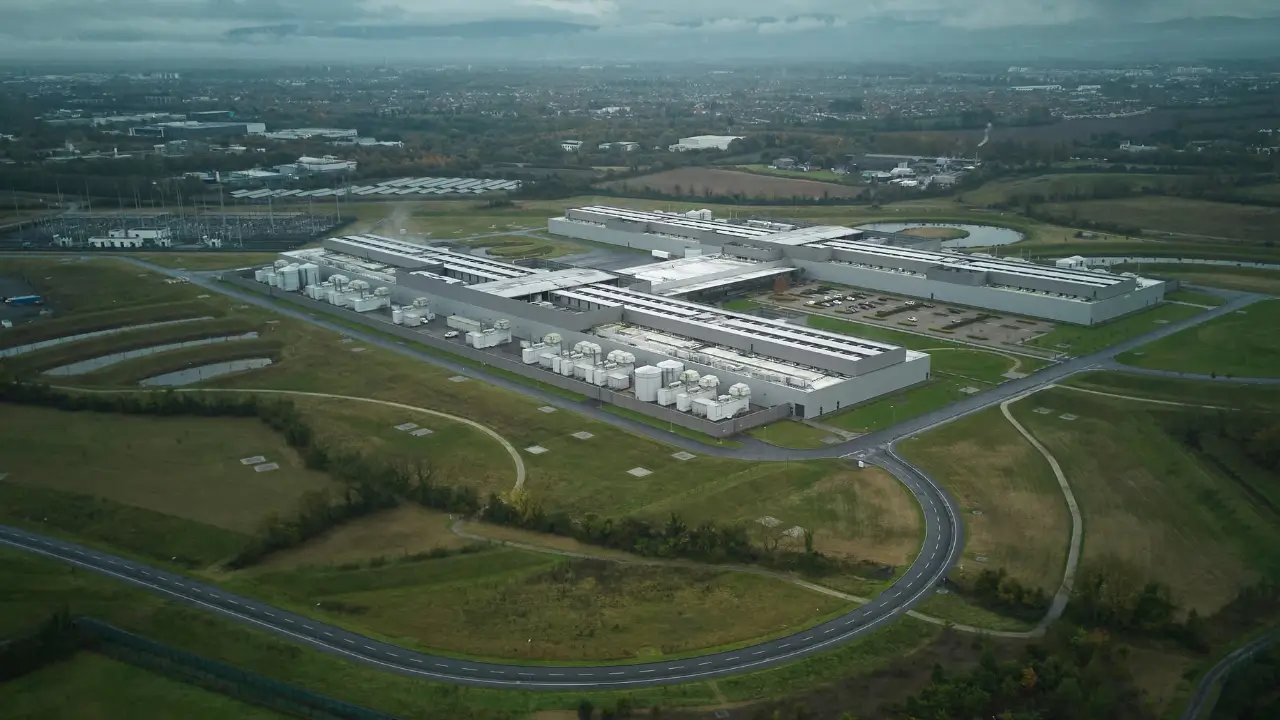
The approved data centers will occupy a 65-acre site on Cruiserath Road in north Dublin. The campus includes three separate buildings, identified as Data Center E, Data Center F, and Data Center G. Each structure will rise across two levels but will differ sharply in size.
Data Center E will cover a gross floor area of 1,425 square meters. Data Centers F and G will each span 20,580 square meters. Together, the three buildings will support a combined power load of 73 megawatts, placing the campus among Ireland’s larger hyperscale developments.
Backup generation forms a major part of the design. Building E will host one generator, while Buildings F and G will each include 19 generators. This configuration reflects resilience requirements for large cloud platforms that serve enterprise and public-sector workloads.
Grid Access Offers Strategic Advantage
A critical factor in the project’s progress lies in its grid position. AWS secured a grid connection agreement with EirGrid in 2019. That early access predates the capacity constraints that later slowed data center development across the Dublin region.
As a result, the campus avoids the effective moratorium that has limited newer projects without firm grid commitments. For operators and investors, the case highlights how early engagement with transmission planning can determine long-term project viability in constrained markets.
Broader Industry Context
Dublin remains a strategic location for cloud and digital infrastructure in Europe. Its connectivity, workforce, and proximity to major customers continue to attract investment. At the same time, power availability and environmental scrutiny now shape development timelines more than real estate or demand forecasts.
The AWS approval signals that regulators still support data center growth, provided developers meet higher standards on energy sourcing and system impact. Renewable PPAs have become a core expectation rather than a differentiator, especially for projects of this scale.
Signals for Executives and Investors
From a broader perspective, the ruling offers a preview of how future data center proposals may advance in Ireland and similar markets. Projects with secured grid access and firm renewable strategies appear more likely to move forward, even as scrutiny intensifies. The outcome positions AWS to expand capacity in a key European region while reflecting the evolving rules that now govern digital infrastructure growth.