
Data centers do not become outdated overnight. They age quietly, continuing to perform as designed even as the demands placed on them shift. Air-based cooling systems still move heat effectively, yet they now operate closer to their intended boundaries. This narrowing tolerance has prompted operators to look for measured responses rather than sweeping change. Within that approach, liquid cooling retrofits are being used to extend operational headroom without rewriting facility design.
Moreover, the challenge is not merely temperature management but architectural inertia embedded in physical layouts. Power distribution paths, floor loading limits, and airflow containment strategies were never designed for wholesale replacement. Therefore, any cooling evolution must respect these constraints to remain operationally viable. Industry conversations increasingly emphasize adaptation rather than replacement. Within that framing, liquid-based systems are being evaluated less as disruptive overhauls and more as modular supplements.
Why Full Facility Redesigns Remain Unattractive
Historically, large-scale mechanical redesigns demanded extended downtime, regulatory re-approval, and capital-intensive construction. Accordingly, such approaches are rarely compatible with multi-tenant environments or always-on enterprise operations. Even hyperscale operators show reluctance to suspend live capacity for prolonged rebuilds. Retrofitting strategies therefore prioritize incremental deployment that aligns with maintenance windows. This operational reality has become central to cooling modernization discussions.
In addition, contractual obligations often restrict how much of a facility can be altered at once. Lease structures, service-level agreements, and redundancy commitments collectively discourage radical change. From an engineering standpoint, preserving existing electrical topologies simplifies risk management. Hence, cooling solutions that integrate without forcing rewiring or floor reconfiguration gain preference. Liquid systems that can coexist with air infrastructure align well with these constraints.
Liquid Cooling as an Overlay, Not a Replacement
Increasingly, liquid cooling is positioned as an overlay technology rather than a wholesale alternative to air. Instead of eliminating computer room air handlers, operators deploy liquid loops only where thermal density demands it. Direct-to-chip cold plates, for example, remove heat at the source while leaving ambient airflow largely unchanged. This selective application reduces systemic disruption. Importantly, it allows facilities to maintain familiar operating practices.
Furthermore, hybrid environments enable gradual learning curves for operations teams. Staff accustomed to airflow management can adapt to liquid monitoring without abandoning existing procedures. Vendors have responded by designing systems that interface cleanly with standard racks and manifolds. In effect, liquid cooling retrofits become a targeted enhancement rather than a philosophical shift. This framing has helped ease organizational resistance.
Rear-Door Heat Exchangers in Existing Rows
Among retrofit-friendly approaches, rear-door heat exchangers have gained notable attention. These devices replace standard rack doors with liquid-cooled heat exchange surfaces. Warm exhaust air passes through the door, transferring heat to circulating liquid before re-entering the room. Consequently, upstream airflow patterns remain largely intact. The solution avoids invasive floor or ceiling modifications.
Equally important, rear-door systems operate independently at the rack level. This modularity allows operators to cool specific high-density enclosures without altering adjacent rows. Facility-wide setpoints often remain unchanged, preserving stability. Because chilled water connections can be routed overhead or along existing pathways, installation complexity stays manageable. Such characteristics explain their popularity in mixed-density halls.
Direct-to-Chip Integration Without Power Redesign
Another retrofit path focuses on direct-to-chip cooling for processors generating concentrated heat loads. Cold plates are attached directly to CPUs or accelerators, extracting heat before it enters the room. As a result, overall air temperatures can remain within original design tolerances. Crucially, power delivery architectures are left untouched. This separation of thermal and electrical change reduces deployment risk.
Companies such as NVIDIA have supported this model by designing hardware compatible with hybrid cooling. Server manufacturers now ship liquid-ready platforms that slot into conventional racks. For operators, the appeal lies in precision. Only the hottest components receive liquid treatment, while the broader facility continues to function as designed.
Manifold Routing Within Existing Structural Limits
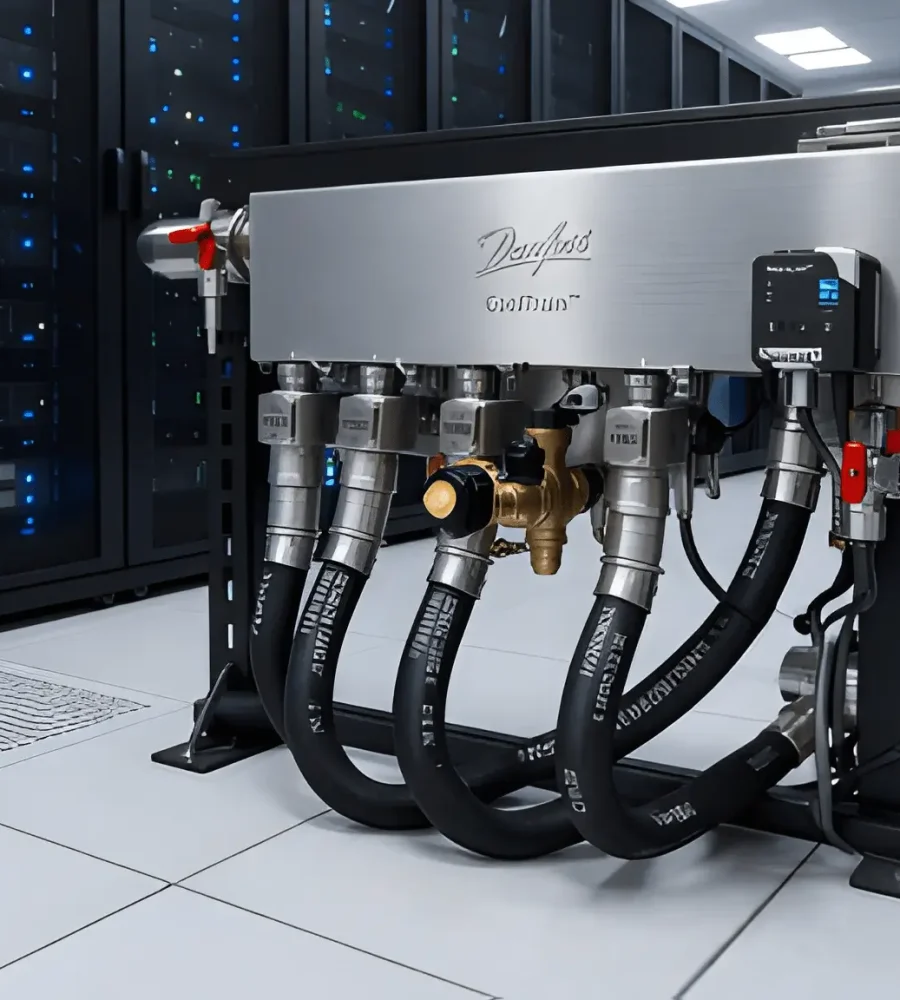
Equally critical to retrofit success is how liquid is distributed across the hall. Instead of trenching floors or rebuilding ceilings, many projects rely on compact manifolds mounted within racks or overhead trays. Flexible hoses connect these manifolds to heat exchangers with minimal structural impact. Therefore, raised floor integrity and load ratings remain unchanged. This approach respects the original building envelope.
Additionally, isolation valves and quick-connect fittings are commonly incorporated to limit risk. In the event of maintenance or failure, individual racks can be serviced without draining entire loops. Such compartmentalization mirrors best practices already familiar from power distribution units. By aligning with existing operational logic, liquid systems become less intimidating to adopt.
Preserving Airflow Balance While Adding Liquids
Importantly, successful retrofits do not abandon airflow management principles. Cold aisle containment, perforated tile placement, and return air paths still play essential roles. Liquid systems simply reduce the thermal burden placed on air. Consequently, fan speeds and setpoints can often remain unchanged. Stability, rather than optimization, guides these decisions.
In practice, operators treat liquid cooling as a pressure relief mechanism. By extracting heat locally, hotspots are neutralized without forcing airflow redistribution. This approach avoids cascading effects that might otherwise require rebalancing the entire hall. Over time, facilities can layer additional liquid-cooled racks as needed. Incrementalism remains the defining characteristic.
Operational Monitoring and Control Continuity
From an operations perspective, retrofits succeed when monitoring integrates with existing systems. Temperature, flow rate, and leak detection sensors are increasingly tied into standard building management platforms. This continuity ensures staff do not juggle parallel dashboards. Vendors emphasize compatibility with widely deployed control protocols. Familiarity reduces training burdens.
Moreover, alarms and thresholds are often configured to mirror established escalation paths. A liquid loop alert, for instance, may trigger the same response hierarchy as an airflow anomaly. Such symmetry reinforces trust in the new technology. Over time, liquid cooling retrofits are perceived less as experimental and more as routine infrastructure.
Vendor Ecosystems Supporting Incremental Adoption
Notably, equipment suppliers have adapted portfolios to suit retrofit realities. Companies like Schneider Electric offer liquid solutions designed to bolt onto existing racks and power systems. This ecosystem approach contrasts with earlier, monolithic designs. Flexibility has become a competitive differentiator.
System integrators also play a growing role by tailoring deployments to site-specific constraints. Rather than prescribing uniform architectures, they map cooling needs rack by rack. This bespoke methodology aligns with the incremental philosophy favored by operators. It reinforces the notion that modernization need not equal reinvention.
Extending Facility Lifespans Through Targeted Cooling
Ultimately, the strategic value of retrofitting lies in lifespan extension. Facilities built for earlier generations of compute can continue supporting modern workloads through selective upgrades. By avoiding disruptive reconstruction, operators preserve both capital and continuity. Liquid cooling retrofits function as enablers rather than replacements. That distinction defines their appeal.
As industry expectations evolve, this pragmatic approach is likely to persist. Incremental thermal adaptation aligns with how data centers are financed, operated, and contracted. Rather than chasing idealized designs, operators focus on workable transitions. In that context, liquid cooling retrofits represent a measured response to changing computational realities.