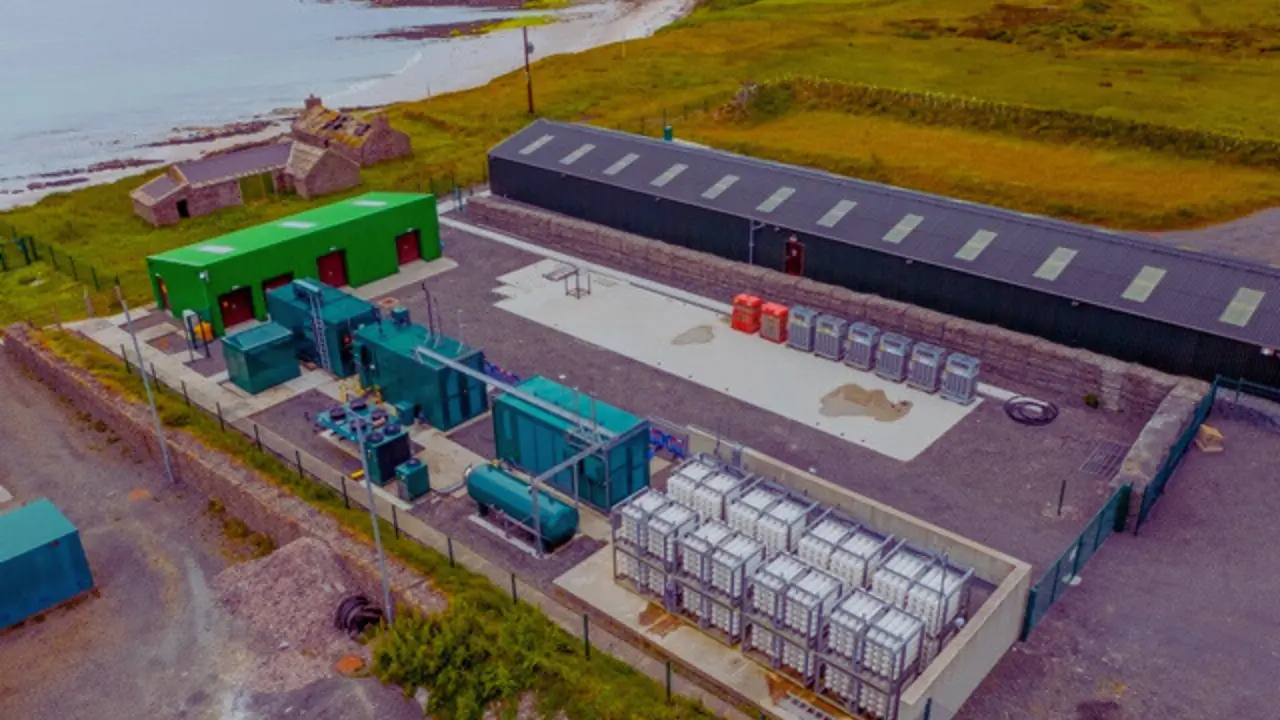
EMEC’s hydrogen production site and energy storage building at Caldale, Eday; Image credit- EMEC
The European Marine Energy Centre (EMEC) has quietly delivered something the marine energy sector has been talking about for years but had never managed to prove at scale: a tidal generation system that not only feeds the grid, but also charges batteries and continuously produces green hydrogen. It’s being described as a world first and for good reason. The trial shows what a genuinely dispatchable tidal-to-hydrogen value chain could look like in the real world, not just on paper.
At the heart of the experiment was a three-part stack: Orbital Marine Power’s O2 tidal turbine, a set of vanadium flow batteries supplied by Invinity Energy Systems, and a 670 kW electrolyser built by ITM Power. EMEC ran the test at its onshore facility on the island of Eday in Scotland’s Orkney archipelago, a place already familiar with the pressures of integrating renewables into a limited grid.
Instead of treating each asset as a standalone unit, the project was designed to mimic a full energy ecosystem. When tidal currents were strong, power from the O2 simultaneously charged the batteries, supplied the electrolyser, and exported surplus electricity to the grid. During slack tides, the battery system stepped in, discharging just enough electricity to keep the electrolyser running. The choreography effectively smoothed out the natural variability of tidal generation, giving the electrolyser something it rarely gets: a steady, on-demand power supply.
The team also stress-tested the system with edge-case scenarios. In one example, an electrolyser trip was simulated; operators had to intervene within seconds to avoid a wider shutdown. EMEC says the test exposed a few areas needing refinement, from battery management strategies to tighter electrolyser controls, and that a higher level of automation will be crucial for long-term reliability and reducing operator error.
Still, the demonstration has broader implications for coastal regions increasingly constrained by limited grid export capacity. “This trial highlights an alternative pathway for tidal energy,” said EMEC’s Operations and Maintenance Manager, Leonore Van Velzen, arguing that integrated systems could help future renewables-heavy grids stay resilient.
For Orbital Marine Power, the result is a proof point for tidal’s role in a diversified renewable mix. CEO Andrew Scott framed it as a blueprint for scaling a predictable resource that has often been overshadowed by wind and solar. Pairing tidal with storage, he noted, reduces curtailment and opens new decarbonisation markets, particularly for industrial offtakers looking for firmed, locally generated green energy.
The project forms part of the EU-funded Interreg North-West Europe ITEG initiative, which has been investigating how hydrogen production can help renewables-rich coastal areas sidestep grid bottlenecks. EMEC is already considering additional hydrogen offtake routes, including synthetic fuel production, a growing priority for the aviation and maritime sectors.
Invinity Energy Systems CEO Jonathan Marren framed the demonstration as a validation of vanadium flow batteries for hydrogen production and tidal “firming,” saying the model could be applicable not only in the UK but globally as grid networks evolve.