
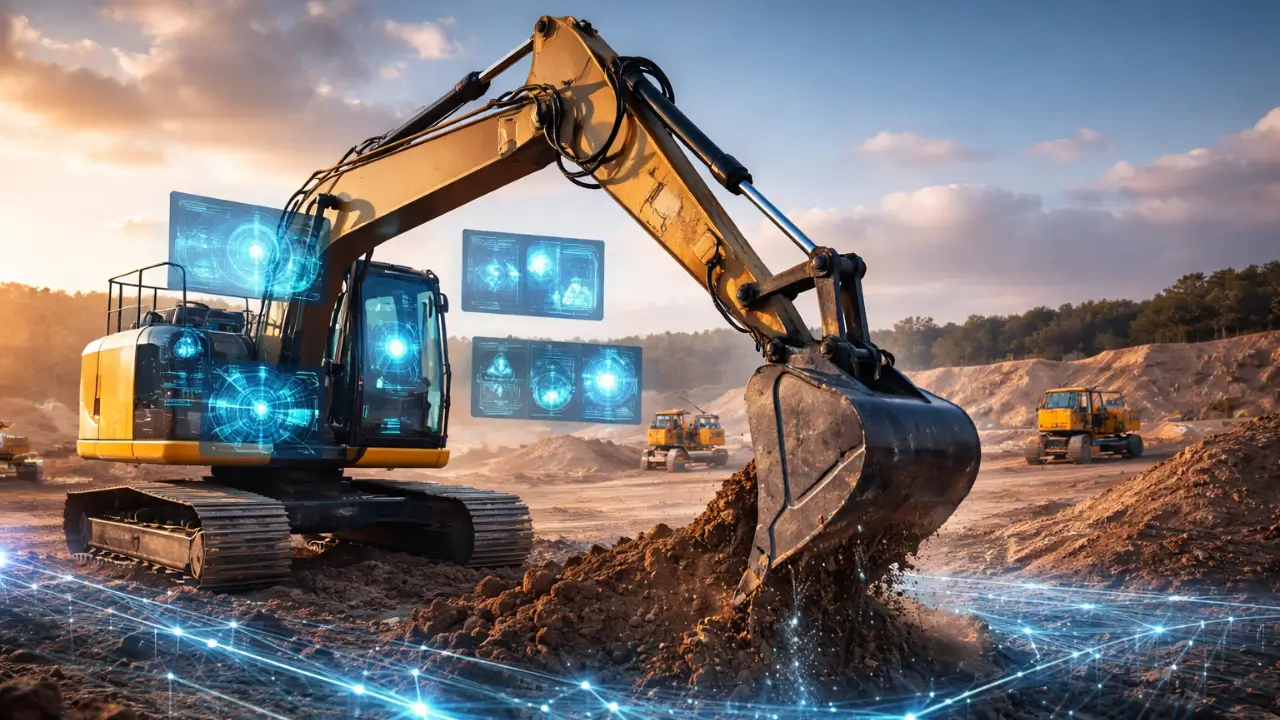
A new phase of industrial automation is taking shape as Caterpillar expands the role of artificial intelligence inside heavy construction machinery. The manufacturer has entered a deeper technical collaboration with Nvidia, signaling how physical AI is moving from controlled environments into active job-sites.
AI Moves Directly Onto the Jobsite
Caterpillar has expanded its use of artificial intelligence by embedding physical AI into construction equipment through a partnership with Nvidia. The move reflects a broader industry shift toward placing intelligence directly on machines rather than relying on external systems.
The initiative focuses on a pilot deployment inside Caterpillar’s mid-size Cat 306 CR Mini Excavator. The system, branded Cat AI Assistant, is being demonstrated at CES. Its debut places construction machinery alongside sectors already reshaped by edge-based AI.
The system runs directly on the equipment. It does not depend on continuous cloud interaction. Caterpillar built the assistant using Nvidia’s Jetson Thor physical AI platform, which is designed for real-world operating environments.
Assistive Intelligence Embedded at the Machine Level
Caterpillar said the Cat AI Assistant operates through a fleet of AI agents. These agents support operators during active work. The system answers operational questions, surfaces technical resources, offers safety guidance, and supports service scheduling.
Brandon Hootman, Vice President of data and AI at Caterpillar, described why on-machine intelligence matters for construction operators.
“Our customers don’t live in front of a laptop day in and day out; they live in the dirt,” Hootman said. “The ability to get the insights and take the action that they need while they’re doing the work is very important to them.”
The approach prioritizes assistive automation rather than full autonomy. Construction sites remain complex environments with unpredictable terrain, safety constraints, and continuous human-machine interaction.
Machine Data Enables Digital Construction Models
The partnership also extends into simulation and planning workflows. Caterpillar is piloting digital twins of construction sites using Nvidia’s Omniverse platform. These models allow teams to test schedules and estimate material requirements before work begins.
Hootman said Caterpillar’s connected machines transmit roughly 2,000 messages per second back to the company. This telemetry supports the creation of accurate simulations and operational models.
The method mirrors practices already used in manufacturing and logistics. In those sectors, digital twins guide planning, resource allocation, and efficiency improvements.
Automation Builds on Mining Operations
Caterpillar already operates fully autonomous vehicles in the mining sector. Those systems run in controlled environments with predictable routes. Construction sites present more variability and risk.
Hootman described the construction pilots as a practical step forward. He said they address current customer challenges while enabling future automation.
“The reason that we started here was it was a real challenge of our our customers today that needed to be addressed, and also something that we had some some real momentum on and we felt like we could we could bring to market pretty quickly,” Hootman said. “What we also liked is that provided a kind of a technology foundation for us to then build upon.”
Physical AI Anchors Nvidia’s Expansion Strategy
For Nvidia, the collaboration aligns with its broader physical AI strategy. The company defines physical AI as intelligence deployed into machines that interact with the real world.
Bill Dally, Nvidia’s chief scientist, told TechCrunch in 2025 that physical AI represents the company’s next major frontier. At CES, Nvidia outlined a full-stack ecosystem supporting this direction. The stack includes open AI models, simulation tools, and developer platforms.
The ecosystem is designed to support deployment across industries. It spans transportation, robotics, and industrial equipment.
Deepu Talla, Vice President of robotics and edge AI at Nvidia, said physical AI extends far beyond traditional robotics.
“Physical AI is the next wave of AI,” Talla said. “Nvidia is pioneering that with computers that train the models, that do the simulation to test the models and deploy the models into the robots, whether [that’s] an autonomous car or a Caterpillar machine.”
Construction Enters the Physical AI Curve
The Caterpillar-Nvidia initiative highlights a growing convergence between industrial manufacturers and advanced AI platforms. Legacy equipment makers are increasingly embedding intelligence directly into machines.
The pilot programs signal how construction automation may evolve. Assistive systems, continuous data exchange, and simulation-led planning now form the foundation. These elements may support deeper autonomy as the technology matures.











