
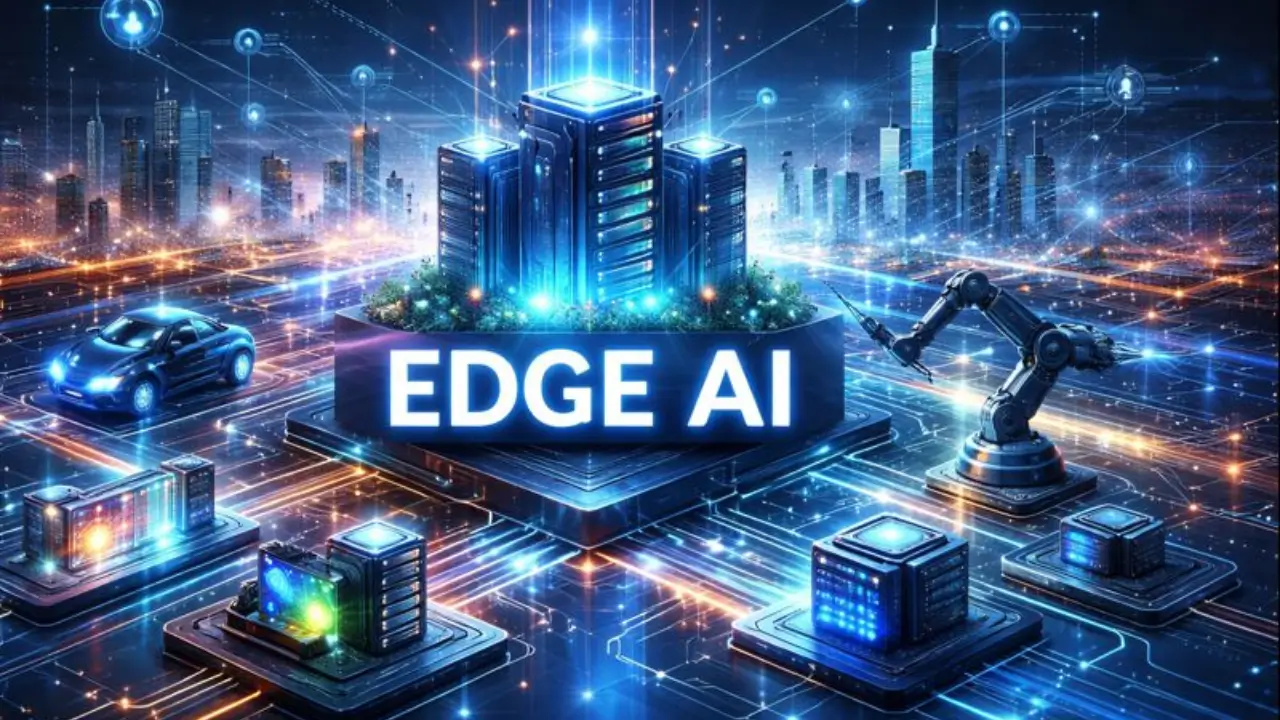
Artificial intelligence is no longer confined to data centers. Advances in Edge AI are empowering devices to process and analyze information locally, reducing reliance on centralized servers. This architectural evolution allows for real-time decision-making, efficient bandwidth usage, and greater security control. As enterprises seek to manage growing data volumes more effectively, Edge AI is rapidly moving from experimental deployments to core operational infrastructure.

Unlike traditional cloud-based AI, which requires transmitting vast amounts of raw data to remote servers, Edge AI performs computations at or near the data source. The result is faster insights, lower latency, and optimized network resources. In industries such as autonomous transportation, industrial automation, and healthcare, these benefits translate directly into safer operations, improved service quality, and enhanced decision-making capabilities.
Understanding Edge AI Architecture
Edge AI integrates artificial intelligence into devices at the network’s periphery, rather than centralizing computation in data centers. Local devices, including sensors, gateways, and on-premise servers carry out processing tasks independently, enabling immediate analysis. This approach is particularly valuable in applications that require split-second decisions.
Specialized hardware accelerates Edge AI processing. Low-power GPUs, neural processing units (NPUs), and field-programmable gate arrays (FPGAs) allow AI inference in energy-constrained environments. These components reduce dependence on cloud infrastructure while maintaining high performance, offering enterprises resilience against network interruptions or cloud outages.

Software frameworks also play a crucial role. Platforms like NVIDIA Jetson, Intel OpenVINO, and Google Coral provide pre-optimized environments for deploying AI models locally. Developers can implement complex machine learning applications efficiently, while containerized deployment and orchestration tools enable IT teams to monitor and manage edge nodes at scale. Such integration ensures performance consistency across distributed locations, reducing operational friction.
Drivers Fueling Edge AI Adoption
Several key factors are accelerating the shift toward Edge AI. The proliferation of IoT devices generates enormous data volumes, which centralized systems cannot process efficiently. Edge AI mitigates this challenge by handling data locally, transmitting only essential insights to the cloud for storage or advanced analytics.
Latency-sensitive applications further reinforce the need for Edge AI. Autonomous vehicles cannot tolerate delays associated with transmitting data to distant servers for processing. Edge AI ensures decisions, such as braking or rerouting, occur instantaneously. Similarly, in healthcare, edge-enabled diagnostic devices analyze patient data on-site, enabling faster and more accurate medical interventions.
Privacy and regulatory concerns also drive decentralized architectures. Data sovereignty laws in multiple regions require sensitive data to remain within specific geographic boundaries. Edge AI enables organizations to comply with these regulations while maintaining operational efficiency. By processing data locally, enterprises retain control over sensitive information without sacrificing analytics capabilities.
Transformative Industry Applications
Edge AI is reshaping operations across several sectors. In manufacturing, predictive maintenance leverages edge sensors to detect equipment anomalies before failures occur. Local analysis of vibration, temperature, and acoustic data reduces downtime, improves safety, and extends machinery lifespan.
Retailers use Edge AI to enhance customer experiences. Smart cameras and IoT devices analyze foot traffic, inventory levels, and purchase behavior in real time. These insights allow dynamic pricing, staffing optimization, and stock management without waiting for centralized reports.
Logistics and supply chains benefit from real-time route optimization. Delivery vehicles equipped with edge processors evaluate traffic, weather, and fuel efficiency locally. This capability ensures timely adjustments, reduces operational costs, and improves service reliability.
Healthcare providers also gain value from Edge AI. On-site AI systems analyze imaging data, enabling immediate diagnostics and treatment planning. Remote monitoring devices identify anomalies and alert caregivers promptly, bridging the gap between data collection and actionable insights.
Overcoming Technical Challenges
Despite its advantages, Edge AI presents technical challenges. Power consumption is a primary concern, particularly in remote or energy-limited environments. Designing energy-efficient AI models and hardware is critical for sustainable deployments.
Scalability requires attention as well. Deploying thousands of edge nodes demands sophisticated orchestration and management frameworks. Enterprises must monitor performance, update models, and troubleshoot issues remotely. Without these capabilities, distributed AI systems risk complexity and operational inefficiency.
Data consistency is another key consideration. Edge nodes operate independently, which can create discrepancies in insights across the network. Federated learning training AI models locally and aggregating them centrally, helps maintain accuracy while preserving privacy. This method balances distributed intelligence with centralized oversight.
Security remains crucial. Edge devices are often physically accessible, increasing vulnerability to tampering. Encryption, secure boot protocols, and intrusion detection systems are essential to protect data integrity and prevent unauthorized access.
Economic and Strategic Implications
Edge AI delivers tangible economic benefits. Reducing reliance on centralized cloud infrastructure lowers operational costs and mitigates network congestion. Enterprises can process data locally, enabling faster insights and more agile responses to market or operational changes.
Real-time analytics also translates into measurable revenue gains. In manufacturing, predictive maintenance reduces downtime, directly impacting profitability. Retail and logistics benefit from optimized operations and enhanced customer experiences. Healthcare providers improve patient outcomes while lowering costs associated with delayed interventions.
Furthermore, Edge AI is creating new market opportunities. Hardware vendors, software developers, and integrators are expanding their offerings to meet growing demand. Startups specializing in edge devices or AI solutions attract significant investment, signaling a broader shift in enterprise computing strategies.
Future Outlook and Deployment Considerations
Analysts anticipate accelerated adoption of Edge AI in the coming years. 5G networks, improved hardware, and advanced AI frameworks will enhance decentralized computing capabilities. Enterprises must carefully evaluate where edge deployments provide the most value, prioritizing latency-sensitive, privacy-critical, and mission-critical applications.
Successful strategies balance Edge AI with centralized cloud systems. While edge devices handle immediate processing and analytics, cloud infrastructure remains essential for large-scale aggregation, deep learning model training, and long-term insights. A hybrid approach allows organizations to capitalize on the benefits of both decentralized and centralized computing.
Workforce readiness is equally important. Engineers skilled in distributed computing, AI optimization, and edge hardware integration are essential to fully realize Edge AI’s potential. Organizations investing in talent development alongside infrastructure are better positioned to leverage this technological evolution.
Why Edge AI is the Enterprise Imperative
Edge AI represents a fundamental shift in enterprise computing, challenging traditional centralized architectures. By processing data at or near the source, organizations achieve faster insights, lower latency, and improved operational efficiency. Across industries from manufacturing and retail to logistics and healthcare, Edge AI is enabling capabilities that centralized cloud models alone cannot deliver.
Although challenges exist, particularly regarding energy efficiency, scalability, and security, organizations that adopt Edge AI strategically are likely to gain competitive advantages. The technology supports immediate operational needs while laying the foundation for long-term resilience and innovation.
The transition to decentralized computing is no longer a theoretical concept; it is a practical necessity for enterprises seeking agility, security, and efficiency. Edge AI is not just an evolution of technology, it is a revolution in how organizations manage data, intelligence, and decision-making in the digital era.











