
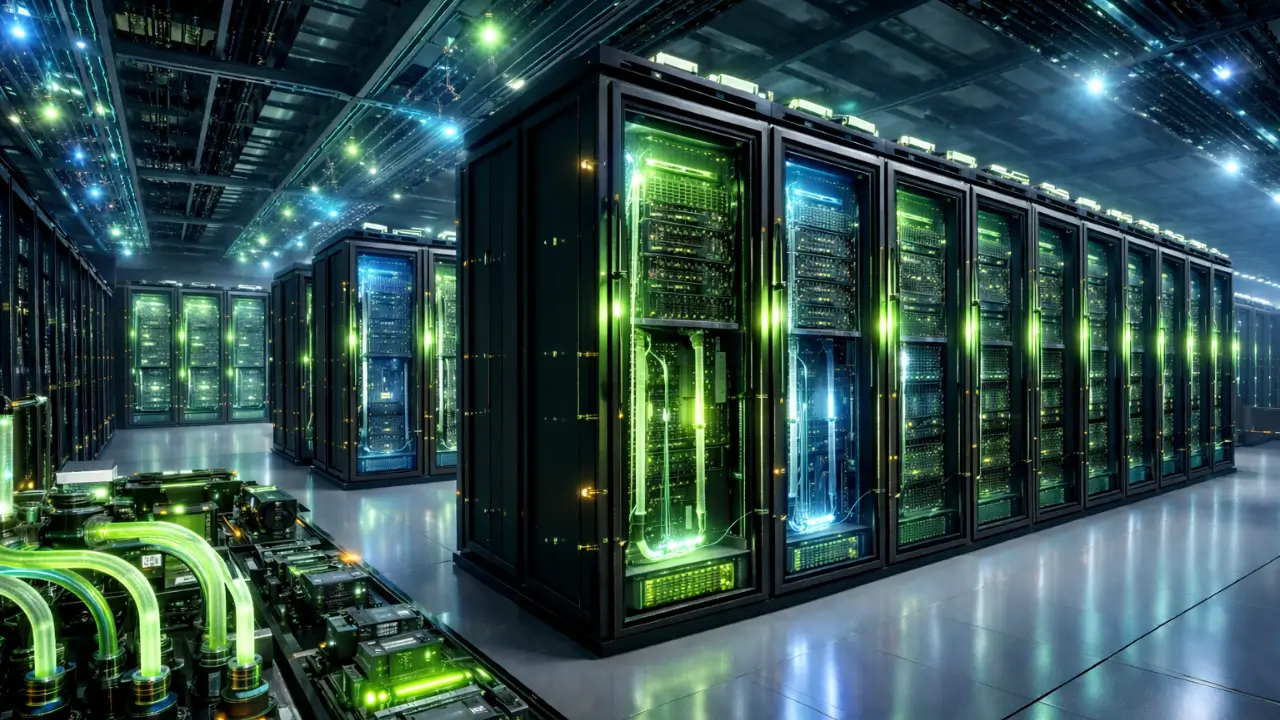
The modern data center is undergoing a structural transformation driven by accelerated computing requirements. Facilities once designed for generalized workloads now increasingly resemble specialized industrial environments. This shift reflects how AI workloads impose physical constraints that traditional enterprise infrastructure never anticipated. Consequently, building design, equipment placement, and operational logic are changing together rather than independently. The industry discussion has moved from abstract performance metrics toward tangible spatial and mechanical realities. At the center of this transition lies AI workloads are redesigning the physical data center.

The transformation is not conceptual or stylistic but material and architectural in nature. Data centers now express workload intent through physical form rather than neutrality. As a result, infrastructure decisions increasingly follow compute physics instead of standardized templates. These facilities increasingly behave like production environments optimized for throughput and continuity. Design teams now engage earlier with silicon vendors and system architects. Such collaboration alters how buildings are planned from the ground up.
Historically, data centers separated compute, power, and cooling into modular layers. AI infrastructure collapses these distinctions by tightly coupling components and subsystems. This coupling reshapes how risk, resilience, and maintenance are understood operationally. Facility layouts now reflect algorithmic density rather than organizational convenience. Therefore, architecture has become a function of computational behavior. The building itself increasingly acts as an extension of the machine.
GPU-Centric Architectures Redefine Spatial Planning
Graphics processing units have shifted from optional accelerators to structural anchors within facilities. Racks now orient around GPU trays rather than commodity servers. Consequently, aisle widths, ceiling heights, and service clearances have been reconsidered. Physical layouts increasingly optimize for short signal paths and mechanical stability. This evolution alters the role of raised floors and overhead cabling. As a result, spatial planning now follows silicon topology.

High-bandwidth memory integration further tightens physical constraints around compute nodes. Memory proximity requirements reduce flexibility in component placement. Therefore, rack designs increasingly favor fixed configurations over interchangeable assemblies. Maintenance access must accommodate dense packaging without disrupting thermal balance. These constraints reduce the practicality of legacy hot-swapping practices. Instead, service models increasingly resemble precision equipment handling.
Interconnect technologies such as NVLink and InfiniBand influence how racks relate to one another. Shorter cable lengths improve latency and signal integrity. As a result, compute clusters occupy compact, contiguous floor zones. This clustering reduces spatial redundancy while increasing local density. Consequently, failure domains become physically smaller but operationally more intense. The facility now mirrors the topology of the workload graph.
Cooling Topologies Evolve With Compute Density
Thermal management has become a primary architectural constraint rather than a supporting function. Air cooling systems designed for low-density racks struggle under sustained AI loads. Therefore, liquid cooling has moved from experimental to foundational. Cooling loops increasingly integrate directly with server chassis. This integration reshapes mechanical room layouts and piping routes. Cooling design now begins at the chip and extends outward.
Direct-to-chip cooling alters how heat is extracted and transported. Coolant distribution units now occupy prominent floor positions. As a result, service corridors and containment strategies have been rethought. Mechanical redundancy shifts closer to compute zones rather than centralized plants. These changes reduce thermal lag and improve predictability. The facility increasingly behaves as a thermal system rather than a room with airflow.
Immersion cooling introduces further architectural implications. Tanks and fluid handling equipment impose static load and safety considerations. Consequently, structural engineering now intersects with IT planning. Fire suppression, spill containment, and maintenance workflows adapt accordingly. These requirements challenge standardized building codes. Cooling infrastructure has become inseparable from overall facility design.
Failure Domains Shrink as Compute Becomes Industrialized
AI-driven layouts compress large amounts of compute into localized zones. This compression alters how failure domains are defined physically. Traditional row-based isolation proves insufficient under clustered architectures. Therefore, resilience strategies increasingly align with workload segmentation. Power, cooling, and networking boundaries follow compute groupings. Risk management becomes spatially explicit.
Power delivery systems also adapt to concentrated demand. Busways, transformers, and switchgear move closer to high-density zones. This proximity reduces losses but increases coordination complexity. Electrical design now reflects instantaneous load behavior rather than averaged consumption. Consequently, protective systems respond to faster transients. Power architecture increasingly resembles industrial manufacturing plants.
Operational practices evolve alongside physical changes. Maintenance windows shrink as utilization approaches continuous operation. Human access becomes more controlled and procedural. Therefore, automation and monitoring integrate deeply with facility management. The data center functions as a compute factory with defined production states. Within this context, AI workloads are redesigning the physical data center at every operational layer.
From Neutral Facilities to Purpose-Built Compute Factories
The concept of infrastructure neutrality is giving way to workload specificity. Facilities increasingly declare intent through design choices. This specificity improves efficiency but reduces flexibility. As a result, repurposing becomes more complex and deliberate. The data center now embodies a single dominant computational narrative. Architecture communicates function without abstraction.
Supply chain relationships also reflect this shift. Equipment vendors collaborate directly with facility designers. This collaboration shortens feedback loops between silicon evolution and building form. Consequently, design cycles align more closely with hardware roadmaps. The facility becomes a co-developed artifact rather than a passive shell. Industry roles increasingly overlap across disciplines.
Ultimately, AI infrastructure transforms the data center into a production environment. Physical design decisions encode assumptions about workload behavior. These assumptions guide power, cooling, and spatial logic simultaneously. Therefore, infrastructure no longer simply hosts computation. It participates actively in enabling it. In this environment, AI workloads are redesigning the physical data center as an engineered system, not a neutral space.











