 Skip to content
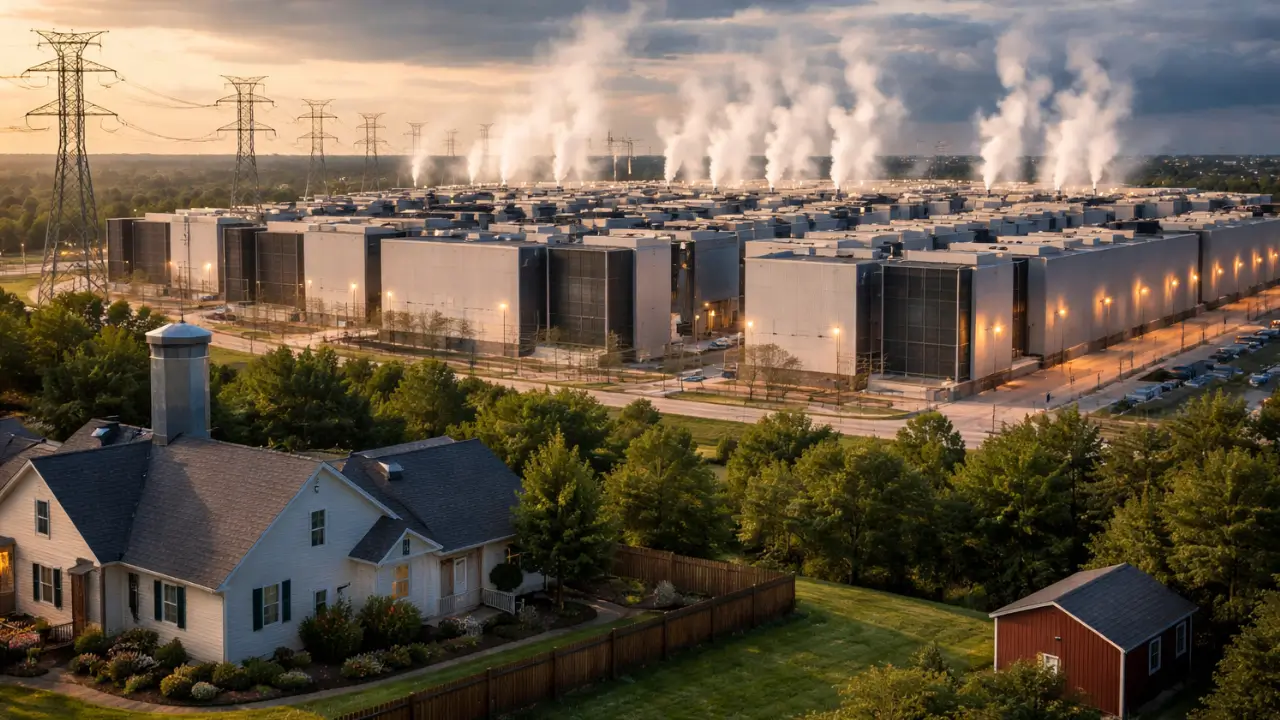
The AI infrastructure NIMBY backlash is emerging as artificial intelligence moves from abstract software into physical reality. Across parts of the United States, data centers built to power AI workloads have become highly visible fixtures, tied directly to land use, electricity demand, and water access. As these facilities expand, they increasingly face the same local resistance once reserved for power plants, pipelines, and heavy industrial sites.

For years, artificial intelligence lived comfortably in abstraction. It existed as software, code, and promises of productivity. Its infrastructure stayed largely invisible to the public. That distance is disappearing. Across parts of the United States, data centers powering AI workloads have become highly visible structures tied to land use, energy demand, and water access. As a result, resistance once reserved for pipelines, power plants, and heavy industry is now directed at AI infrastructure.
This shift marks the arrival of a familiar political dynamic in a new domain. The “Not In My Backyard” response, long associated with industrial siting disputes, has found a new target. However, the stakes are higher. AI infrastructure underpins national competitiveness, economic growth strategies, and technological leadership. Public consent, therefore, has become both more difficult to secure and more consequential to lose.
Data Centers Join the Industrial Class
Historically, communities pushed back against projects that altered landscapes or strained shared resources. Power stations raised concerns over emissions and land value. Pipelines triggered fears about safety and environmental damage. Heavy manufacturing faced opposition due to noise, traffic, and pollution. Data centers once avoided this scrutiny because they appeared clean, quiet, and digital.

That perception no longer holds. Modern AI-driven facilities consume large amounts of electricity and, in some designs, significant volumes of water.They require high-voltage grid connections, extensive cooling systems, and large tracts of land. As a result, communities increasingly view them as industrial assets rather than neutral technology facilities.
Moreover, unlike factories or warehouses, data centers employ relatively few people once built. This imbalance intensifies local skepticism. Residents see significant resource consumption without proportional job creation. Consequently, opposition grows not from hostility to technology, but from questions about fairness and local benefit.
From Abstraction to Physical Reality
AI’s transition from software narrative to physical footprint explains much of the backlash. When innovation feels distant, communities rarely object. When it arrives as concrete, substations, and water pipelines, scrutiny follows. Furthermore, AI infrastructure demands continuous operation. These facilities are not designed to easily scale down during periods of grid stress or water scarcity. As a result, local planners and utilities face difficult trade-offs. Residential growth, agricultural needs, and public services now compete with always-on compute demand.
Public consent erodes when trade-offs appear opaque. Residents often struggle to understand why an algorithm requires more power than entire neighborhoods. Without clear explanations, suspicion replaces acceptance.
National Priorities Meet Local Authority
The tension between national ambition and local authority defines the current debate. Federal leaders and technology companies emphasize AI as strategic infrastructure. States and municipalities, however, control zoning, permitting, and utility access. This mismatch creates friction.
Local governments must respond to constituents first. When communities raise concerns about water access or grid reliability, elected officials cannot defer to abstract national goals. Instead, they must weigh immediate impacts against long-term economic promises.
As a result, approval processes slow. Conditions multiply. In some cases, policymakers reconsider whether incentives offered to attract data centers still make sense. These actions do not signal opposition to AI itself. Rather, they reflect a demand for infrastructure that aligns with local capacity and priorities.
Why AI Faces Tougher Scrutiny Than Past Infrastructure
Although comparisons to pipelines and power plants are useful, AI infrastructure faces unique challenges. Traditional industrial projects often served nearby populations directly. Power plants supplied local electricity. Manufacturing created visible employment pipelines. AI data centers, by contrast, frequently serve distant users and global platforms.
This geographic disconnect matters. Communities struggle to see tangible returns on shared resource use. Tax revenue alone rarely satisfies concerns when water tables drop or grid upgrades affect household bills.
Additionally, AI lacks a long public history. While power plants and factories became familiar over decades, AI infrastructure arrived quickly. Rapid deployment compresses the timeline for trust-building, consultation, and adaptation.
The Risk of Consent Fatigue
As more projects seek approval, some communities report signs of consent fatigue. Each proposal triggers hearings, environmental reviews, and utility studies. Residents grow wary of cumulative impact rather than any single facility. This fatigue poses risks for both policymakers and developers. Delays increase costs. Opposition hardens positions. Dialogue becomes transactional rather than collaborative.
However, resistance does not indicate inevitable rejection. Communities often respond positively when developers address concerns early, explain trade-offs clearly, and invest in shared infrastructure improvements. Transparency remains the most effective counter to suspicion.
Every major infrastructure shift requires a social license to operate. Railroads, highways, and energy networks all faced resistance before becoming normalized. AI infrastructure now enters that same phase. The outcome depends on how stakeholders respond. If AI continues to present itself as weightless and intangible, opposition will grow. Physical systems demand physical accountability. Communities expect clear explanations of resource use, long-term planning, and local benefit.
Moreover, policymakers must adapt frameworks designed for older industries. Zoning laws, water rights, and grid planning need updating to reflect continuous high-density compute loads. Without adjustment, friction will persist.
Visibility Changes the Debate
AI’s power once came from invisibility. Its influence felt diffuse and abstract. That advantage has faded. Today, AI manifests as concrete buildings, transmission lines, and cooling infrastructure. Visibility invites debate. This debate does not threaten AI’s future. Instead, it signals maturity. Technologies shape societies only when societies notice them. Resistance reflects engagement, not rejection.
The challenge lies in managing that engagement responsibly. Public consent will not come from urgency narratives or competitive fear. It will come from alignment between national ambition and local reality.
The New NIMBY Is Here to Stay
AI infrastructure has entered the same political space once occupied by heavy industry. Communities now evaluate it through the lens of land, water, and power. That shift reshapes how and where AI can scale.
The new NIMBY dynamic does not mean the AI boom will stall. However, it ensures that growth will face negotiation rather than automatic approval. In the long run, that friction may strengthen outcomes by forcing smarter design, clearer communication, and better integration with local systems.
AI has left the cloud. From now on, its success depends not only on code, but also on consent.












