Skip to content
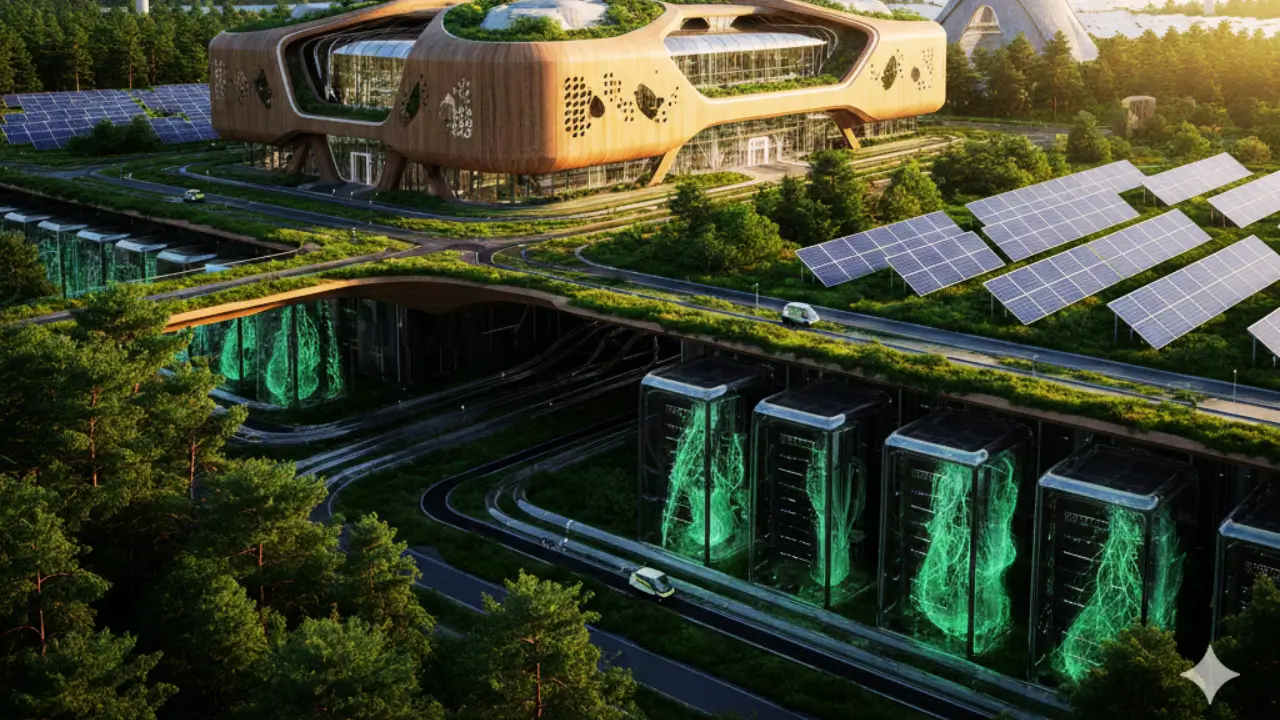
As the industry moves toward carbon-neutral data center design by 2030, incremental efficiency gains and renewable energy credits no longer meet regulatory scrutiny, stakeholder expectations, or grid realities. Over the past decade, these approaches helped reduce impact at the margins. However, as 2030 approaches, designers and operators now position data centers as active participants within surrounding energy, thermal, material, and water systems.

Carbon neutrality now functions as a systems-level engineering requirement rather than a reporting exercise. Accordingly, the central challenge lies in how facilities generate, manage, and exchange energy, heat, materials, and water with the regions they serve.
Energy Architecture: Designing for 24/7 Carbon-Free Power
Earlier renewable procurement strategies depended on annual matching of electricity consumption with renewable certificates or offsets. By contrast, regulatory frameworks emerging by 2030 require hourly or sub-hourly alignment between demand and carbon-free supply. As a result, annual accounting models no longer satisfy compliance or credibility thresholds.
Therefore, the industry defines carbon neutrality through continuous access to carbon-free power across all hours. Designers now synchronize real-time consumption with real-time generation. This shift elevates three foundational elements: firm low-carbon baseload power, long-duration energy storage, and grid-interactive demand.

Firm Baseload Through Small Modular Reactors
Small modular reactors provide a practical response to the intermittency constraints of large-scale solar and wind. These reactors deliver high capacity factors and dispatchable output, which align well with continuous data center load profiles.
In practice, facilities either co-locate with reactors or secure dedicated output through long-term agreements. Consequently, operators reduce reliance on fossil-based peaker plants during periods of low renewable availability. Additionally, SMRs contribute voltage support and grid inertia, which strengthens grid stability as inverter-based generation expands.
Long-Duration Energy Storage
By 2030, four-hour lithium-ion battery systems fail to cover extended renewable shortfalls. Instead, data centers deploy storage technologies capable of sustaining operations across multiple days. Iron-flow and other aqueous battery chemistries provide long cycle life and deep discharge, while high-temperature thermal storage systems complement onsite generation assets.
Moreover, operators design storage systems to optimize carbon outcomes alongside cost. Control platforms schedule charging and discharging using forecasts of grid carbon intensity. As a result, stored energy directly supports continuous carbon-free operation.
Grid-Interactive Demand as Core Infrastructure
Demand flexibility now functions as a core operational capability. Workload schedulers and power management systems actively adjust non-critical compute in response to grid conditions while preserving performance requirements for latency-sensitive services.
In parallel, planners quantify flexible demand alongside generation and storage capacity. Grid operators compensate data centers for these services through contracts that resemble capacity and ancillary service markets. Consequently, data centers reinforce grid stability while maintaining operational resilience.
The Thermal Shift: From Waste Heat to Economic Resource
Historically, heat rejection represented an unavoidable inefficiency. By 2030, designers treat unused waste heat as a missed opportunity. Therefore, thermal systems now assume that heat carries economic and environmental value beyond the facility boundary.
District Heating and Thermal Integration
In cold and temperate regions, data centers connect directly to district heating networks. Liquid-cooled infrastructure generates consistent low-grade heat that integrates effectively with municipal water heating systems. As a result, facilities deliver thermal energy to residential, commercial, and industrial users instead of dissipating it into the atmosphere.
Additionally, controlled-environment agriculture benefits from this approach. Greenhouses use waste heat for space conditioning and crop production. Meanwhile, industrial tenants increasingly locate near hyperscale campuses to access predictable process heat, forming tightly coupled thermal ecosystems.
Liquid-to-Chip Cooling as the Default
Rising rack densities, often exceeding 120 kilowatts for AI workloads, push air cooling beyond practical limits. Consequently, new construction favors direct liquid-to-chip and two-phase immersion cooling. These systems extract heat efficiently and deliver it at temperatures suitable for reuse.
Designers now capture and condition the majority of IT waste heat. Manifolded coolant distribution simplifies thermal collection, while dense sensing enables predictive maintenance. Therefore, operators transfer heat reliably to secondary systems with minimal loss.
Materiality and Embodied Carbon
Operational emissions account for only one dimension of climate impact. By 2030, embodied carbon associated with construction materials and supply chains carries equal weight in sustainability assessments.
Low-Carbon Concrete and Green Steel
Project teams increasingly specify concrete mixes that incorporate alternative binders and carbon-sequestering additives. Many formulations rely on industrial by-products or captured carbon streams, which reduces cement intensity while locking carbon into the structure. At the same time, procurement teams source structural steel from suppliers that use recycled inputs and hydrogen-reduced iron.
Accordingly, life-cycle assessments now sit at the center of procurement workflows. Contracts define carbon intensity thresholds and verification requirements, which directly influence supplier selection and cost modeling.
Modular and Circular Construction
Offsite modular construction has become standard practice. Factory-built power skids, cooling modules, and rack assemblies improve quality control and reduce onsite waste. Furthermore, designers configure these modules for disassembly, refurbishment, and redeployment.
As a result, design for deconstruction now appears in planning standards. Standardized interfaces, material labeling, and connection systems ensure that reuse remains feasible throughout the facility lifecycle.
Cross-Laminated Timber
For regional and edge facilities with appropriate structural requirements, cross-laminated timber has gained acceptance. CLT provides favorable seismic performance, strong thermal characteristics, and long-term carbon storage. Consequently, adoption remains strongest in regions with established forest management practices and transparent sourcing certifications.
The Intelligence Layer: Digital Twins as Infrastructure
Manual tuning cannot deliver the precision required for carbon-aligned operation at scale. Therefore, digital twins and AI-driven control platforms now form a core layer of data center infrastructure.
AI-Optimized Thermal Control
Digital twins continuously model physical and thermal conditions, simulating airflow, coolant behavior, and workload-driven heat output in real time. Predictive analytics anticipate thermal excursions, enabling control systems to adjust flow rates and setpoints before thresholds are reached.
As a result, facilities reduce overcooling, lower pumping energy, and maintain stable performance under rapidly changing compute loads.
Carbon-Aware Workload Scheduling
Advanced schedulers distribute workloads across regions based on real-time and forecasted carbon intensity. AI training runs and batch analytics execute during periods of high carbon-free energy availability. Additionally, these systems integrate renewable forecasts, grid congestion data, and carbon market signals to guide execution timing and location.
Consequently, compute operates as a flexible resource that supports grid decarbonization while preserving service-level commitments.
Water Positivity as a Co-Equal Objective
Water stewardship now aligns directly with energy and carbon planning. Cooling strategies that relied heavily on evaporative losses have given way to systems designed to minimize withdrawals and strengthen watershed outcomes.
Zero-Liquid-Discharge Cooling
Closed-loop cooling architectures with zero-liquid discharge eliminate routine blowdown. Facilities treat cooling water onsite and recycle it continuously, which significantly reduces freshwater demand. Advanced membrane filtration and evaporation-crystallization technologies recover nearly all process water, while operators manage residual solids through controlled disposal pathways.
Successful deployment requires close coordination between water chemistry, materials selection, and operational monitoring.
Restorative Water Impact
Leading facilities pursue restorative water outcomes. Operators capture stormwater and graywater, treat these streams, and reuse them for non-critical applications. When facilities discharge effluent, they meet or exceed regulatory quality standards, which supports downstream ecosystems.
Accordingly, water planning increasingly occurs in coordination with utilities and watershed authorities. Data centers now function as contributors to regional water resilience.
Conclusion
The carbon-neutral data center of 2030 operates as an integrated node within broader energy, thermal, material, and water systems. Facilities support grid stability through firm low-carbon generation, long-duration storage, and responsive demand. Waste heat flows into district networks and adjacent industries. Material choices reduce lifecycle emissions. Digital intelligence coordinates resources continuously. Water is conserved, treated, and returned with improved quality.
Data centers now serve as durable civic infrastructure that supports a decarbonized and resource-efficient economy.