
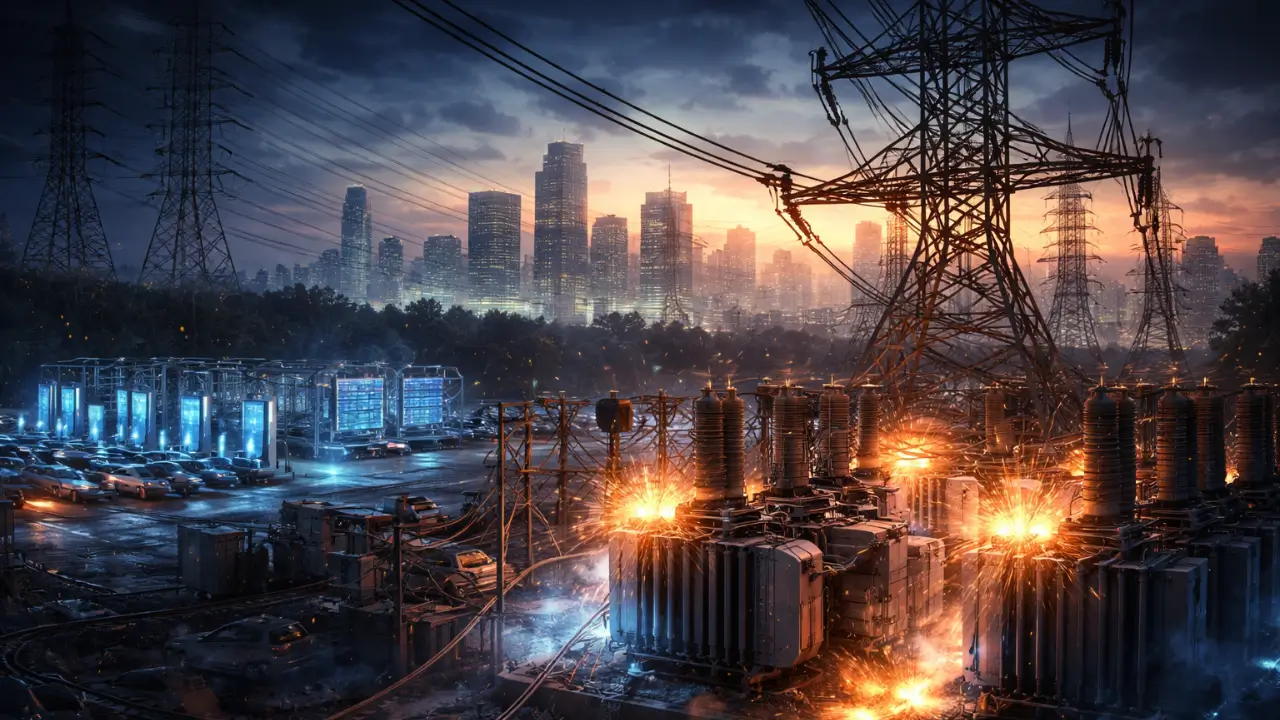
Electrification grid vulnerability is no longer a theoretical concern or a policy debate. Across transportation, industry, buildings, and digital infrastructure, electrification has become an operational reality. Yet as electrons replace molecules at scale, the global grid faces a test it was never designed to pass. The challenge extends far beyond capacity or generation. Electrification exposes the weakest layer of the grid: its structural logic.

For decades, power systems evolved around predictable flows. Utilities built grids to deliver energy from centralized sources to passive consumers. Demand increased steadily, rarely shifting abruptly. Planning followed linear assumptions, and infrastructure expanded incrementally. Today, electrification disrupts that logic by introducing volatility, spatial concentration, and real-time complexity into a system optimized for stability.
What emerges is not simply strain but revelation.
By accelerating change, electrification forces the grid to confront its hidden assumptions. It reveals where the system lacks flexibility, intelligence, and strategic coherence. It shows that resilience depends less on hardware and more on architecture. Most importantly, it demonstrates that the weakest layer is not always physical infrastructure, it is often governance, coordination, and design philosophy.

The Grid Was Built for Predictability, Not Acceleration
Every major grid reflects the era in which it was conceived. Engineers designed transmission networks to carry power from large plants to distributed load centers. Regulators shaped markets to balance reliability and cost. Operators developed procedures to manage gradual change. Electrification overturns that equilibrium.
Electric vehicles cluster demand in neighbourhoods that never hosted heavy loads. Data centers concentrate consumption in regions once considered peripheral. Heat pumps transform seasonal demand curves. Industrial electrification shifts energy use from fossil fuels to electricity at unprecedented speed. Under these conditions, the grid no longer merely supplies power, it interprets it.
Traditional planning models struggle to keep pace with this shift. They assume stable growth rather than sudden spikes. They prioritize redundancy instead of adaptability. They treat consumers as endpoints rather than dynamic actors. As a result, electrification exposes a fundamental mismatch between legacy design and modern demand.
Infrastructure Without Intelligence Becomes a Bottleneck
Modern grids still rely on physical assets: transmission lines, substations, transformers, and distribution networks. These assets remain essential, yet electrification highlights a deeper truth. Physical infrastructure alone cannot manage modern energy flows.
To function effectively, the grid must evolve from a delivery network into a decision-making system. Without digital intelligence, grids cannot optimize distributed energy resources, coordinate storage, or integrate intermittent renewables at scale. Without real-time data, operators cannot predict congestion or prevent localized failures. Without algorithmic control, grids cannot balance millions of micro-decisions occurring simultaneously across devices, vehicles, and buildings.
Electrification therefore exposes a paradox. The more electricity societies consume, the more they depend on software to manage it. When intelligence lags behind electrification, infrastructure becomes a bottleneck rather than an enabler. In this environment, resilience no longer depends solely on spare capacity. Instead, it depends on the grid’s cognitive ability to orchestrate complexity.
The Weakest Layer Is Often Institutional, Not Technical
Discussions about grid vulnerability often focus on aging infrastructure or insufficient investment. These issues matter, yet they do not fully explain the fragility that electrification reveals. In many cases, the weakest layer lies in institutional design.
Grid governance frequently fragments across jurisdictions, agencies, and stakeholders. Utilities operate within regulatory frameworks built for slower cycles. Market structures incentivize short-term optimization rather than systemic resilience. Planning processes prioritize compliance over experimentation.
When demand accelerates, institutional inertia becomes a technical risk. When new technologies emerge, regulatory rigidity slows integration. When cross-sector coordination becomes essential, siloed governance fails.
The grid does not falter because cables fail alone. It falters because institutions cannot adapt quickly enough to changing realities. Electrification therefore raises a broader question: Can governance evolve at the same speed as technology?
Digital Infrastructure and Energy Infrastructure Are Converging
Electrification blurs the boundary between energy systems and digital systems. Data centers, cloud platforms, and AI workloads increasingly shape electricity demand patterns. Conversely, grid performance influences digital reliability. This convergence amplifies the stakes.
Digital infrastructure demands ultra-high reliability, low latency, and predictable power quality. Traditional grids were not designed to meet these expectations at scale. Consequently, electrification exposes a widening gap between digital ambitions and energy realities.
At the same time, digital technologies offer tools to strengthen the grid. Advanced analytics, AI-driven forecasting, and automated control systems can transform how grids operate. Deploying these tools, however, requires cultural and organizational change.
Electrification thus reveals a strategic tension. The grid must become more digital, yet many institutions still treat digitalization as an accessory rather than a core capability.
The Myth of Unlimited Electrification
Public discourse often frames electrification as an unqualified good. Policymakers celebrate ambitious targets. Corporations announce net-zero strategies. Cities promote electric mobility and smart infrastructure. However, electrification is not infinite. Physical networks, regulatory frameworks, and social acceptance constrain it. When electrification accelerates without corresponding transformation of the grid, systemic risk emerges. Bottlenecks appear. Reliability declines. Public confidence erodes.
Electrification therefore forces a reckoning with realism. Societies must confront the gap between aspiration and infrastructure. This does not mean slowing electrification. It means redesigning the grid’s weakest layer before it becomes a systemic liability.
From Reactive Upgrades to Strategic Architecture
Historically, grid upgrades followed crises. Blackouts triggered investments. Congestion prompted incremental expansion. Electrification challenges this reactive model. The grid must shift from reactive upgrades to strategic architecture.
Strategic architecture means designing systems for uncertainty rather than stability. It means embedding flexibility into physical networks. It means integrating digital intelligence at every layer. It means aligning governance, technology, and market incentives around long-term resilience.
When grids remain trapped in legacy logic, electrification becomes a stress test they cannot pass. When grids embrace strategic architecture, electrification becomes a catalyst for transformation.
A New Definition of Strength
Electrification does not merely test the grid’s capacity. It tests its philosophy. A strong grid is no longer defined by megawatts alone. Adaptability, intelligence, and coordination now define strength. The ability to integrate diverse actors into a coherent system matters more than sheer scale. The capacity to evolve without breaking has become the ultimate benchmark. Electrification exposes the weakest layer because it accelerates change faster than institutions, architectures, and assumptions can adapt.
The real question is not whether grids can carry more electricity. The question is whether they can think faster than demand grows. If they cannot, electrification will continue to reveal vulnerabilities. If they can, electrification will redefine the grid as the most strategic infrastructure of the digital age.In that sense, electrification is not a threat. It is a diagnostic tool. It shows where the grid is strongest, and where it must reinvent itself to survive.











