
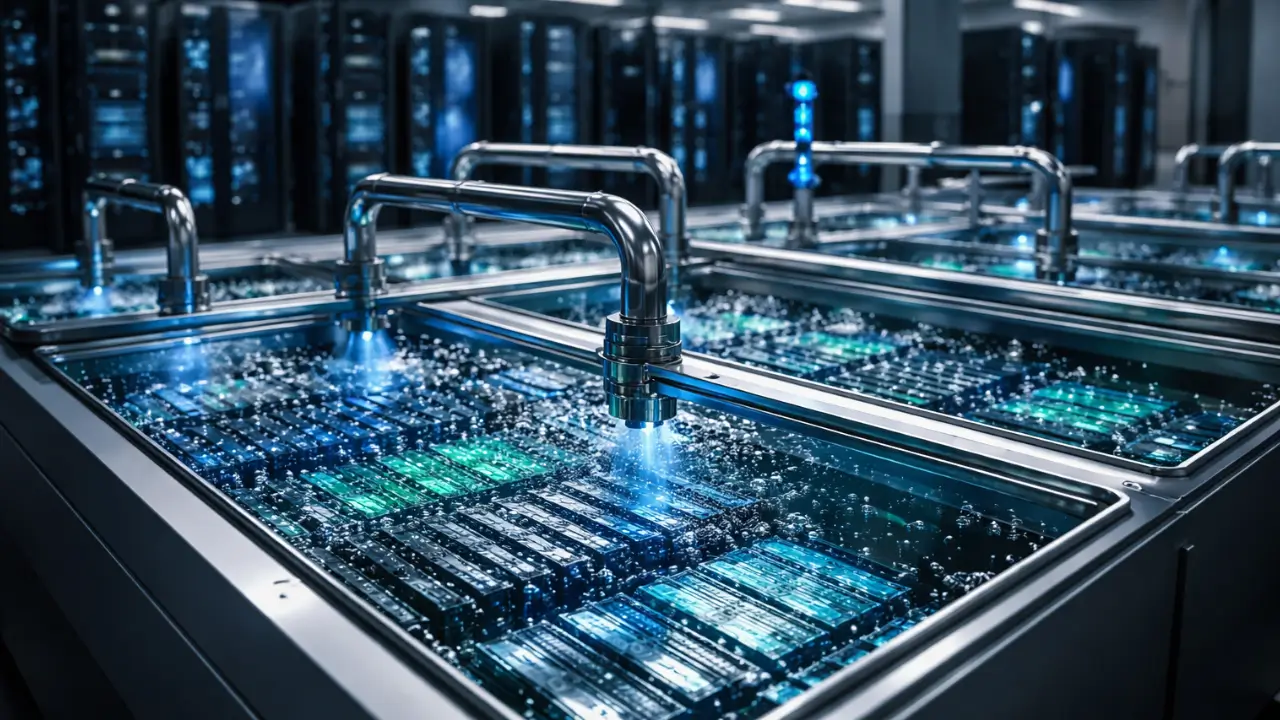
Immersion cooling in enterprise infrastructure is rapidly evolving from a specialized thermal management niche into a strategic pillar for top-tier enterprises. It reshapes how organizations design compute deployments for high-density workloads and AI-driven applications. By submerging servers in dielectric liquids, the technology transfers heat far more efficiently than traditional air cooling. Industry observers note that immersion systems support denser compute clusters while maintaining thermal stability that air-cooled systems struggle to achieve. These solutions also eliminate major mechanical subsystems, reducing operational complexity and improving predictability in diverse facilities. Enterprises increasingly adopt immersion cooling to meet energy efficiency and water conservation goals while aligning with broader sustainability strategies. As a result, many organizations consider immersion cooling not just as a cost-saving measure, but as an architectural choice that drives performance, reliability, and innovation.

Overcoming Air Cooling Constraints
In traditional data centers, airflow management and mechanical chilling infrastructure set hard limits on growth, often forcing planners to compromise between power density and reliability. Immersion cooling reshapes that constraint by enabling direct thermal exchange between hot components and a liquid medium, eliminating the dependency on air movement and raised floor designs. Because dielectric fluids do not conduct electricity, servers can operate submerged without short‑circuit risk, opening opportunities for scaled racks that air cooling cannot support. The uniform thermal environment offered by immersion systems also smooths temperature variability, which directly affects component wear and stress over time. This stabilization translates into reduced failure rates for critical hardware and more predictable maintenance windows for enterprise operators. The operational predictability of immersion methods further supports standardized deployments across facilities with diverse climates and workloads.
Unlocking Sustained High Performance
For performance‑centered organizations, especially those operating in AI, high‑performance computing (HPC), and real‑time analytics, immersive thermal management eliminates a longstanding bottleneck in computational throughput. Advanced processors and GPU‑intensive clusters generate heat at levels that render traditional air cooling ineffective without throttling performance to avoid thermal overload. Immersion cooling removes thermal throttling by extracting heat directly at the source, allowing processors to sustain performance over extended workloads.
Enterprises that face continuous peak computing demands find that this stability fosters more predictable and repeatable execution of complex tasks. In doing so, firms can squeeze more effective use from their hardware investments and accelerate cycles of testing, training, and deployment. These characteristics support strategic objectives beyond cooling itself, enabling faster innovation cycles in software and hardware integration.
Maximizing Space Efficiency and Capacity Planning
Enterprise data center operators also view immersion cooling through the lens of space efficiency and long‑term capacity planning in facilities constrained by footprint and power. By removing the need for expansive airflow pathways, fan arrays, and chiller infrastructure, immersion systems condense the physical space required per unit of compute. Rack layouts can prioritize component placement for thermal efficiency rather than ducting, enabling denser compute clusters in existing facilities without costly expansions. This spatial advantage aligns with broader corporate strategies that seek to maximize real estate investment and defer large capital outlays for new build‑outs. The ability to retrofit or integrate immersion cooling in modular zones also supports phased growth strategies common among global operators. For sectors such as financial services and life sciences, where on‑premise compute is strategic, this spatial flexibility supports both compliance and performance goals.

Reliability has emerged as another compelling driver for immersion adoption among enterprise compute planners, particularly in environments where uninterrupted uptime is central to service level agreements (SLAs). The removal of high‑failure components such as fans and moving pumps reduces the frequency of mechanical breakdowns that often plague air‑cooled systems. A uniform thermal environment also reduces stress on electronic components, extending service life and minimizing the risk of thermal cycling damage. The decreased incidence of hotspots and temperature variances directly correlates with fewer unexpected outages. Enterprises operating compute clusters for critical applications value this improved hardware longevity and plan capacity around stable thermal management. By reducing unplanned maintenance, immersion cooling contributes to more predictable operational expenditure profiles over multi‑year technology refresh cycles.
Sustainability and ESG Integration
Strategic enterprise leaders also consider sustainability imperatives as intrinsic to infrastructure planning, and here immersion cooling occupies a meaningful position in corporate environmental, social, and governance frameworks. By lowering the power required for cooling overhead and enabling dry coolers or warm‑water heat rejection, immersion designs reduce reliance on evaporative cooling that stresses water resources in drought‑prone regions.
This decoupling of cooling efficiency from water usage aligns with regulatory pressures and internal ESG commitments to reduce environmental impact. Organizations committed to carbon reporting find that immersion systems simplify emissions tracking by concentrating thermal management within predictable parameters. Furthermore, heat rejected from immersion systems offers potential reuse in ancillary processes, aligning with circular energy strategies. These sustainability considerations increasingly factor into board-level discussions about infrastructure investments.
While the strategic benefits of immersion cooling are increasingly recognized, enterprise adoption requires careful planning, training, and operational discipline. Immersion systems differ significantly from air cooling, requiring specialized tanks, fluid handling knowledge, and tailored workflows for maintenance and monitoring. Organizations must invest in infrastructure modifications, safety protocols, and staff expertise to ensure operational stability and performance optimization. Vendors now provide training programs, reference designs, and managed services to simplify adoption, but expertise remains essential for achieving expected benefits. Enterprises that proactively integrate operational readiness into planning are most likely to realize performance, reliability, and efficiency advantages. These considerations highlight that immersion cooling is a strategic initiative, not an automatic or plug-and-play replacement for existing systems.
Cross-Industry Enterprise Adoption
Enterprise adoption patterns indicate that immersion cooling is not limited to hyperscale cloud builders but spans banking, healthcare, automotive, and research institutions. These organizations run HPC and simulation workloads that demand thermal environments beyond what air cooling can efficiently support. In financial services, for example, risk modeling and analytics workloads benefit from sustained performance and reduced latency tied to stable thermal conditions. Healthcare and life sciences compute clusters likewise require predictable thermal behavior for continuous data processing. The automotive industry leverages immersion cooling to support simulation and design compute farms essential to engineering cycles. These cross-industry implementations suggest that immersion cooling shapes strategic infrastructure planning across diverse enterprise verticals.
Global Compute Consistency
Forward‑looking enterprise architects also view immersion cooling as a means to support global compute strategies that must operate consistently across heterogeneous climate zones. Traditional air-cooled facilities often require region-specific adjustments to handle local heat and humidity profiles, introducing variability in performance and metrics. Immersion systems internalize thermal management, enabling a common operational profile regardless of external environmental conditions. This consistency simplifies global deployment strategies and monitoring, enhancing predictability for multinational operators. For edge and remote compute sites, immersion designs reduce dependency on local mechanical infrastructure that may be difficult to maintain. Standardized thermal environments support remote operations without extensive local cooling expertise.
Moreover, the strategic turn to immersion cooling is reshaping vendor landscapes and hardware alliances as server OEMs and chip manufacturers co‑engineer solutions certified for liquid immersion environments. Partnerships between hardware providers and immersion specialists accelerate time to production for enterprise clusters designed specifically for immersion cooling. These alliances also address compatibility challenges by producing reference designs and validated components, reducing integration risk for enterprise adopters. Industry patent activity and fluid chemistry innovations further signal maturation of the technology and its ecosystem. As a result, enterprises can select integrated solutions that align with long-term infrastructure roadmaps. This vendor momentum reinforces immersion cooling as a strategic platform rather than an isolated experiment.
Operational Visibility and Control
Enterprise operators emphasize that control and visibility into compute infrastructure is essential for long-term performance. Immersion cooling improves both aspects by consolidating thermal management data. Traditional air-cooled systems require multiple monitoring layers for fans, airflow, temperature, and chillers. This fragmented oversight can complicate operational decisions. In contrast, immersion systems collect thermal data directly from liquid temperature, flow, and heat rejection paths. Consolidated metrics simplify threshold management and align with centralized infrastructure frameworks. Standardized telemetry also supports predictive maintenance and smarter decisions for workload placement and failure avoidance.
Risk Mitigation in Extreme Operating Conditions
Enterprises delivering services across global networks face extreme environmental conditions that can stress infrastructure. Immersion cooling reduces exposure to temperature swings by isolating critical hardware from ambient conditions. Internal thermal regulation remains consistent, limiting the impact of heat waves, dust, humidity, and other external factors. Operators report fewer reactive interventions during adverse weather, reducing operational risk and team strain. Mission-critical environments, such as trading floors and healthcare IT centers, benefit from this stability. Consequently, immersion cooling strengthens continuity strategies and supports reliable compute delivery even under unpredictable conditions.
Adoption of immersion cooling also affects workforce skills and talent development in IT and facilities teams. Traditional cooling relies on mechanical, electrical, and HVAC expertise. Immersion cooling adds requirements, including fluid dynamics, dielectric liquids, two-phase systems, and safety protocols for liquid environments. Enterprise leaders have developed training programs to bridge existing skills with new technical needs. Vendors support these programs with operational guidance for monitoring, maintenance, and incident response. These initiatives reduce reliance on contractors and strengthen institutional knowledge over time. Workforce readiness becomes a core part of immersion adoption planning, influencing timelines and integration approaches.
Standardization and Ecosystem Maturation
Standardization of hardware, enclosures, and management protocols is vital for scaling immersion cooling. Previously, lack of widely accepted standards made deployments bespoke, adding engineering effort and risk. Industry alliances now provide guidelines for interoperability, fluid specifications, and enclosure safety. These standards reduce variation and improve predictability for enterprise deployments. They also benefit suppliers by lowering component compatibility barriers and testing overhead. As the ecosystem matures, enterprises gain confidence that immersion technologies integrate smoothly across facilities while preserving service commitments.
As enterprise computing grows denser and more complex, immersion cooling has become more than a thermal solution. It is a strategic infrastructure decision that shapes performance, reliability, and innovation. Organizations benefit from consistent thermal regulation, reduced mechanical complexity, and increased capacity within existing facilities. These advantages translate into predictable uptime and longer hardware life. The technology also supports sustainability by lowering energy overhead, reducing water dependency, and enabling heat reuse. Operational predictability, integrated telemetry, and global standardization enhance its value further. Vendor support and cross-industry adoption indicate that immersion cooling is becoming a mainstream platform for high-performance computing.











