
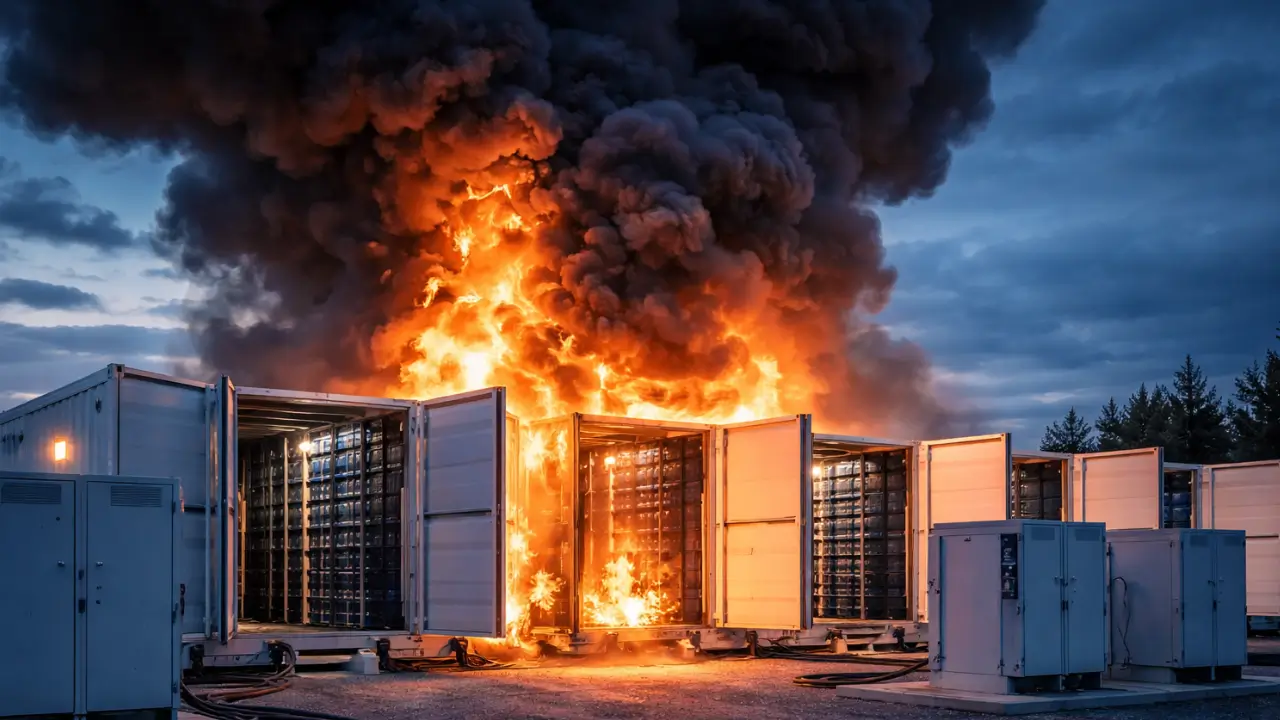
As long-duration energy storage systems scale beyond traditional capacity thresholds, safety validation has become a strategic priority rather than a regulatory formality. HiTHIUM has now entered this critical phase with an experiment designed to expose how ultra-high-density systems behave under extreme failure conditions. Recently, the company completed the world’s first open-door large-scale fire test of its ∞Power 6.25MWh four-hour long-duration energy storage system equipped with kiloampere-hour battery cells. The test, which aligns with the framework of a 6.25MWh long-duration energy storage fire test, took place under the full supervision of UL Solutions, U.S. Authorities Having Jurisdiction, and Fire Protection Engineers.

The test results demonstrate that the high-energy-density 6.25MWh energy storage system, incorporating ultra-large-capacity battery cells, exhibited stable and controllable safety performance under extreme conditions. This marks a critical breakthrough in safety validation at higher energy levels for LDES systems, further strengthening the safety foundation for large-scale industry deployment.
Instead of positioning safety as a supporting feature, HiTHIUM placed it at the center of system architecture. This shift reflects a broader industry reality: as energy storage approaches infrastructure-scale relevance, failure tolerance must match the stakes of national grids and hyperscale deployments.
From Component Testing to System-Level Stress Validation
HiTHIUM did not treat the 6.25MWh test as an incremental upgrade from earlier demonstrations. Building on its previous open-door fire test of a 5MWh system, the company conducted an expanded validation focused on the ∞Power 6.25MWh LDES system and its core ∞Cell 1175Ah, verifying system-level safety at significantly higher energy levels.

Rather than isolating individual risks, the test explored how multiple stress factors interact within a fully integrated system. This approach reflects a growing understanding across the energy storage sector: real-world failures rarely originate from a single point. They emerge from cascading interactions across cells, modules, and structural frameworks.
Simulating Conditions Beyond Conventional Safety Scenarios
To push the system beyond standard certification environments, HiTHIUM designed a test configuration that amplified physical and thermal stress. The container doors remained fully open throughout the test, creating an open-door combustion environment with maximum oxygen flow and flame exposure. Adjacent containers were positioned back-to-back and side-by-side with only fifteen centimeters of spacing. The system operated at full state of charge, while all active fire suppression systems remained disabled, forcing reliance on intrinsic safety design.
This configuration transformed the test into an examination of architectural resilience rather than procedural compliance. It also raised a fundamental question for the industry: can long-duration energy storage systems maintain control when external mitigation tools disappear?
Multi-Layer Safety Architecture Under Extreme Pressure
To address the compounded risks introduced by ultra-large-capacity cells and high-energy-density systems, HiTHIUM implemented a multi-layer safety architecture spanning the cell, module, and system levels. Guided by the technical framework of release, protection, and resistance, the test validated three core safety challenges.
Instead of relying on redundancy alone, the system integrated safety mechanisms into a coordinated structural logic. This design philosophy suggests that future LDES platforms may depend less on reactive intervention and more on pre-engineered behavioral control.
To manage the massive energy release during thermal runaway of 1175Ah cells, HiTHIUM designed a three-dimensional airflow channel with directional venting, and the module adopted a dual pressure relief valve safety design. This structure enabled rapid and controlled gas release at the cell and module levels, preventing explosive pressure buildup. No explosions or debris ejections were observed during the test.
For the broader industry, this result challenges the assumption that higher-capacity cells inevitably lead to uncontrollable energy release. It suggests that system-level airflow and pressure management can scale alongside energy density.
Fire Containment in High-Density Deployment Conditions
Under severe conditions of open-door combustion and minimal container spacing, the system endured direct flame exposure and intense heat transfer. Fire-resistant module covers, reinforced steel enclosures, and insulated multi-layer container structures confined the fire to a single battery system with no thermal propagation across the containers, and temperatures of cells in adjacent containers remained below safety thresholds.
This outcome holds strategic importance for dense energy storage deployments, where spatial constraints often amplify risk. It demonstrates that containment strategies can evolve without sacrificing capacity expansion. To withstand prolonged high-temperature exposure, the ∞ Power 6.25MWh system was structurally reinforced with a high-strength steel frame, stiffeners, and dual-layer partitions. After continuous combustion, the affected container remained structurally intact, with no significant deformation or collapse observed.
Structural stability at this scale influences more than engineering confidence. It affects regulatory acceptance, insurance modeling, and long-term infrastructure planning for large-scale energy storage systems.
Repositioning Safety as a Strategic Growth Engine
This test systematically verified the overall safety performance of the ∞Power 6.25MWh LDES system equipped with kAh battery cells, representing a milestone within the global energy storage safety validation framework.
As system capacity continues to increase from 5MWh to 6.25MWh, HiTHIUM remains committed to advancing safety and reliability through rigorous design standards and extreme-condition testing.
Looking ahead, HiTHIUM will remain focused on LDES as a strategic priority, further strengthening its safety foundation and core technologies. By participating in the development of global energy storage safety frameworks to higher standards, and working closely with industry partners, HiTHIUM aims to drive LDES toward larger scale, higher reliability, and safer, more efficient deployment, supporting a steady and sustainable global energy transition.
Why This Moment Matters
HiTHIUM’s open-door fire test signals a shift in how the energy storage industry defines technological leadership. Capacity alone no longer determines relevance. Instead, controllability under extreme failure scenarios increasingly shapes market trust.
As grids integrate more long-duration storage, stakeholders will demand proof that systems can endure worst-case conditions without cascading failures. HiTHIUM’s test positions the company within this emerging logic of infrastructure-grade credibility. In the next phase of the energy transition, the winners will not only scale energy storage, they will prove that scale remains governable.











