
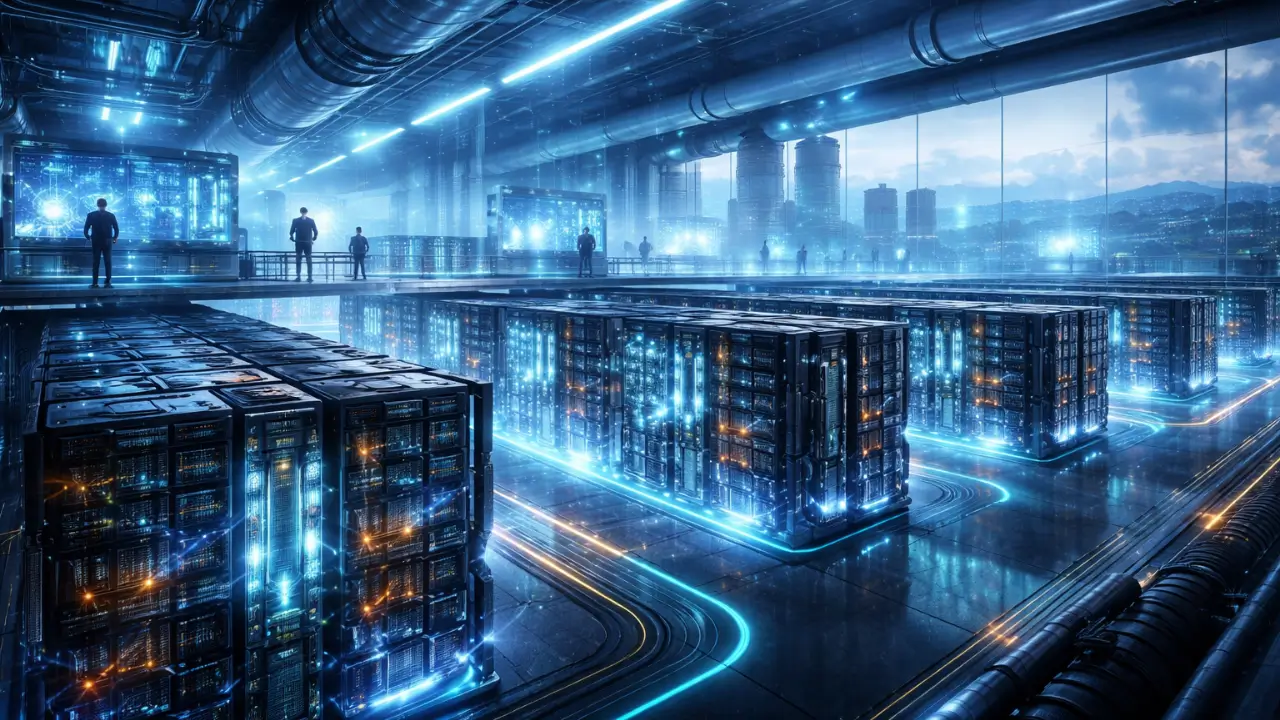
The moment a data center crosses a certain threshold of compute density, it stops behaving like a traditional digital facility and starts acting like a living system whose internal logic no longer follows legacy rules. Engineers often describe this transition in terms of megawatts, racks, and thermal loads, yet the deeper transformation occurs in architectural thinking rather than physical components. High-density AI compute is redefining Neo-Cloud architecture, forcing an abrupt shift in assumptions that govern power distribution, spatial planning, and system resilience. Cloud infrastructure once evolved through incremental upgrades, but AI-scale compute has accelerated changes in how operators design, monitor, and scale dense environments.

Organizations now discover that the very foundations of hyperscale design fail to interpret the behavior of nonlinear AI workloads, which respond to power and cooling in ways that legacy environments never anticipated. This emerging reality exposes a critical truth: cloud architecture is no longer a neutral container for compute, but an active participant in shaping how intelligence is produced, scaled, and stabilized. As the Neo-Cloud era accelerates, infrastructure no longer adapts slowly to demand, but instead restructures itself around the logic of dense, sovereign, and intelligent compute ecosystems. The story of high-density compute therefore unfolds not as a technical upgrade, but as a philosophical reinvention of how cloud environments are conceived, built, and governed.
Neo-Cloud First, Infrastructure Second
The Neo-Cloud emerged not from a single technological breakthrough, but from a convergence of sovereignty demands, AI acceleration, and geopolitical sensitivity surrounding digital infrastructure. Traditional cloud models optimized for scale, efficiency, and global reach, yet they rarely questioned the underlying architectural assumptions that shaped their physical and logical layers. In contrast, the Neo-Cloud prioritizes autonomy, density, and intelligence as foundational principles, which fundamentally alter how infrastructure must behave under pressure.
This shift forces architects to treat infrastructure not as a passive substrate, but as a strategic system whose behavior directly influences computational outcomes and operational stability. As organizations deploy AI-native workloads, they increasingly recognize that cloud design decisions cannot remain abstracted from power behavior, spatial constraints, and lifecycle dynamics. The Neo-Cloud therefore represents a structural ideology in which compute ambition dictates infrastructure logic, rather than infrastructure capacity limiting compute potential. By reframing cloud architecture as a philosophy rather than a service model, the Neo-Cloud establishes a new baseline for how digital ecosystems evolve under conditions of extreme density and strategic autonomy.

Compute Density as the New Architectural Driver
Compute density has become the primary variable that reshapes every layer of cloud architecture, from rack design to campus-scale planning, in ways that legacy hyperscale models never anticipated. In earlier cloud eras, capacity expansion followed predictable patterns in which additional servers translated into linear increases in power and cooling requirements. AI workloads disrupt this linearity because they concentrate computational intensity into smaller physical footprints while generating highly variable power and thermal signatures. As a result, spatial design must now align with energy flows, thermal gradients, and network topology rather than simply maximizing floor utilization.
Cloud architects increasingly discover that density does not merely increase operational complexity, but transforms the logic by which infrastructure decisions are prioritized and sequenced. This transformation forces organizations to treat compute clusters as architectural anchors around which power distribution, cooling systems, and resilience strategies must be orchestrated. The rise of density-driven design thus signals a departure from expansion-centric hyperscale thinking toward a model in which architectural coherence emerges from the interplay between compute intensity and infrastructure behavior. In the Neo-Cloud paradigm, compute density no longer represents a performance metric, but a structural force that reshapes the physical and strategic geometry of cloud environments.
When AI Workloads Break Legacy Design Assumptions
Legacy cloud environments evolved around workloads that exhibited relatively stable and predictable consumption patterns, which allowed engineers to design infrastructure with evenly distributed power and cooling margins. AI workloads undermine this predictability because they generate bursty, synchronized, and nonlinear demand patterns that concentrate stress on specific parts of the infrastructure stack. As GPU clusters scale, they introduce rapid fluctuations in load behavior that legacy power architectures struggle to interpret and stabilize.
This mismatch reveals that traditional assumptions about redundancy, capacity planning, and fault tolerance no longer apply in environments dominated by AI-native compute. Organizations that rely on hyperscale-era design principles often experience invisible inefficiencies that manifest as power quality issues, thermal hotspots, and accelerated hardware degradation. These outcomes demonstrate that AI workloads do not merely strain existing infrastructure, but expose conceptual blind spots embedded in traditional cloud architecture. By breaking legacy assumptions, AI compute compels cloud designers to rethink how infrastructure should anticipate, absorb, and adapt to dynamic computational behavior. The Neo-Cloud therefore emerges not as an evolutionary extension of hyperscale design, but as a corrective response to the structural limitations revealed by AI-driven compute intensity.
Power Behavior as a Reflection of Compute Architecture
Power behavior in modern cloud environments increasingly reflects the structural organization of compute clusters rather than the characteristics of electrical components alone. In AI-dense facilities, the rhythm of electricity consumption mirrors the orchestration of algorithms, training cycles, and data flows within GPU fabrics. This relationship reveals that power is no longer an independent variable, but an emergent property of computational architecture that expresses how intelligence is produced and scaled. Traditional power engineering approaches attempted to smooth demand through buffering and redundancy, yet AI workloads generate patterns that resist such simplification.
As a result, engineers must interpret electrical signals as indicators of architectural alignment or misalignment between compute design and infrastructure capacity. This shift transforms power analysis from a purely technical exercise into a diagnostic tool for understanding the coherence of cloud architecture. Organizations that grasp this relationship can design infrastructure that anticipates computational behavior rather than reacting to it after instability occurs. In the Neo-Cloud context, power behavior thus becomes a narrative of how compute ambition interacts with physical reality, revealing whether architecture supports or constrains the evolution of intelligent systems.
Harmonics as a Symptom of Architectural Mismatch
Harmonics in electrical systems are often treated as isolated technical anomalies, yet in AI-dense cloud environments they increasingly signal deeper architectural inconsistencies between compute behavior and infrastructure design. When GPU clusters operate at extreme densities, they generate complex load signatures that distort waveforms across power distribution networks. These distortions reveal that legacy infrastructure was never designed to accommodate the synchronized, nonlinear demand patterns produced by AI workloads. Engineers who focus solely on mitigation techniques risk overlooking the underlying architectural causes that produce harmonic instability in the first place.
By interpreting harmonics as symptoms rather than root problems, organizations can uncover how compute topology, power routing, and system orchestration interact in unintended ways. This perspective reframes electrical anomalies as feedback mechanisms that expose whether cloud architecture aligns with the realities of AI-scale computation. As Neo-Cloud environments mature, harmonic analysis evolves from a maintenance concern into a strategic indicator of architectural health and design coherence. The presence of harmonics therefore becomes not merely a technical challenge, but a signal that cloud infrastructure must be redesigned to reflect the behavioral logic of high-density compute.
Infrastructure Lifecycles in the Age of AI Acceleration
Infrastructure lifecycles once followed predictable timelines that allowed cloud operators to amortize assets across decades of incremental technological change. AI acceleration disrupts this stability because dense compute environments impose stress patterns that compress the lifespan of power, cooling, and network components simultaneously. When GPU clusters operate continuously at high utilization levels, they accelerate wear across electrical systems in ways that traditional lifecycle models fail to predict. This compression forces organizations to reconsider not only procurement strategies, but also the conceptual frameworks that define acceptable risk and durability within cloud environments.
Engineers increasingly observe that lifecycle assumptions embedded in hyperscale-era design no longer align with the operational reality of AI-native workloads. As a result, infrastructure planning shifts from static timelines toward dynamic resilience models that account for fluctuating demand, thermal stress, and power volatility. The Neo-Cloud thus redefines infrastructure lifecycles as adaptive processes rather than fixed schedules, requiring architects to integrate longevity considerations directly into the structural logic of compute design.
The Compression of Tolerance Across the Stack
The compression of tolerance across the infrastructure stack emerges as one of the most profound consequences of high-density compute environments. In traditional cloud facilities, margins of error existed at multiple layers, allowing systems to absorb fluctuations without immediate structural consequences. AI-scale compute reduces these margins because synchronized workloads generate cascading effects that propagate rapidly across power, cooling, and network layers. This phenomenon forces engineers to confront the reality that tolerance is no longer distributed evenly, but concentrated in fragile points where architectural assumptions intersect with operational stress.
As tolerance compresses, minor deviations in load behavior can trigger disproportionate impacts on system stability and performance. Organizations that fail to recognize this compression risk misinterpreting early warning signals as isolated incidents rather than systemic vulnerabilities. By contrast, Neo-Cloud architects increasingly treat tolerance as a design variable that must be intentionally engineered rather than implicitly assumed. This shift transforms tolerance from a passive buffer into an active architectural principle that shapes how dense compute environments are structured and governed.
From Centralized Hyperscale to Distributed Neo-Cloud Campuses
Centralized hyperscale architectures once represented the pinnacle of cloud efficiency because they concentrated resources within massive facilities optimized for economies of scale. AI-driven compute density disrupts this logic because extreme concentration amplifies power volatility, thermal complexity, and systemic risk within single locations. Distributed Neo-Cloud campuses emerge as an alternative architectural response that prioritizes modularity, sovereignty, and adaptive power behavior over sheer scale. These campuses consist of interconnected clusters designed to operate semi-independently while maintaining coordinated orchestration across regional or national boundaries.
By distributing compute density across modular units, cloud operators can mitigate nonlinear load behavior without sacrificing performance or sovereignty. This architectural shift reflects a deeper recognition that AI workloads require spatial flexibility rather than centralized uniformity. As Neo-Cloud campuses proliferate, they redefine cloud geography not as a map of hyperscale hubs, but as a network of power-aware, intelligence-driven clusters embedded within strategic territorial frameworks.
Modular Clusters as Architectural Anchors
Modular clusters function as architectural anchors within distributed Neo-Cloud campuses because they align compute density with localized power and cooling capabilities. Unlike hyperscale facilities that impose uniform design templates across vast footprints, modular clusters allow architects to tailor infrastructure behavior to the specific characteristics of AI workloads. This flexibility enables cloud operators to isolate nonlinear load patterns, reducing the risk of systemic instability across entire campuses. Engineers increasingly recognize that modularity does not merely improve scalability, but enhances architectural intelligibility by making the relationship between compute behavior and infrastructure response more transparent.
As clusters become architectural anchors, they redefine how cloud environments balance autonomy with integration across distributed networks. This approach transforms cloud design from monolithic engineering into a composition of interconnected systems whose behavior can be orchestrated with greater precision. The rise of modular clusters therefore signals a structural shift in which Neo-Cloud architecture prioritizes adaptability and power awareness over uniform expansion. By embedding intelligence into the spatial organization of infrastructure, modular clusters embody the philosophical foundations of the Neo-Cloud paradigm.
Substations as Strategic Infrastructure, Not Peripheral Assets
Substations once occupied a peripheral role in cloud architecture because hyperscale facilities treated them as external utilities rather than integrated components of system design. AI-driven compute density elevates substations into strategic assets because power behavior now directly influences the stability and scalability of cloud environments. As nonlinear workloads generate volatile demand patterns, substations must respond not only to aggregate load but also to the temporal dynamics of AI computation. This requirement transforms substations from static delivery points into active participants in architectural orchestration across Neo-Cloud campuses.
Engineers increasingly integrate substation design with compute topology, cooling systems, and network architecture to ensure coherent system behavior under fluctuating workloads. By repositioning substations within the core architectural framework, cloud operators can align power distribution with the structural logic of dense compute clusters. This integration reflects a broader shift in which infrastructure elements previously considered peripheral become central to strategic decision-making in the Neo-Cloud era. As substations evolve into architectural nodes, they redefine how sovereignty, resilience, and intelligence converge within modern cloud ecosystems.
Integrated Power Architecture and Sovereignty
Integrated power architecture plays a critical role in supporting sovereign cloud strategies because it ensures that computational autonomy aligns with energy autonomy. Governments and enterprises increasingly recognize that sovereignty cannot exist without control over the physical systems that sustain digital infrastructure. AI-driven workloads intensify this realization because dependence on external power systems exposes cloud environments to geopolitical, regulatory, and operational vulnerabilities. By designing integrated power architectures, Neo-Cloud operators can synchronize energy generation, distribution, and consumption with the structural requirements of dense compute environments.
This synchronization enables cloud ecosystems to maintain stability even under conditions of extreme load variability and external disruption. Engineers therefore treat integrated power architecture not as an optional enhancement, but as a foundational requirement for sovereign compute strategies. As sovereign ambitions expand across regions, integrated power design becomes a critical determinant of whether Neo-Cloud environments can sustain autonomy without sacrificing performance. The convergence of sovereignty and power architecture thus reflects a deeper transformation in which energy systems become inseparable from the strategic identity of cloud infrastructure.
The Rise of Power-Conscious Cloud Architecture
Power-conscious cloud architecture emerges as a defining characteristic of the Neo-Cloud because AI workloads demand unprecedented sensitivity to electrical behavior. Traditional cloud design prioritized redundancy and capacity, yet often treated power quality as a secondary consideration rather than a structural parameter. AI-scale compute forces architects to model waveform integrity, load dynamics, and harmonic behavior as integral components of system design rather than operational afterthoughts. This shift requires interdisciplinary collaboration between compute engineers, power specialists, and infrastructure strategists to align architectural decisions with electrical realities. As power-conscious design becomes mainstream, cloud operators increasingly adopt predictive analytics to anticipate how compute behavior will shape energy consumption patterns.
These predictive models enable organizations to design infrastructure that responds proactively to nonlinear demand rather than reacting to instability after it emerges. By embedding power awareness into architectural logic, Neo-Cloud environments achieve a level of coherence that hyperscale-era designs could not sustain under AI-driven density. The rise of power-conscious architecture therefore represents not merely a technical evolution, but a conceptual redefinition of how cloud systems interpret and manage energy as a strategic resource.
Waveform Integrity as an Architectural Constraint
Waveform integrity increasingly functions as an architectural constraint because AI workloads produce complex electrical signatures that challenge traditional power distribution frameworks. In legacy cloud environments, waveform distortions rarely influenced design decisions because load behavior remained relatively stable and predictable. AI-scale compute disrupts this stability by generating synchronized demand spikes that propagate across electrical networks with minimal damping. Engineers therefore must treat waveform integrity not as a maintenance concern, but as a design parameter that shapes how compute clusters, power systems, and cooling architectures interact.
This approach requires cloud architects to integrate electrical modeling into early-stage design processes rather than addressing power quality issues after deployment. As waveform integrity becomes an architectural constraint, it influences decisions about cluster placement, power routing, and modular segmentation across Neo-Cloud campuses. Organizations that internalize this constraint gain the ability to design infrastructure that anticipates nonlinear compute behavior rather than compensating for it retrospectively. The elevation of waveform integrity to architectural significance thus exemplifies how AI-driven density transforms electrical phenomena into strategic determinants of cloud design.
Designing Cloud Environments for Nonlinear Compute
Designing cloud environments for nonlinear compute requires architects to abandon linear scaling assumptions that dominated hyperscale thinking for decades. AI workloads generate demand patterns that fluctuate across multiple temporal and spatial dimensions, making traditional capacity planning models insufficient for predicting system behavior. This complexity forces cloud designers to integrate adaptive control mechanisms that can respond dynamically to shifting compute intensity and power behavior. As nonlinear compute becomes the norm, architectural frameworks must account for emergent interactions between compute clusters, power systems, and cooling networks. Engineers increasingly treat cloud environments as cyber-physical systems whose behavior cannot be fully understood through isolated component analysis.
This perspective encourages architects to model infrastructure as interconnected feedback loops rather than discrete layers, enabling more accurate prediction of system responses to extreme load conditions. By designing for nonlinear compute, Neo-Cloud environments achieve resilience not through redundancy alone, but through structural alignment between computational logic and physical infrastructure. The shift toward nonlinear design therefore marks a fundamental departure from hyperscale-era methodologies, signaling the maturation of cloud architecture into a discipline that integrates computational theory with physical engineering.
Adaptive Infrastructure as a Design Imperative
Adaptive infrastructure emerges as a design imperative because nonlinear compute environments require systems that can evolve in real time rather than relying on static configurations. In traditional cloud facilities, infrastructure upgrades occurred through scheduled cycles that reflected predictable growth trajectories. AI-driven density disrupts this rhythm because workload behavior can change abruptly in response to algorithmic evolution, data availability, or market demand. Engineers therefore design adaptive infrastructure capable of reconfiguring power distribution, cooling pathways, and network topology without disrupting operational continuity.
This adaptability transforms infrastructure from a fixed asset into a dynamic system that mirrors the fluid nature of AI computation. As adaptive design principles proliferate, cloud operators increasingly integrate software-defined control layers with physical infrastructure to enable coordinated responses to nonlinear load behavior. This integration blurs the boundary between digital orchestration and physical engineering, reinforcing the Neo-Cloud philosophy that infrastructure and compute must evolve together. By embracing adaptive infrastructure as a core design principle, Neo-Cloud environments achieve a level of responsiveness that hyperscale architectures could not attain under static design assumptions.
The Convergence of Compute Engineering and Infrastructure Strategy
The convergence of compute engineering and infrastructure strategy represents a defining characteristic of the Neo-Cloud because AI workloads collapse the traditional separation between silicon decisions and physical design. In hyperscale environments, compute engineering often operated independently from infrastructure planning because workloads followed predictable patterns that infrastructure could accommodate through standardized templates. AI-driven density disrupts this separation because the architectural implications of silicon choices directly influence power behavior, cooling requirements, and system resilience.
Engineers therefore must collaborate across disciplinary boundaries to ensure that compute architecture aligns with infrastructure capabilities and constraints. This convergence transforms cloud design from a sequential process into an iterative dialogue between computational ambition and physical feasibility. As organizations adopt this integrated approach, they gain the ability to anticipate how emerging compute technologies will reshape infrastructure requirements before deployment. The Neo-Cloud thus emerges as a domain where compute engineering and infrastructure strategy co-evolve, reflecting a broader shift toward holistic design paradigms in digital infrastructure. By aligning silicon decisions with architectural strategy, cloud operators can design environments that sustain AI-scale compute without sacrificing stability or sovereignty.
Silicon Choices as Architectural Decisions
Silicon choices increasingly function as architectural decisions because the characteristics of AI accelerators determine how infrastructure must be designed to support dense compute environments. In legacy cloud models, hardware upgrades rarely forced fundamental changes in facility design because incremental performance gains aligned with existing power and cooling frameworks. AI accelerators disrupt this continuity because they introduce unprecedented power densities, thermal gradients, and synchronization patterns that reshape infrastructure requirements. Engineers therefore treat silicon selection not as a procurement decision, but as a strategic choice that influences the structural geometry of cloud campuses.
This perspective compels organizations to evaluate hardware options in terms of their architectural implications rather than focusing solely on performance metrics. As silicon choices shape power routing, cooling topology, and modular segmentation, they become integral to the design logic of Neo-Cloud environments. Cloud operators who recognize this relationship can align hardware innovation with infrastructure evolution, reducing the risk of architectural mismatch. The elevation of silicon choices to architectural significance thus exemplifies how AI-driven density dissolves traditional boundaries between computation and infrastructure in the Neo-Cloud era.
Electrical Resilience as a Competitive Differentiator
Electrical resilience emerges as a competitive differentiator because AI-driven compute environments expose vulnerabilities that traditional redundancy models cannot fully mitigate. In hyperscale facilities, resilience often relied on layered backup systems designed to ensure continuity under predictable failure scenarios. AI-scale compute disrupts this approach because nonlinear load behavior can trigger cascading effects that bypass conventional redundancy mechanisms. Engineers therefore redefine resilience as the ability of infrastructure to maintain coherent behavior under volatile demand rather than merely surviving component failures.
This redefinition forces cloud operators to integrate resilience into architectural design rather than treating it as an operational contingency. Organizations that achieve electrical resilience gain a strategic advantage because they can sustain AI workloads without performance degradation or systemic instability. As competition intensifies among Neo-Cloud operators, electrical resilience becomes a visible indicator of architectural maturity and strategic foresight. The Neo-Cloud era thus transforms resilience from a defensive measure into a proactive design philosophy that differentiates cloud ecosystems in terms of stability, sovereignty, and intelligence.
Architectural Coherence as Stability
Architectural coherence increasingly defines stability because AI-driven density demands alignment across compute, power, cooling, and network layers. In traditional cloud environments, stability often emerged from redundancy and overprovisioning rather than from structural alignment between system components. AI workloads undermine this approach because misalignment between compute behavior and infrastructure design can generate instability even in highly redundant systems. Engineers therefore prioritize coherence as a design objective that ensures each layer of the architecture responds consistently to nonlinear load dynamics.
This emphasis on coherence transforms stability from an emergent property into a deliberate outcome of integrated design decisions. As Neo-Cloud architectures mature, coherence becomes a measurable indicator of how effectively infrastructure supports the behavioral logic of dense compute environments. Organizations that achieve architectural coherence can scale AI workloads with greater confidence because their infrastructure behaves predictably under extreme conditions. The Neo-Cloud thus reframes stability not as redundancy, but as the harmonious interaction of interconnected systems that evolve together under the pressures of high-density computation.
Sovereign Compute Demands Infrastructure Intelligence
Sovereign compute demands infrastructure intelligence because autonomy in the digital domain depends on the ability to interpret and manage physical system behavior in real time. Governments and enterprises increasingly pursue sovereign cloud strategies to reduce dependence on external platforms and geopolitical uncertainties. AI-driven workloads intensify this pursuit because dense compute environments amplify the consequences of infrastructure instability and external energy dependencies. Engineers therefore embed intelligence into infrastructure systems to monitor, predict, and optimize power behavior across Neo-Cloud campuses.
This intelligence transforms infrastructure from a static asset into a cognitive system capable of adapting to nonlinear compute dynamics. As sovereign ambitions expand, infrastructure intelligence becomes a prerequisite for sustaining autonomy without compromising performance or resilience. Organizations that integrate intelligence into infrastructure design can align national or enterprise strategies with the operational realities of AI-scale compute. The Neo-Cloud thus emerges as a domain where sovereignty is not achieved through policy alone, but through the intelligent orchestration of physical systems that support dense computational ecosystems.
Energy Awareness as a Strategic Capability
Energy awareness increasingly functions as a strategic capability because AI-driven density forces organizations to understand how compute behavior interacts with energy systems at multiple scales. In hyperscale environments, energy management often focused on efficiency metrics rather than behavioral dynamics of workloads. AI workloads disrupt this focus by generating complex demand patterns that require continuous interpretation rather than periodic optimization. Engineers therefore develop energy-aware architectures that integrate sensing, analytics, and control mechanisms across power distribution networks.
This integration enables cloud operators to anticipate how algorithmic activity will influence energy consumption and system stability. As energy awareness becomes embedded in infrastructure strategy, organizations can design cloud environments that balance performance, sovereignty, and sustainability more effectively. The Neo-Cloud paradigm thus elevates energy awareness from an operational concern to a strategic capability that shapes architectural decisions and competitive positioning. By aligning energy intelligence with compute design, Neo-Cloud operators can navigate the challenges of dense computation while maintaining systemic coherence and strategic autonomy.
The Neo-Cloud as a Self-Stabilizing Ecosystem
The Neo-Cloud increasingly resembles a self-stabilizing ecosystem because dense compute environments require continuous interaction between physical infrastructure and computational logic. In traditional cloud models, stability emerged from static design principles that assumed predictable workload behavior and linear scaling. AI-driven density disrupts these assumptions by introducing feedback loops between compute clusters, power systems, and cooling networks that evolve dynamically over time. Engineers therefore conceptualize Neo-Cloud environments as ecosystems in which each component influences and responds to the behavior of others.
This ecological perspective enables architects to design systems that adapt to nonlinear dynamics rather than resisting them through rigid control mechanisms. As self-stabilizing ecosystems, Neo-Cloud architectures rely on continuous sensing, analysis, and orchestration to maintain equilibrium under extreme computational pressure. Organizations that embrace this paradigm can design cloud environments that sustain AI-scale workloads without sacrificing resilience or sovereignty. The Neo-Cloud thus represents not merely a technological platform, but an evolving ecosystem in which compute density, power behavior, and architectural intelligence converge into a unified system of self-regulation and adaptation.
The Neo-Cloud as a Self-Stabilizing Ecosystem
Feedback loops between compute, power, and cooling increasingly define the operational logic of Neo-Cloud environments because dense AI workloads generate interdependent behavioral patterns across physical systems. In legacy cloud architectures, compute activity rarely influenced power and cooling behavior in real time because workloads exhibited relatively stable and predictable demand profiles. AI-scale compute disrupts this separation by producing synchronized load surges that propagate simultaneously through electrical and thermal systems.
Engineers therefore must model feedback loops as architectural features rather than treating them as anomalies that require ad hoc mitigation. This modeling approach enables cloud architects to anticipate how changes in algorithmic behavior will ripple through power distribution and cooling networks across entire campuses. As feedback loops become explicit design considerations, Neo-Cloud environments evolve toward systems that can self-regulate under nonlinear demand conditions. The emergence of feedback-driven design thus signals a transition from reactive infrastructure management to proactive architectural orchestration in AI-native cloud ecosystems.
Orchestration as Physical Infrastructure Logic
Orchestration increasingly functions as physical infrastructure logic because AI workloads require coordinated control across compute clusters, power systems, and cooling architectures. In traditional cloud environments, orchestration focused primarily on software-level resource allocation rather than on the physical behavior of infrastructure components. AI-driven density dissolves this distinction because algorithmic orchestration directly shapes electrical load patterns and thermal dynamics across facilities. Engineers therefore integrate orchestration frameworks with infrastructure monitoring systems to align digital decisions with physical realities. This integration transforms orchestration from a software abstraction into a governing principle that defines how Neo-Cloud environments behave under stress.
As orchestration becomes embedded in infrastructure logic, cloud architects gain the ability to synchronize computational ambition with physical constraints in real time. Organizations that master this integration can design cloud systems that maintain stability while scaling AI workloads at unprecedented density. The Neo-Cloud paradigm thus redefines orchestration as a bridge between digital intelligence and physical infrastructure, ensuring that computational growth remains structurally coherent.
The Structural Economics of High-Density Compute
High-density compute increasingly functions as an economic force because AI workloads reshape the cost structure of cloud infrastructure across power, cooling, and capital investment domains. In hyperscale models, economies of scale emerged from uniform expansion strategies that optimized cost per unit of compute through standardized infrastructure. AI-driven density disrupts this logic by introducing nonlinear cost curves in which incremental performance gains require disproportionate increases in power and cooling investment. Engineers and financial planners therefore must reinterpret cost models to account for the architectural implications of dense compute clusters.
This reinterpretation reveals that the economic viability of Neo-Cloud environments depends not only on hardware efficiency, but also on architectural coherence between compute design and infrastructure behavior. As cost structures become more sensitive to density-driven stress, organizations increasingly treat architectural innovation as a financial strategy rather than a purely technical pursuit. The Neo-Cloud thus transforms high-density compute into a structural economic variable that influences investment decisions, risk assessment, and long-term strategic planning. By aligning economic models with architectural realities, cloud operators can sustain AI-scale growth without undermining financial stability or operational resilience.
Capital Allocation in the Neo-Cloud Era
Capital allocation in the Neo-Cloud era reflects the shifting balance between compute ambition and infrastructure constraints because AI workloads demand unprecedented investment in power and cooling systems. In traditional cloud environments, capital expenditure prioritized server capacity and networking equipment because infrastructure scaling followed predictable trajectories. AI-driven density alters this priority by elevating power distribution, cooling technology, and campus design to strategic investment categories. Financial decision-makers therefore must evaluate capital allocation through the lens of architectural interdependence rather than isolated component performance.
This evaluation reveals that underinvestment in infrastructure coherence can generate hidden costs that exceed the apparent savings from hardware-focused spending. As Neo-Cloud architectures mature, capital allocation strategies increasingly emphasize integrated design that aligns compute capability with physical system capacity. Organizations that adopt this approach can mitigate the risk of architectural bottlenecks while maximizing the return on AI-driven innovation. The Neo-Cloud paradigm thus reframes capital allocation as an architectural decision that determines whether dense compute environments can scale sustainably without eroding financial and operational stability.
The Geopolitics of Dense Compute Infrastructure
Dense compute increasingly functions as a geopolitical asset because AI capabilities depend on physical infrastructure that is geographically anchored and strategically controlled. In the hyperscale era, cloud providers emphasized global reach and centralized efficiency, often overlooking the geopolitical implications of infrastructure concentration. AI-driven density intensifies these implications because high-performance compute clusters become critical resources that influence national competitiveness, security, and technological sovereignty.
Governments therefore treat dense compute infrastructure not merely as commercial assets, but as strategic instruments within broader geopolitical frameworks. Engineers and policymakers must collaborate to ensure that Neo-Cloud architectures align with national energy systems, regulatory environments, and security requirements. This collaboration reveals that infrastructure design decisions carry geopolitical consequences that extend far beyond technical performance metrics. As dense compute becomes a cornerstone of national digital strategies, Neo-Cloud environments increasingly reflect the political and economic priorities of the regions in which they operate. The Neo-Cloud paradigm thus transforms cloud architecture into a geopolitical domain where infrastructure design, energy policy, and technological sovereignty intersect.
Regional Energy Systems and Cloud Architecture
Regional energy systems increasingly shape cloud architecture because AI-driven density requires alignment between compute clusters and local power infrastructure. In hyperscale models, cloud providers often abstracted energy considerations through centralized procurement and standardized facility design. AI-scale compute disrupts this abstraction because regional variations in grid stability, renewable integration, and regulatory frameworks directly influence the feasibility of dense compute deployment. Engineers therefore must design Neo-Cloud environments that integrate with regional energy systems rather than imposing uniform architectural templates across diverse geographies.
This integration forces cloud operators to balance performance objectives with local energy constraints and policy requirements. As regional energy systems become architectural determinants, cloud design evolves toward context-sensitive models that reflect local power behavior and infrastructure capabilities. Organizations that embrace this regionalized approach can deploy AI-scale compute with greater resilience and regulatory alignment. The Neo-Cloud paradigm thus reveals that cloud architecture is not globally uniform, but regionally embedded within the physical and political realities of energy systems that sustain dense computational ecosystems.
The Cognitive Turn in Infrastructure Design
Infrastructure increasingly functions as a cognitive system because AI-driven density requires continuous interpretation and adaptation of physical behavior. In traditional cloud environments, infrastructure management relied on static rules and periodic monitoring that assumed predictable workload patterns. AI-scale compute undermines this assumption by generating dynamic interactions between compute clusters, power systems, and cooling networks that evolve in real time. Engineers therefore embed cognitive capabilities into infrastructure through analytics, machine learning, and autonomous control mechanisms.
This cognitive turn transforms infrastructure from a passive support system into an active participant in cloud operations that can anticipate and respond to nonlinear demand patterns. As infrastructure becomes cognitive, cloud architects gain the ability to design environments that learn from operational data and adjust architectural parameters dynamically. Organizations that adopt cognitive infrastructure models can sustain dense compute workloads with greater efficiency and stability than those relying on static design principles. The Neo-Cloud paradigm thus redefines infrastructure as an intelligent system whose ability to perceive and adapt determines the long-term viability of AI-scale cloud ecosystems.
Machine Learning in Power and Cooling Optimization
Machine learning increasingly shapes power and cooling optimization because AI-driven density produces complex operational patterns that exceed the predictive capacity of traditional engineering models. In hyperscale environments, optimization strategies often relied on deterministic rules that assumed stable and predictable load behavior. AI-scale compute disrupts these assumptions by introducing stochastic demand patterns that require adaptive modeling rather than fixed thresholds. Engineers therefore deploy machine learning algorithms to analyze real-time data from sensors, power systems, and thermal networks to predict and mitigate instability before it occurs.
This approach enables cloud operators to align infrastructure behavior with computational dynamics in ways that static optimization frameworks cannot achieve. As machine learning becomes integral to infrastructure management, Neo-Cloud environments evolve toward systems that continuously refine their architectural behavior based on operational feedback. Organizations that integrate machine learning into power and cooling optimization can achieve higher levels of efficiency, resilience, and architectural coherence under dense compute conditions. The Neo-Cloud paradigm thus illustrates how AI not only drives compute demand, but also becomes a tool for governing the infrastructure that sustains its own growth.
The Limits of Legacy Metrics in the Neo-Cloud
Traditional key performance indicators fail in high-density cloud environments because they were designed to measure linear growth rather than nonlinear computational behavior. In hyperscale models, metrics such as power usage effectiveness, uptime, and capacity utilization provided reliable indicators of infrastructure health under predictable workloads. AI-driven density disrupts this reliability because synchronized compute activity generates emergent patterns that cannot be captured by static metrics alone. Engineers therefore discover that conventional KPIs often mask underlying architectural stress until instability becomes visible at the system level.
This limitation forces cloud operators to develop new measurement frameworks that account for dynamic interactions between compute clusters, power systems, and cooling architectures. As metrics evolve, organizations increasingly interpret infrastructure performance through behavioral indicators rather than static efficiency ratios. The Neo-Cloud paradigm thus reveals that measurement itself must be reinvented to reflect the complexity of dense compute environments, where stability depends on architectural coherence rather than isolated performance metrics.
Behavioral Metrics as Architectural Signals
Behavioral metrics increasingly function as architectural signals because AI-driven workloads reveal system health through patterns rather than isolated events. In legacy cloud environments, engineers monitored discrete failures or capacity thresholds to assess infrastructure stability. AI-scale compute environments require a different approach because instability often emerges gradually through subtle shifts in load distribution, power quality, and thermal gradients. Engineers therefore analyze behavioral metrics that capture how infrastructure responds to changing computational demands across time and space.
This approach transforms monitoring from reactive fault detection into proactive architectural diagnosis that identifies misalignment between compute behavior and infrastructure design. As behavioral metrics gain prominence, cloud operators can detect architectural mismatches before they escalate into systemic disruptions. Organizations that adopt this perspective gain the ability to treat infrastructure behavior as a continuous narrative rather than a series of isolated incidents. The Neo-Cloud paradigm thus elevates behavioral metrics to strategic tools that reveal whether cloud architecture remains aligned with the realities of dense compute ecosystems.
The Human Dimension of Neo-Cloud Architecture
Cloud architects increasingly function as systems thinkers because AI-driven density requires holistic understanding of interactions between compute, power, cooling, and organizational strategy. In hyperscale environments, architectural decisions often focused on optimizing individual components rather than systemic relationships across infrastructure layers. AI-scale compute disrupts this approach because local optimizations can generate global instability when nonlinear workloads interact with physical systems. Architects therefore must integrate technical expertise with strategic foresight to design infrastructures that behave coherently under extreme computational pressure.
This transformation expands the role of architects from technical designers to strategic integrators who translate computational ambition into physical reality. As systems thinking becomes central to cloud architecture, organizations increasingly value interdisciplinary collaboration between engineers, energy specialists, and policymakers. The Neo-Cloud paradigm thus redefines architectural expertise as the ability to interpret complex feedback loops rather than merely optimizing isolated technical parameters. By cultivating systems thinkers, cloud operators can design infrastructures that sustain AI-scale workloads while maintaining structural stability and strategic alignment.
Organizational Culture and Infrastructure Design
Organizational culture increasingly influences infrastructure design because AI-driven density demands alignment between technical decisions and strategic priorities. In traditional cloud organizations, infrastructure teams often operated independently from business strategy, relying on standardized templates and incremental upgrades. AI-scale compute disrupts this separation because architectural decisions directly affect performance, resilience, and sovereignty outcomes at the organizational level. Leaders therefore must cultivate cultures that encourage cross-functional collaboration between compute engineers, infrastructure specialists, and strategic planners.
This cultural shift enables organizations to interpret infrastructure behavior as a strategic signal rather than a purely technical concern. As culture becomes intertwined with architecture, organizations that foster integrated decision-making gain a competitive advantage in designing resilient Neo-Cloud environments. By contrast, organizations that maintain siloed structures risk misalignment between computational ambition and infrastructural capacity. The Neo-Cloud paradigm thus reveals that infrastructure design is not only a technical challenge, but also an organizational transformation that requires cultural adaptation to the realities of dense compute ecosystems.
The Temporal Dynamics of High-Density Compute
Time increasingly functions as an architectural variable because AI-driven density accelerates the pace at which infrastructure must respond to computational demand. In hyperscale environments, infrastructure evolution occurred through predictable cycles that allowed organizations to plan upgrades over long time horizons. AI-scale compute disrupts this temporal stability because workload behavior can change dramatically within short timeframes as algorithms evolve and data volumes expand. Engineers therefore must design infrastructures that can adapt not only spatially, but also temporally, to rapidly shifting computational requirements. This temporal dimension transforms architecture from a static blueprint into a dynamic process that evolves alongside AI workloads.
As time becomes an architectural variable, cloud operators increasingly adopt real-time monitoring and adaptive control mechanisms to align infrastructure behavior with computational rhythms. Organizations that internalize this temporal perspective can design Neo-Cloud environments that remain stable despite rapid fluctuations in demand. The Neo-Cloud paradigm thus reveals that time itself becomes a design constraint and strategic resource in dense compute ecosystems.
Latency Between Compute and Infrastructure Response
Latency between compute activity and infrastructure response emerges as a critical factor because AI workloads generate rapid demand changes that challenge traditional control systems. In legacy cloud architectures, infrastructure response times often lagged behind compute activity without causing significant instability because workloads evolved gradually. AI-driven density disrupts this tolerance because synchronized compute surges can outpace the ability of power and cooling systems to adjust in real time. Engineers therefore must minimize latency between computational behavior and infrastructure adaptation to maintain stability in dense environments.
This requirement forces cloud architects to integrate predictive analytics and automated control systems that anticipate workload changes before they occur. As latency becomes an architectural concern, organizations increasingly design infrastructures that operate with near-real-time responsiveness to nonlinear demand patterns. The Neo-Cloud paradigm thus transforms latency from a networking metric into a systemic property that influences the stability and scalability of AI-driven cloud environments. By aligning infrastructure response times with computational dynamics, Neo-Cloud operators can sustain high-density workloads without compromising architectural coherence.
The Strategic Narrative of the Neo-Cloud
Architecture increasingly functions as a strategic language because AI-driven density forces organizations to express technological ambition through physical infrastructure design. In hyperscale environments, architecture often served as a technical implementation layer rather than a strategic narrative that reflected organizational priorities. AI-scale compute disrupts this hierarchy because infrastructure decisions directly communicate strategic intent regarding sovereignty, resilience, and innovation capacity. Engineers and executives therefore interpret architectural choices as statements about how organizations position themselves within the evolving digital ecosystem.
This perspective transforms cloud architecture into a medium through which organizations articulate their long-term vision for AI-driven growth. As architecture becomes a strategic language, cloud operators increasingly design infrastructures that reflect their commitment to autonomy, stability, and technological leadership. Organizations that master this language can align technical design with strategic messaging, strengthening their position in competitive and geopolitical contexts. The Neo-Cloud paradigm thus reveals that architecture is not merely a technical artifact, but a narrative framework through which organizations define their identity in the era of high-density compute.
Infrastructure as a Competitive Story
Infrastructure increasingly becomes a competitive story because AI-driven density exposes architectural strengths and weaknesses that differentiate cloud operators in measurable ways. In traditional cloud markets, competition often centered on price, scale, and service offerings rather than on underlying infrastructure design. AI-scale compute disrupts this competitive logic because architectural coherence determines whether cloud environments can sustain dense workloads without instability or excessive cost. Engineers therefore recognize that infrastructure design itself becomes a source of competitive advantage that shapes market perception and strategic positioning.
Organizations that articulate their infrastructure strategy effectively can attract enterprise and sovereign clients seeking stability, autonomy, and long-term scalability. This narrative dimension transforms infrastructure from an invisible backbone into a visible differentiator that influences customer trust and investment decisions. As competition intensifies in the Neo-Cloud era, infrastructure stories increasingly define how organizations communicate their readiness for AI-driven transformation. The Neo-Cloud paradigm thus elevates infrastructure from a technical necessity to a strategic narrative that shapes competitive dynamics in the global cloud ecosystem.
The Future Logic of Neo-Cloud Architecture
Predictive architecture increasingly defines Neo-Cloud design because AI-driven density requires infrastructure that anticipates computational behavior rather than merely responding to it. In hyperscale environments, infrastructure planning relied on historical trends and incremental forecasting that assumed stable growth trajectories. AI-scale compute disrupts this predictability because algorithmic innovation and data expansion can alter demand patterns abruptly and unpredictably. Engineers therefore embed predictive models into architectural design to simulate how compute clusters will interact with power and cooling systems under future scenarios.
This predictive approach enables cloud operators to design infrastructures that remain resilient even as workloads evolve beyond current expectations. As predictive architecture becomes a design principle, organizations increasingly treat simulation and scenario modeling as foundational tools rather than optional enhancements. The Neo-Cloud paradigm thus transforms architecture from a reactive discipline into a forward-looking science that integrates computational foresight with physical system design. By aligning predictive insights with infrastructure planning, Neo-Cloud environments achieve stability not through static capacity, but through anticipatory architectural intelligence.
Scenario-Driven Infrastructure Planning
Scenario-driven infrastructure planning emerges as a critical methodology because AI-driven density introduces uncertainty that traditional planning frameworks cannot adequately address. In legacy cloud environments, infrastructure expansion followed deterministic models that assumed incremental growth and predictable workload behavior. AI-scale compute disrupts these assumptions by introducing multiple plausible futures in which compute density, energy availability, and regulatory constraints evolve in divergent ways. Engineers therefore design Neo-Cloud infrastructures through scenario analysis that evaluates how architectural choices perform under varying conditions of demand, power volatility, and technological change.
This methodology enables cloud operators to identify architectural configurations that remain robust across a spectrum of potential futures rather than optimizing for a single expected outcome. As scenario-driven planning becomes mainstream, organizations increasingly integrate strategic foresight into technical design processes to align infrastructure development with long-term uncertainty. The Neo-Cloud paradigm thus elevates scenario analysis from a strategic exercise to a core architectural practice that shapes how dense compute environments are structured and governed. By embracing scenario-driven planning, cloud operators can navigate the uncertainty of AI-driven growth while maintaining architectural coherence and operational resilience.
The Ethical and Sustainability Dimensions of Dense Compute
Sustainability increasingly functions as an architectural constraint because AI-driven density amplifies the environmental impact of cloud infrastructure across energy consumption, water usage, and material resources. In hyperscale environments, sustainability initiatives often focused on efficiency improvements within existing architectural frameworks rather than on fundamental design transformation. AI-scale compute disrupts this approach because extreme density intensifies resource consumption in ways that incremental efficiency gains cannot fully offset. Engineers therefore integrate sustainability considerations into architectural design to align compute ambition with environmental limits and societal expectations.
This integration forces cloud operators to evaluate trade-offs between performance, sovereignty, and ecological impact at the architectural level rather than treating sustainability as a peripheral objective. As sustainability becomes embedded in Neo-Cloud design, organizations increasingly adopt holistic metrics that measure environmental impact alongside performance and resilience. The Neo-Cloud paradigm thus reframes sustainability from a compliance requirement to a structural design constraint that shapes how dense compute environments are conceived and deployed. By embedding sustainability into architecture, cloud operators can align technological progress with long-term environmental responsibility without compromising systemic stability.
Ethical Implications of Infrastructure Density
Ethical implications increasingly arise from infrastructure density because AI-driven compute concentrates technological power within physical systems that influence economic, social, and political outcomes. In traditional cloud models, infrastructure scale rarely raised ethical questions because its societal impact remained diffuse and indirect. AI-scale compute disrupts this neutrality because dense clusters of computational power enable capabilities that shape information flows, economic competitiveness, and national security. Engineers and policymakers therefore must consider how architectural decisions affect equity, access, and accountability within digital ecosystems.
This ethical dimension forces cloud operators to evaluate not only technical feasibility, but also societal consequences of infrastructure concentration and sovereignty strategies. As ethical considerations become intertwined with architectural design, organizations increasingly adopt governance frameworks that align infrastructure development with broader social values. The Neo-Cloud paradigm thus reveals that dense compute architecture is not merely a technical phenomenon, but a socio-technical system whose design choices carry ethical and political significance. By integrating ethical reflection into infrastructure strategy, Neo-Cloud operators can balance technological ambition with societal responsibility in an era of unprecedented computational power.
The Neo-Cloud Was Never Just About Software
The Neo-Cloud was never merely an evolution of software platforms, but a structural transformation in how compute ambition interacts with physical reality across power, cooling, and spatial design. High-density AI workloads reveal that cloud architecture can no longer rely on legacy assumptions about linear scaling, predictable demand, and passive infrastructure behavior. As compute density intensifies, it forces architects to treat power behavior, lifecycle dynamics, and campus-scale integration as core design principles rather than operational afterthoughts. This shift demonstrates that infrastructure is no longer a background system supporting digital services, but a foundational layer that actively shapes how intelligence is produced, stabilized, and governed.
Organizations that recognize this transformation can design Neo-Cloud environments where compute engineering and infrastructure strategy converge into coherent architectural systems capable of sustaining nonlinear AI workloads. By contrast, those that cling to hyperscale-era assumptions risk building cloud environments that appear powerful on the surface but remain structurally misaligned with the realities of dense computation. The Neo-Cloud era therefore marks a decisive moment in which infrastructure ceases to be supportive and becomes constitutive of cloud identity, sovereignty, and resilience. As AI compute continue to accelerate, the architectural reinvention of the cloud will not occur through incremental upgrades, but through a fundamental reimagining of how physical systems and computational logic co-evolve within the emerging ecosystem of high-density intelligence.











