
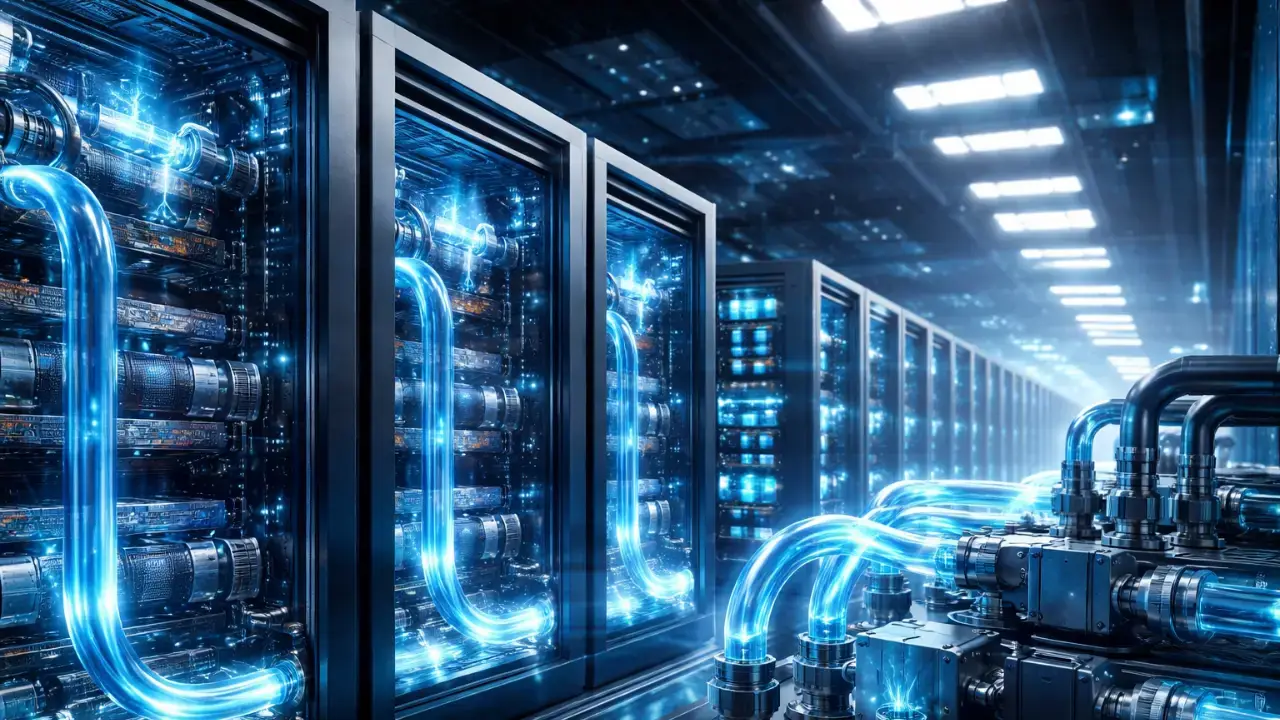
China AI Liquid Cooling Push Signals Infrastructure Reset
China’s artificial intelligence expansion has entered a new phase, one defined less by algorithms and more by thermodynamics. As computing density rises across next-generation data centers, cooling has shifted from a supporting function to a strategic constraint. Consequently, liquid cooling now sits at the center of China’s effort to reconcile AI ambition with energy discipline. This emerging tension defines what many now describe as the China AI liquid cooling energy crunch, where compute expansion and energy discipline collide at infrastructure scale.

Chinese companies are accelerating investments in liquid cooling technologies as demand for AI-driven infrastructure intensifies. Several listed firms have announced plans to expand or adopt liquid-based systems. Meanwhile, Shenzhen-based Envicool has seen its stock more than triple over the past year. Analysts from Goldman Sachs and UBS have raised their price targets, signaling growing institutional conviction around the segment.
However, the surge reflects more than investor optimism. It underscores a structural shift in how China views energy-intensive computing infrastructure. AI clusters demand higher power densities, and traditional air-based systems increasingly struggle to dissipate the resulting heat efficiently. As a result, liquid cooling has evolved from a niche optimization tool into a strategic lever. The question now becomes broader: Can liquid cooling meaningfully ease China’s AI energy crunch or does it simply buy time in a system under mounting pressure?
AI Expansion Meets Energy Discipline
China is building large-scale computing clusters at a rapid pace. Government policies actively promote energy-efficient data centers while aligning with green development objectives. In parallel, AI workloads continue to scale in both training and inference complexity.

This convergence produces a paradox. On one hand, AI strengthens national competitiveness. On the other, it intensifies power consumption at a moment when grid resilience and sustainability carry heightened priority. Cooling sits at the intersection of these forces. High-density AI servers generate significantly more heat than traditional enterprise workloads. Therefore, cooling efficiency directly influences power usage effectiveness, operational expenditure, and grid load.
Liquid cooling addresses this challenge through thermodynamic advantage. Fluids transfer heat more efficiently than air. Consequently, operators can reduce energy spent on mechanical chillers and air handling. In high-density environments, this efficiency gain becomes increasingly material. According to estimates from UBS, the global liquid-cooling market could reach $31 billion by 2030, expanding at roughly 51% annually. Such projections reflect both technological adoption curves and policy alignment across major computing markets. Yet cooling alone cannot resolve the structural tension between AI expansion and energy supply. Instead, it recalibrates the efficiency baseline.
Beyond Efficiency: Strategic Value Creation
China’s current pivot toward liquid cooling signals more than incremental improvement. It reframes data centers as integrated energy assets rather than passive power consumers.
Liquid systems enable higher rack densities without proportionally increasing facility footprints. Therefore, operators can extract more compute output per square meter. Additionally, liquid cooling creates pathways for heat reuse strategies, particularly in urban clusters where district heating integration becomes feasible. This dynamic aligns with national green development goals. Rather than viewing cooling as operational overhead, policymakers increasingly regard it as infrastructure optimization.
Moreover, the rise of companies such as Envicool highlights a domestic innovation ecosystem forming around thermal management. Investors appear to interpret this as a durable industrial theme, not a temporary AI trade. However, sustainability narratives must remain grounded in system-level thinking. Even the most efficient cooling architecture cannot offset exponential compute growth indefinitely. If AI demand accelerates faster than efficiency gains, total energy consumption may still rise. The more strategic framing centers on balance: liquid cooling reduces marginal energy intensity, while policy frameworks shape aggregate demand.
Policy, Capital and Market Signals
Government backing plays a critical role in China’s infrastructure trajectory. Policymakers have encouraged energy-efficient data center development, particularly in regions positioned for renewable integration and grid stability. Liquid cooling complements this framework. By lowering cooling-related electricity demand, operators can improve compliance with efficiency benchmarks. Consequently, financial markets respond to companies aligned with this direction.
The price target revisions from Goldman Sachs and UBS illustrate how capital markets increasingly evaluate cooling technology as strategic infrastructure, not peripheral hardware. This trend does not suggest competition between companies or cooling methods. Rather, it reflects portfolio diversification within a maturing ecosystem. Air cooling will continue serving certain workloads effectively. Hybrid architectures will likely dominate transitional phases. Nevertheless, AI clusters with extreme power densities increasingly favor liquid-based approaches. Thus, capital allocation patterns reinforce technological evolution rather than disrupt it.
The Thermodynamic Reality of AI Scale
The physics of AI cannot be negotiated. Higher computational intensity produces higher heat flux. As model sizes expand and inference scales across industries, heat management grows more complex. Liquid cooling mitigates localized thermal constraints. It allows chips and accelerators to operate within optimal temperature ranges. Therefore, performance stability improves under sustained load. Facility operators gain greater predictability in energy modeling. In a grid-sensitive environment, predictability carries strategic value.
However, liquid cooling introduces operational considerations. It requires revised maintenance protocols, material compatibility assurance, and workforce training. Consequently, adoption depends not only on capital expenditure but also on ecosystem readiness.
China’s rapid industrial coordination may accelerate this readiness. Domestic supply chains, engineering expertise, and policy clarity collectively reduce friction in deployment. Still, the long-term equation extends beyond hardware. Energy generation mix, transmission capacity, and demand management ultimately determine whether AI expansion remains sustainable.
Cooling as a Bridge, Not a Silver Bullet
Liquid cooling offers a meaningful efficiency bridge in China’s AI buildout. It reduces thermal bottlenecks, improves energy utilization, and aligns with green development frameworks. Furthermore, it attracts institutional capital that supports domestic innovation. Yet it does not eliminate the underlying tension between exponential compute demand and finite energy resources.
Therefore, the strategic value of liquid cooling lies in moderation rather than resolution. It buys time for grid upgrades, renewable integration, and workload optimization strategies to mature. It enables policymakers and operators to sustain AI momentum without immediate infrastructure shock. In this sense, cooling becomes part of a broader systems recalibration. AI growth continues. Energy discipline strengthens. Infrastructure evolves accordingly.
A Structural Inflection Point
China’s acceleration into liquid cooling marks a structural inflection point in digital infrastructure design. As AI reshapes industrial priorities, thermodynamics increasingly shapes capital allocation.
The sector’s trajectory suggests that cooling will remain central to compute strategy rather than peripheral engineering detail. Companies positioned within this value chain may benefit from sustained policy alignment and technological demand.
Nevertheless, sustainability will depend on integration across the entire stack from chip architecture to facility design to grid modernization. Liquid cooling can help solve parts of China’s AI energy crunch. It cannot solve all of it. However, it represents a pragmatic and strategic step toward balancing ambition with efficiency. In the evolving AI era, that balance may prove more decisive than any single breakthrough.











