 Skip to content
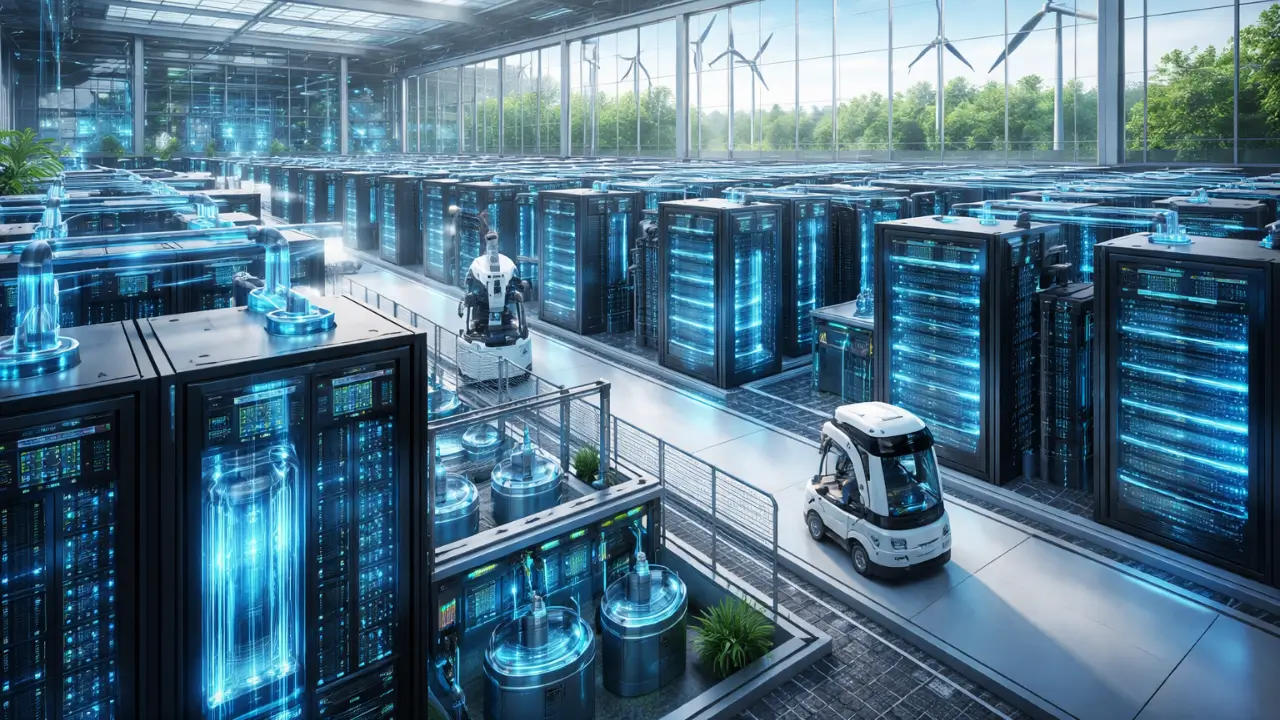
The data center of 2035 will not resemble the rigid, manually supervised facilities that defined the early cloud era, because intelligence is moving from the application layer into the infrastructure itself. Operators no longer view facilities as passive enclosures for servers, since artificial intelligence now shapes how power flows, how heat dissipates, and how workloads migrate across continents. Digital campuses increasingly behave like coordinated systems rather than isolated buildings, reflecting a broader shift toward infrastructure autonomy. Meanwhile, hyperscale expansion and AI-native workloads demand architectural rethinking at every layer of design. Engineers therefore treat facilities as dynamic ecosystems capable of sensing, adapting, and learning in real time. The next decade of data center architecture will establish a blueprint for infrastructure that thinks before it reacts and evolves before it fails.
Many of the capabilities discussed in this article are already emerging in limited deployments across hyperscale and enterprise environments. Their convergence at scale remains developmental, and timelines will vary by region, regulatory landscape, and capital strategy. The 2035 horizon therefore represents a directional model rather than a guaranteed industry state. Infrastructure maturity will continue to depend on technical feasibility, economic alignment, and environmental policy frameworks.

AI-Orchestrated Infrastructure: The Brain of the Facility
Artificial intelligence is increasingly being deployed as a coordination layer within advanced data center environments, particularly in facilities supporting AI-intensive workloads. Rather than replacing existing control systems outright, AI platforms are augmenting infrastructure management by analyzing telemetry streams across cooling, power, and compute domains. In certain deployments, these systems assist with predictive workload placement by evaluating thermal headroom, latency sensitivity, and available capacity. Operators retain governance oversight, yet AI-driven analytics help identify optimization opportunities that may not be immediately visible through manual monitoring alone. This progression reflects an incremental integration of intelligence into facility operations rather than a wholesale automation shift. Consequently, the concept of a 2035-ready data center architecture represents a directional model where AI coordination expands alongside operational maturity.
Thermal optimization strategies increasingly incorporate machine learning tools capable of interpreting environmental variability in real time. These systems analyze inlet temperatures, coolant flow behavior, humidity levels, and equipment density patterns to recommend adjustments. In some facilities, automated control loops can implement predefined changes under established safety parameters. However, such automation typically operates within boundaries set by engineering teams to maintain reliability standards. Instead of eliminating human supervision, AI supports faster interpretation of complex environmental interactions. This measured integration improves efficiency while preserving operational accountability.
Power management is also experiencing gradual integration of AI-assisted forecasting. Electrical infrastructure platforms can analyze historical load curves, battery performance indicators, and transformer behavior to support planning decisions. In environments where dynamic load balancing is permitted by design, AI tools may assist in redistributing power within defined electrical hierarchies. Nonetheless, safety compliance and regulatory constraints continue to shape how extensively automation can intervene. Facilities therefore adopt AI-enhanced power optimization selectively rather than universally. This cautious progression ensures that innovation does not outpace resilience safeguards.
Self-learning systems remain in developmental stages across most deployments. While machine learning models can refine predictions based on accumulated data, they typically operate within supervised frameworks. Continuous improvement processes require validation cycles and human review before structural changes occur. Infrastructure evolution thus reflects collaboration between analytics engines and engineering oversight. The long-term vision of AI-orchestrated facilities depends on sustained technological refinement and regulatory alignment. For this reason, the architectural horizon toward 2035 should be viewed as progressive maturation rather than guaranteed automation dominance.
Autonomous Operations and Self-Healing Systems
Modern facilities are progressively incorporating predictive monitoring systems designed to identify irregularities earlier in the equipment failure lifecycle. Advanced analytics platforms evaluate vibration signatures, thermal drift, and electrical fluctuation patterns to flag emerging concerns. In many cases, these systems generate prioritized alerts that guide engineering teams toward preventative action. Some deployments enable predefined corrective responses under controlled governance policies. However, complete operational autonomy remains limited by risk tolerance frameworks and compliance requirements. Therefore, autonomous operations in practice often represent structured automation within carefully managed boundaries.

Digital twins have become valuable planning and validation tools in complex environments. These virtual models replicate airflow dynamics, energy distribution behavior, and spatial configuration scenarios based on live telemetry inputs. Engineers use digital twins to simulate infrastructure adjustments before implementing them physically. This simulation-based validation reduces uncertainty during expansion or modification phases. While digital twins enhance foresight, they function as decision-support systems rather than independent controllers. Their effectiveness depends on accurate data integration and ongoing calibration.
Fault isolation strategies are gradually incorporating automated segmentation capabilities. In certain architectures, intelligent controls can isolate localized electrical or mechanical disturbances without affecting broader operations. Workload reconfiguration may occur through orchestration layers that shift computational demand away from affected nodes. Nonetheless, such actions typically occur within predefined resilience frameworks designed by engineers. Oversight remains integral to ensure corrective measures align with service commitments. Thus, self-healing infrastructure should be understood as automation-supported resilience rather than full autonomy.
Operational staffing models are evolving accordingly. Engineers increasingly focus on validation, governance, and strategic optimization while automation handles repetitive monitoring tasks. AI-enhanced dashboards synthesize telemetry into contextualized insights, improving situational awareness. Human expertise remains essential for interpreting complex anomalies and guiding architectural evolution. The long-term trajectory suggests greater automation support, yet accountability structures continue to anchor operational control. This balance defines responsible advancement toward 2035.
Robotics in the Data Hall
Robotic systems are beginning to augment operational workflows in select high-density data center environments. These systems primarily support inspection routines, environmental scanning, and limited maintenance assistance. Equipped with sensors and computer vision capabilities, mobile platforms can navigate structured aisles and collect telemetry from areas that require frequent monitoring. Their deployment reduces repetitive exposure of personnel to high-power zones without eliminating human oversight. In most cases, robotics function as supplementary tools integrated into broader asset management platforms. Adoption remains uneven across the industry, reflecting varying risk tolerance and capital priorities.
Cable management and visual inspection tasks represent early-stage robotic applications. Vision-enabled units can scan structured cabling layouts to identify irregular routing or physical damage indicators. These capabilities enhance documentation accuracy and airflow integrity in dense configurations. However, corrective intervention typically requires human authorization and supervision. Robotics therefore contribute to data collection and early anomaly detection rather than autonomous infrastructure modification. This incremental integration supports operational consistency while preserving manual control where necessary.
Hardware handling automation is also under limited exploration in advanced facilities. Robotic arms calibrated for precision may assist with component insertion or extraction in controlled testing environments. Widespread deployment, however, depends on standardization of rack configurations and compatibility frameworks. High-density AI racks introduce complexity that may constrain fully automated replacement processes. Consequently, robotics in the data hall should be viewed as an evolving augmentation strategy rather than a near-term universal solution. Their maturation will depend on engineering interoperability and operational economics.
Liquid-First Cooling Architectures
Cooling philosophy within next-generation facilities increasingly prioritizes liquid as the primary thermal transport medium rather than an auxiliary enhancement. AI accelerators and high-density processors generate concentrated heat loads that exceed the efficient limits of air-based systems. Direct-to-chip liquid cooling channels coolant directly across heat-generating surfaces, reducing thermal resistance at the source. Immersion systems submerge hardware in dielectric fluids, enabling uniform heat extraction without reliance on forced airflow. Instead of retrofitting legacy halls with incremental solutions, architects now design structural layouts around liquid distribution pathways. Consequently, the 2035-ready data center architecture treats liquid cooling as foundational infrastructure rather than optional adaptation.
Closed-loop ecosystems further enhance efficiency by recirculating coolant without continuous reliance on external water supply. Facilities integrate heat exchangers that transfer thermal energy to secondary loops, which then dissipate or repurpose heat externally. This architecture reduces water dependency while maintaining consistent thermal performance across variable load conditions. Engineers design piping networks with redundancy and leak detection systems to preserve reliability standards. Instead of isolating cooling as a mechanical subsystem, planners embed it within structural and electrical design frameworks. Thus, thermal management becomes an integrated architectural discipline within 2035-ready facilities.
Immersion Systems and Structural Integration
Immersion cooling introduces structural considerations that influence building layout and rack configuration. Tanks containing dielectric fluids require reinforced flooring, modular containment boundaries, and spill management protocols. Architects align structural load calculations with fluid weight distribution to ensure operational stability. Instead of stacking conventional racks within raised floors, designers allocate zones optimized for immersion clusters and service corridors. These architectural adjustments reflect the growing dominance of AI workloads that benefit from consistent thermal equilibrium. Therefore, immersion systems reshape spatial planning rather than occupying residual space within legacy halls.
Direct-to-chip systems also demand integration with facility-wide monitoring networks. Coolant distribution units regulate flow rates according to processor activity levels measured by orchestration platforms. Instead of fixed pump speeds, AI engines adjust circulation dynamically to match computational intensity. This coordination ensures thermal precision without excessive mechanical strain. Additionally, liquid-first systems reduce fan dependency, lowering vibration and acoustic load within halls. Consequently, thermal infrastructure aligns closely with AI orchestration strategies governing compute placement.
Liquid-dominant designs further support energy reuse initiatives by delivering higher-grade waste heat suitable for external applications. Because liquid systems capture concentrated thermal output, facilities can channel heat toward district networks or industrial processes with minimal loss. Engineers integrate heat exchangers directly into coolant return loops to simplify reuse pathways. Rather than dissipating heat as byproduct exhaust, operators treat thermal output as a resource stream. This philosophy strengthens sustainability strategies embedded in 2035-ready data center architecture.
Carbon-Negative Campus Design
Sustainability ambitions within advanced data center development increasingly extend beyond energy efficiency toward broader carbon impact reduction. Some operators are exploring campus models that aim to approach carbon-neutral or, in limited cases, net-negative performance through integrated renewable sourcing and energy reuse strategies. Achieving such outcomes depends heavily on regional grid composition, lifecycle accounting methodologies, and regulatory verification standards. While fully carbon-negative facilities remain uncommon, the direction of travel reflects growing environmental accountability. Developers are therefore evaluating renewable integration, storage capacity, and material selection during early planning phases. These efforts indicate a progressive shift rather than an industry-wide transformation.
Renewable energy ecosystems are gradually becoming more integrated into campus infrastructure. On-site generation assets, power purchase agreements, and battery storage systems can coordinate with load forecasting platforms to improve clean energy utilization. However, renewable intermittency and transmission constraints continue to influence practical feasibility. Facilities typically maintain grid connectivity to preserve reliability standards. As a result, renewable integration strategies complement rather than replace conventional infrastructure. The evolution toward deeper sustainability remains contingent on economic and regulatory conditions.
Construction materials also factor into carbon impact assessments. Developers increasingly evaluate embodied carbon within structural components and prefabricated modules. Alternative cement blends, recycled steel, and modular construction techniques help reduce lifecycle emissions. Nevertheless, supply chain transparency and reporting standards vary by region. Carbon-negative positioning therefore requires rigorous verification and documentation frameworks. These complexities underscore the need for cautious framing when discussing regenerative campus models.
AI-Aware Power Ecosystems
Electrical infrastructure is gradually incorporating AI-assisted analytics to support planning and load management in environments characterized by variable AI workloads. Rather than redefining power architecture entirely, these systems enhance visibility into consumption patterns and equipment performance. Predictive models can forecast load transitions based on compute telemetry, enabling engineers to adjust distribution strategies proactively. Implementation depth varies depending on facility design and regulatory allowances. Automation typically operates within safety-certified parameters established by electrical standards. This measured adoption reflects a balance between innovation and operational conservatism.
Microgrid participation is expanding in some regions where regulatory frameworks permit structured integration. Facilities equipped with on-site generation and storage may engage in grid-responsive programs under defined reliability commitments. AI-enhanced analytics can optimize battery dispatch sequences while maintaining mission-critical uptime. However, participation models differ widely across jurisdictions. Grid integration therefore remains context-dependent rather than universal. The evolution of AI-aware power ecosystems will depend on policy harmonization and technological refinement.
Energy storage optimization increasingly leverages predictive analytics to extend asset lifespan and improve performance forecasting. Machine learning models can analyze cycle depth patterns and temperature behavior to inform maintenance schedules. Nonetheless, final dispatch decisions often require human validation to align with resilience planning. Power infrastructure continues to prioritize redundancy and compliance above experimental automation. As a result, AI-enhanced power systems represent incremental advancement rather than disruptive overhaul.
Modular, Scalable, and Adaptive Construction
Architectural philosophy increasingly prioritizes modularity to accommodate unpredictable growth trajectories in AI workloads. Developers assemble prefabricated infrastructure blocks that integrate power, cooling, and network components into transportable units. Instead of constructing monolithic halls with rigid layouts, planners deploy scalable modules that expand incrementally. These prefabricated systems reduce on-site disruption and accelerate commissioning timelines. Engineers standardize mechanical and electrical interfaces to ensure interoperability between modules. Consequently, the 2035-ready data center architecture supports expansion without compromising structural coherence.
Plug-and-play power pods exemplify this modular strategy by encapsulating switchgear, transformers, and monitoring systems within factory-built enclosures. Facilities connect these pods to main distribution backbones using predefined integration protocols. Rather than redesigning electrical systems for every expansion phase, operators replicate standardized modules. This repeatability improves quality control and simplifies regulatory compliance. AI orchestration layers recognize new modules automatically and incorporate them into operational models. Therefore, scalability becomes systematic rather than improvisational.
Flexible Cooling Blocks and Evolutionary Architecture
Cooling infrastructure also benefits from modular configuration, particularly as liquid-first strategies gain dominance. Designers create scalable cooling blocks that include coolant distribution units, heat exchangers, and monitoring sensors within self-contained frameworks. Instead of extending complex piping networks manually during expansions, operators connect standardized cooling modules. AI systems update thermal models immediately to account for new capacity. This agility ensures that expansion aligns with performance and sustainability objectives. Thus, adaptive cooling design reinforces long-term architectural flexibility.
Evolutionary architecture requires planning for change rather than assuming static capacity over decades. Developers design floor loading, cable pathways, and structural spans to accommodate future density increases. Instead of treating expansion as disruption, architects anticipate transformation within the initial blueprint. Digital twins simulate phased growth scenarios to validate infrastructure resilience before physical deployment. This foresight reduces retrofitting complexity and protects capital investment. Consequently, modular construction becomes an enabler of continuous architectural evolution.
Prefabrication further supports sustainability objectives by minimizing material waste and improving fabrication precision. Factory environments enable standardized quality checks and optimized resource utilization. Instead of transporting excess materials to job sites, developers rely on measured assembly processes. Modularization also reduces construction timelines, which lowers indirect environmental impact. These benefits align construction methodology with broader carbon-negative ambitions. Therefore, modularity serves both operational scalability and environmental responsibility within 2035-ready facilities.
Climate-Resilient Structural Engineering
Extreme weather patterns increasingly influence site selection and structural design decisions for digital campuses. Facilities must withstand floods, heatwaves, seismic events, and severe storms without compromising service continuity. Engineers conduct environmental risk assessments during early planning phases to inform foundation depth, elevation, and material selection. Instead of relying solely on historical climate data, planners incorporate forward-looking projections into resilience modeling. Structural frameworks therefore reflect both present conditions and anticipated environmental shifts. The 2035-ready data center architecture treats resilience as an integral design parameter rather than an afterthought.
Flood mitigation strategies often include elevated equipment platforms, reinforced drainage systems, and perimeter water barriers. Facilities located in vulnerable zones raise critical infrastructure above projected flood lines. Instead of concentrating mechanical rooms at ground level, architects distribute sensitive systems vertically for added protection. Engineers integrate sensor networks that detect moisture intrusion and trigger containment responses instantly. This layered defense approach minimizes disruption even during severe weather events. Consequently, structural resilience aligns with autonomous operational philosophies described earlier.
Heat-Resilient Materials and Seismic Preparedness
Heat-resilient materials play a central role in maintaining structural integrity under rising ambient temperatures. Architects select cladding systems and roofing materials designed to reflect solar radiation and reduce thermal absorption. Instead of relying exclusively on mechanical cooling to offset environmental heat, buildings incorporate passive mitigation strategies. Reinforced insulation and advanced glazing improve thermal stability across seasons. These design choices protect internal systems from external volatility. Thus, material science becomes a strategic partner in resilience planning.
Seismic-ready frameworks also define structural priorities in regions prone to tectonic activity. Engineers design flexible support systems and shock-absorbing mounts that protect racks and cooling equipment during ground movement. Rather than anchoring hardware rigidly, planners incorporate vibration-tolerant assemblies that preserve alignment. Facilities test these frameworks through simulation before commissioning. Digital twins further validate performance under modeled stress conditions. Through these measures, structural engineering anticipates instability rather than reacting to it.
Elevated infrastructure planning integrates resilience across all environmental dimensions. Developers assess wind load patterns, regional fire risk, and water scarcity during architectural conception. Instead of retrofitting safeguards after incidents, facilities embed adaptive design into foundational stages. This proactive approach complements AI-driven operational autonomy. Over time, climate-resilient engineering ensures that digital campuses remain stable even as environmental variability intensifies. Therefore, resilience becomes a defining attribute of 2035-ready data center architecture.
Intelligent Heat Reuse and Thermal Economies
Heat recovery initiatives are gaining attention in regions where district energy infrastructure supports structured integration. Facilities equipped with liquid cooling systems can capture higher-grade thermal output suitable for redistribution. In select cases, operators have established partnerships with municipal heating networks or adjacent industrial facilities. These arrangements depend on geographic proximity, regulatory alignment, and seasonal demand stability. Not all regions possess compatible infrastructure for heat exchange. Therefore, intelligent heat reuse should be considered a regionally viable strategy rather than a universal practice.
Industrial reuse models are similarly context-sensitive. Agricultural, aquaculture, or manufacturing partners may utilize recovered heat under structured agreements. Such collaborations require careful synchronization between compute intensity and thermal demand patterns. AI-assisted monitoring can support this coordination by stabilizing exchange parameters. Nevertheless, operational risk assessments guide deployment decisions. The scalability of thermal economies remains linked to urban planning frameworks and infrastructure investment.
Zero-Touch Physical Security and Smart Perimeters
Physical security frameworks are progressively incorporating higher degrees of automation through biometric authentication and AI-assisted surveillance. Rather than eliminating manual oversight, these systems streamline identity verification and anomaly detection workflows. Access control platforms can integrate facial recognition or multi-factor validation under established privacy regulations. Computer vision analytics enhance situational awareness across perimeters and interior zones. However, final response authority remains governed by security personnel and compliance policies. Automation therefore functions as augmentation rather than replacement of established protocols.
Predictive analytics tools are also being applied to security datasets to identify irregular access patterns. By analyzing historical logs and contextual variables, systems can flag deviations for further review. This capability supports proactive risk assessment while preserving audit transparency. Integration with broader facility management platforms enhances coordination during incidents. Nonetheless, ethical and regulatory considerations shape deployment boundaries. As a result, security automation evolves within strict governance frameworks.
Human-AI Collaborative Operations Centers
Despite the rise of autonomous systems, human expertise remains central to governance and strategic oversight within advanced facilities. Operations centers evolve into AI-augmented command hubs where analysts interpret predictive dashboards rather than react to alarms. Augmented reality overlays display thermal maps, power distribution pathways, and maintenance histories directly within immersive interfaces. Instead of scanning fragmented data streams, engineers access synthesized insights generated by orchestration engines. This shift enables faster scenario analysis and informed decision-making. Therefore, collaboration between human judgment and machine intelligence defines the operational culture of 2035-ready data center architecture.
Predictive dashboards consolidate telemetry from cooling systems, power infrastructure, robotics, and security networks into unified visual frameworks. AI platforms prioritize anomalies based on potential impact rather than chronological occurrence. Instead of overwhelming operators with redundant alerts, systems highlight strategic risks that require human validation. This prioritization enhances clarity during complex operational scenarios. Engineers maintain authority over critical decisions while automation manages routine stabilization tasks. Consequently, operations centers transition from reactive monitoring rooms to strategic intelligence environments.
Augmented Reality and Oversight of Autonomous Systems
Augmented reality interfaces enhance situational awareness by overlaying digital models onto physical infrastructure. Technicians equipped with AR headsets visualize airflow dynamics, electrical pathways, and component histories while standing within data halls. Instead of consulting separate manuals or screens, personnel access contextual information instantly. This capability accelerates troubleshooting and improves training efficiency. AI systems update AR overlays in real time based on telemetry inputs. Thus, physical and digital environments converge within collaborative operations frameworks.
Oversight mechanisms ensure that autonomous systems remain accountable and transparent. Governance protocols require AI orchestration engines to log decision pathways and corrective actions comprehensively. Instead of delegating authority blindly, operators review algorithmic recommendations through structured validation processes. Ethical guidelines and compliance frameworks shape how automation interacts with critical infrastructure. This layered oversight maintains trust between human teams and machine intelligence. Therefore, collaboration replaces control as the defining principle of advanced operations centers.
Training programs also adapt to reflect this evolving partnership. Engineers develop competencies in data analytics, AI validation, and systems modeling alongside traditional mechanical expertise. Instead of narrowing specialization, professional development broadens to encompass interdisciplinary fluency. This skill diversification ensures that human teams guide long-term architectural evolution responsibly. As automation expands, human oversight becomes more strategic and less procedural. Consequently, collaborative command hubs reinforce the adaptive intelligence of the 2035-ready data center architecture.
Sustainable Materials and Circular Hardware Lifecycle
Circular design principles increasingly shape procurement, construction, and hardware lifecycle strategies across digital campuses. Manufacturers design servers and components with modular replaceability to facilitate refurbishment rather than disposal. Instead of discarding entire units when individual parts fail, operators swap modules efficiently. Supply chain transparency enables tracking of material origin and recyclability metrics. AI platforms forecast component degradation to optimize reuse cycles. Consequently, sustainability extends beyond energy management into material stewardship.
Low-impact construction materials reduce embodied carbon within facility frameworks. Developers select recycled steel, alternative cement blends, and responsibly sourced insulation products during procurement. Instead of defaulting to conventional materials, architects evaluate environmental performance across lifecycle stages. Modular prefabrication minimizes waste and improves quality assurance. These choices align structural development with carbon-negative campus objectives. Therefore, sustainable materials underpin the long-term integrity of 2035-ready data center architecture.
Recyclable Components and End-of-Life Reintegration
Recyclable server components support reintegration into supply chains at the end of operational life. Vendors design chassis, boards, and cooling assemblies for disassembly and material recovery. Instead of relegating obsolete equipment to landfill, operators partner with certified recycling programs. AI-driven asset tracking ensures transparency across disposal processes. This accountability reinforces regulatory compliance and stakeholder confidence. As a result, hardware lifecycle management becomes an active sustainability strategy rather than an afterthought.
End-of-life reintegration strategies increasingly involve refurbishment markets and secondary deployment pathways. Operators evaluate residual performance capacity before decommissioning assets permanently. Instead of treating older hardware as waste, organizations redirect equipment to lower-intensity workloads or emerging markets. Circular procurement contracts encourage manufacturers to reclaim materials for future production cycles. This closed-loop approach reduces resource extraction pressure while maintaining operational standards. Hence, circular hardware lifecycle planning strengthens environmental resilience within advanced campuses.
Lifecycle analytics platforms consolidate sustainability data alongside performance metrics to guide procurement decisions. Engineers evaluate not only compute capacity but also recyclability and embodied impact during selection. Instead of separating environmental and operational criteria, decision-makers integrate them within unified frameworks. AI orchestration platforms incorporate these parameters into long-term infrastructure planning. Through this integration, sustainability becomes inseparable from performance optimization. Therefore, circular principles complete the architectural transformation toward regenerative infrastructure.
The 2035 Data Center as a Living, Adaptive Ecosystem
By 2035, data center architecture may increasingly reflect an adaptive ecosystem shaped by incremental integration of AI-assisted orchestration, modular construction, resilient engineering, and sustainability frameworks. The convergence of these capabilities will depend on technological advancement, economic feasibility, and regulatory evolution across regions. While elements of this transformation are already visible in partial deployments, full-scale maturity will vary by market and operational model. Infrastructure design is progressively incorporating predictive analytics, flexible power systems, and circular material strategies without abandoning foundational reliability principles. Human oversight continues to anchor accountability even as automation expands its analytical reach. In this context, the 2035-ready data center architecture represents a strategic direction informed by present momentum rather than a predetermined industry outcome.












