
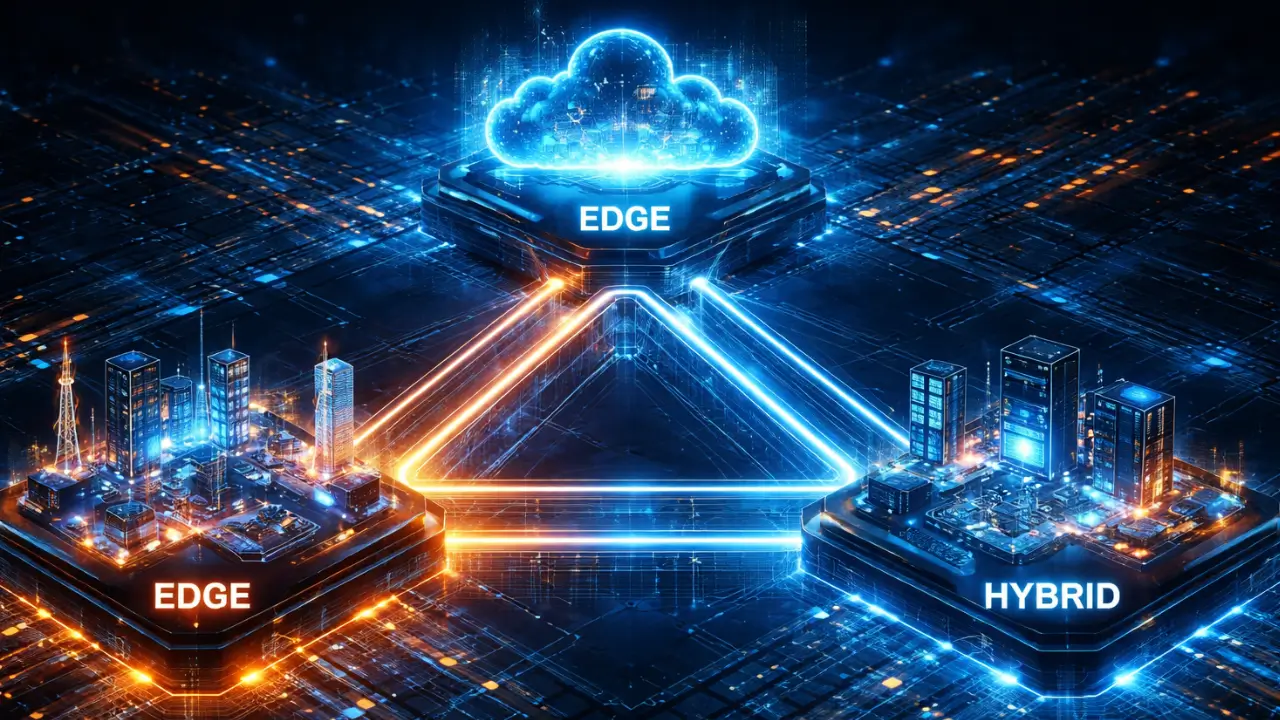
A hyperscale campus powers up in one region while a micro-edge cluster activates inside a dense urban exchange across the globe, illustrating how edge cloud hybrid infrastructure strategy now shapes digital deployment at scale. Fiber routes light up between facilities that never share a skyline yet operate as one coordinated fabric. Investors analyze capacity maps while operators tune latency corridors and interconnection density. Meanwhile, platform providers refine orchestration layers that stretch from centralized cloud regions to distributed edge environments. The industry narrative no longer frames edge and cloud as competing build philosophies. Instead, the infrastructure market now functions within a three-way balance that blends scale, proximity, and integration into a unified compute fabric.

This movement reshapes how facilities interconnect and how capital deploys across regions. Hyperscale campuses anchor large-scale processing clusters, yet they depend on distributed nodes to support latency-sensitive workloads. Metro data centers evolve into aggregation hubs where traffic concentrates before routing to centralized compute zones. Meanwhile, interconnection fabrics stitch these environments into continuous corridors of data mobility. The power triangle of edge, cloud, and hybrid now functions as an operational continuum embedded within global infrastructure markets.
Workload Placement Becomes a Strategic Infrastructure Lever
Workload geography now acts as a capital allocation signal across hyperscale and colocation markets. AI training clusters concentrate in regions with high-capacity transmission access, scalable substation infrastructure, and favorable land aggregation patterns, reflecting documented hyperscale expansion strategies. In contrast, inference and latency-sensitive deployments gravitate toward metro-adjacent facilities where fiber density and carrier neutrality support deterministic routing. Market data consistently shows hyperscale growth correlating with power availability and interconnection ecosystems rather than corporate IT restructuring cycles. Developers therefore evaluate transmission corridors, renewable procurement options, and network topology before committing to new campus builds. Infrastructure deployment follows compute demand physics, not internal enterprise governance processes.
Interconnection density reinforces these placement decisions across regions. Metro facilities that support inference clusters require low-latency fiber routes into backbone networks connected to centralized training campuses. Subsea cable landings and long-haul fiber corridors increasingly influence site attractiveness, particularly in AI-driven markets. Carrier-neutral exchanges serve as aggregation points where distributed workloads transition between proximity-based processing and hyperscale compute layers. Power provisioning models differ accordingly, with centralized campuses designed for high-density GPU clusters while metro-edge nodes optimize for lower-density yet latency-critical workloads. As a result, workload placement directly shapes facility design, network routing strategy, and energy procurement frameworks across the digital infrastructure economy.

The Cloud Is Expanding — Not Replacing
As workloads distribute, hyperscale cloud platforms continue to expand without absorbing every compute layer. New regions launch alongside enhanced interconnection options that extend cloud adjacency into third-party facilities. Rather than centralizing all processing, cloud providers integrate with edge clusters through hybrid connectivity frameworks. This expansion strategy preserves the scalability of hyperscale environments while enabling proximity-based deployment models. Cloud regions operate as gravitational centers that coordinate distributed activity rather than displace it. The infrastructure market reflects growth through federation instead of consolidation.
This integration becomes visible in physical design choices. Colocation campuses now allocate dedicated halls for cloud on-ramps and direct interconnection suites. Edge facilities host modular deployments that align with cloud-native orchestration frameworks. Backbone networks synchronize traffic between centralized and localized compute tiers without manual routing adjustments. Platform operators extend management planes across these layers to maintain visibility and policy consistency. Through coordinated integration, cloud ecosystems reinforce distributed infrastructure instead of competing against it.
Edge as an Experience Engine
When that AI request reaches the metro, localized infrastructure assumes control. Edge nodes process time-sensitive transactions close to end users, reducing the distance data must travel before response. Financial platforms leverage proximity to exchanges to sustain deterministic transaction timing. Content delivery networks cache high-demand assets within urban facilities to stabilize streaming performance. AI inference clusters positioned near population centers respond to interactive applications with minimal latency. In each scenario, edge facilities operate as experience engines embedded within broader compute fabrics.
Yet these nodes rarely function alone. After completing immediate processing tasks, they transmit aggregated or contextual data back to centralized clusters for deeper analysis. Secure backbone connectivity ensures continuity between localized and hyperscale environments. Power provisioning strategies differ across these sites, reflecting lower-density inference loads compared to centralized training clusters. Remote management platforms maintain uniform configuration standards across distributed nodes. Therefore, edge capacity complements centralized compute by extending responsiveness without fragmenting governance.
Hybrid Architecture as the Market Baseline
Hybrid architecture now reflects how modern campuses are physically designed rather than how IT teams structure software stacks. Developers increasingly integrate cloud-adjacent halls, high-density AI-ready suites, and flexible colocation modules within the same master plan. Hyperscale tenants require scalable power blocks capable of supporting accelerated compute loads, while adjacent interconnection suites facilitate traffic exchange with distributed environments. This blended design mirrors the documented growth of hybrid and multicloud deployments across global markets. Energy contracts, cooling infrastructure, and floor loading specifications now anticipate mixed-density deployment patterns from inception. Campus layouts therefore assume cross-traffic between centralized and distributed compute tiers as a structural norm.
Operational baselines also reflect this structural integration. Container orchestration platforms such as Kubernetes enable workload mobility across hyperscale regions and third-party facilities without requiring physical consolidation. Network overlays unify routing policies between cloud zones and metro-edge deployments, reinforcing distributed topology consistency. Observability platforms aggregate telemetry across environments to maintain infrastructure performance visibility. Security enforcement aligns through standardized identity and encryption frameworks across interconnected estates. Hybrid capability therefore functions as a facility-level and ecosystem-level baseline embedded in infrastructure markets rather than as a transitional enterprise IT phase.
Orchestrating Without Owning Every Node
Digital infrastructure growth increasingly depends on federated coordination rather than vertical consolidation. Hyperscalers extend into metro markets through telecom partnerships and localized edge deployments without directly owning every facility. Colocation providers host cloud on-ramps that integrate hyperscale backbones into carrier-dense campuses. Infrastructure funds allocate capital across complementary segments including interconnection hubs, fiber networks, and hyperscale campuses to capture ecosystem-wide value. Centralized control planes maintain visibility across these federated environments using API-driven integration models. Strategic influence therefore derives from integration density and traffic exchange capability rather than physical asset consolidation alone.
In mature distributed ecosystems, software-defined networking abstracts physical differences between sites to enable consistent routing policies. Where orchestration maturity allows, identity and encryption frameworks extend security governance across independently operated facilities. API-based provisioning supports dynamic capacity allocation between cloud regions and third-party edge environments. Cross-platform monitoring tools synchronize operational oversight without collapsing ownership boundaries. The coordination layer binds hyperscale, colocation, and carrier infrastructure into a unified compute fabric while preserving asset specialization.
Ecosystems Over Ownership
The workload’s journey reveals that no single operator controls the entire path. Hyperscale providers contribute centralized compute scale. Colocation operators supply interconnection-rich aggregation hubs. Carriers deliver fiber routes that bridge regions and metros. Renewable energy partners align generation capacity with compute clusters to stabilize supply. Collectively, these participants form infrastructure ecosystems defined by interdependence.
Capital allocation mirrors this interdependence. Investment vehicles diversify across hyperscale campuses, metro-edge facilities, and interconnection platforms. Debt structures incorporate long-term power contracts alongside cross-connect revenue streams. Portfolio strategies emphasize ecosystem positioning rather than isolated asset ownership. Market valuations increasingly reflect network density and traffic exchange potential. Infrastructure value now derives from participation within integrated corridors of compute and connectivity.
The Future Is Fluid Infrastructure
The infrastructure landscape now operates along a fluid spectrum that balances centralized scale with distributed proximity. Hyperscale regions anchor massive compute clusters while metro-edge nodes sustain localized service delivery. Interconnection fabrics bind these environments into unified traffic corridors across continents. Energy infrastructure aligns with this topology to sustain diversified density requirements across sites. Operators coordinate deployment models that adapt to workload characteristics without rigid segmentation. The power triangle of edge, cloud, and hybrid therefore functions as a dynamic equilibrium embedded within the global compute economy.











