
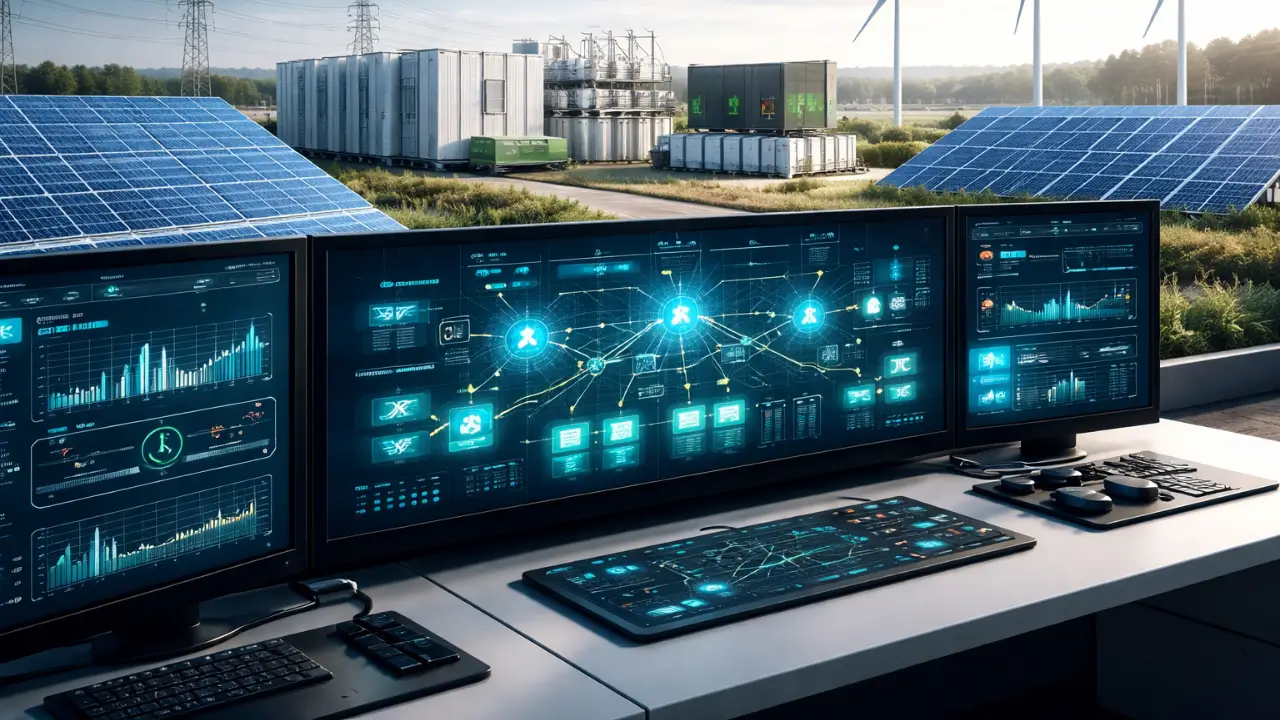
Critical infrastructure facilities now operate in an environment where energy continuity defines operational credibility and financial stability.Utilities once delivered predictable centralized supply, yet growing load volatility and climate-driven disruptions have challenged that model across industrial regions. Operators of data centers, healthcare campuses, and advanced manufacturing plants require energy architectures that respond dynamically rather than react defensively.
Microgrid frameworks have emerged as engineered systems that integrate distributed generation, storage, and advanced controls within a defined electrical boundary.Design teams increasingly treat these systems as operational infrastructure instead of contingency equipment, embedding intelligence into switching logic and dispatch coordination.This architectural shift reframes energy supply as a controllable asset that aligns reliability objectives with decarbonization mandates inside mission-critical environments.

Redefining Reliability in the Era of Distributed Power
Reliability once depended on centralized power plants, long transmission corridors, and layered backup generators positioned at facility edges.Grid disturbances exposed the fragility of that linear architecture when cascading faults traveled across interconnections before operators could intervene.Microgrid engineering restructures that dependency by relocating control authority closer to the load, where intelligent controllers analyze conditions continuously.
System designers embed sensors, protection schemes, and automated relays into a cohesive platform that anticipates anomalies before voltage instability propagates.Facility managers gain visibility across generation assets, storage reserves, and demand profiles through supervisory control layers integrated with building management systems.Reliability becomes an actively managed outcome shaped by predictive modeling and coordinated dispatch rather than a passive expectation of upstream supply continuity.Traditional backup strategies relied on diesel generators that remained idle until a grid outage triggered manual or semi-automatic startup sequences.
Those systems provided emergency power but offered limited optimization capability during normal operations because they lacked real-time coordination logic.Contemporary microgrid platforms transform standby equipment into synchronized resources that participate in daily load balancing and resilience planning. Controllers evaluate fuel availability, storage state of charge, and forecasted demand to determine dispatch priorities within milliseconds.Mission-critical facilities benefit from this orchestration because redundancy now integrates directly into operational workflows instead of remaining isolated in emergency silos.Reliability metrics thus reflect system intelligence and coordination depth rather than simple generator capacity or transfer switch speed.
Islanding Capabilities and Operational Autonomy
Islanding capability allows a facility to disconnect from the primary grid when disturbances threaten voltage stability or frequency tolerance.Protective relays monitor grid conditions and initiate separation sequences based on predefined thresholds embedded in control firmware. Synchronization modules maintain phase alignment between local generation and utility supply during normal operation to enable seamless transitions.Once separation occurs, the microgrid controller shifts into autonomous mode and regulates internal frequency using droop control or inverter-based balancing strategies.Facilities maintain uninterrupted operations because the transition logic coordinates breaker actions and generation ramp rates without human intervention.Operational autonomy emerges as a predictable function of engineered design rather than a reactive measure triggered by crisis conditions.
Seamless islanding requires robust communication pathways between protection devices, supervisory controllers, and distributed resources. Engineers configure redundant communication protocols to prevent single points of failure from undermining autonomy.Control algorithms calculate available spinning reserves before approving separation to ensure that local supply exceeds instantaneous demand. Voltage regulation modules coordinate reactive power flows to maintain stability across internal distribution feeders.Testing procedures validate islanding performance under simulated disturbances to confirm that protective sequences execute within design tolerances. Facilities that implement such structured validation processes achieve operational independence without sacrificing compliance or safety integrity.
Automated Switching and Real-Time Energy Orchestration
Advanced microgrid controllers enable automated switching among utility supply, on-site generation, and storage assets through continuous condition assessment.
Transfer operations occur without perceptible disruption because control logic coordinates breaker timing and ramp profiles precisely.Real-time data streams from smart meters and phasor measurement units inform dispatch algorithms that respond to load fluctuations instantly.
Predictive analytics modules evaluate weather forecasts and consumption trends to prepare generation assets ahead of expected demand shifts.
Energy orchestration therefore evolves into a proactive discipline that anticipates stress scenarios rather than reacting after imbalance manifests.
Automated switching systems reduce reliance on manual operator decisions during high-pressure events and preserve service continuity across mission-critical operations.

Digital twin environments simulate electrical behavior under varied operating conditions to refine control strategies before field deployment. Engineers model generator dynamics, inverter response curves, and storage discharge characteristics to calibrate switching thresholds.
AI-driven management layers analyze historical performance data to optimize dispatch sequences in alignment with operational goals.
Supervisory systems can incorporate externally available carbon intensity data streams where such signals are accessible, enabling operators to inform resource selection during routine operation in systems designed for carbon-aware optimization.Real-time orchestration aligns resilience with sustainability objectives because resource prioritization accounts for both stability and emissions considerations.Facilities leverage this integration to maintain performance benchmarks while advancing environmental commitments embedded in corporate governance frameworks.
Integrating Distributed Energy Resources into a Unified System
Distributed energy resources such as photovoltaic arrays, fuel cells, and battery storage systems require coordinated management to function cohesively.Inverter-based resources introduce dynamic response characteristics that differ from conventional rotating generators.
Control platforms harmonize these diverse assets by standardizing communication interfaces and establishing hierarchical dispatch authority.Engineers configure grid-forming inverters to provide voltage reference signals during islanded operation when synchronous machines remain offline.
Thermal systems integrate through combined heat and power configurations that convert fuel input into both electricity and usable heat streams.Unified coordination ensures that each resource contributes to stability margins while supporting facility uptime requirements. Interoperability challenges arise when equipment vendors apply proprietary communication standards within control firmware. System integrators address this complexity by adopting open protocols that enable secure data exchange across heterogeneous platforms.
Cybersecurity frameworks protect distributed assets from unauthorized access while preserving operational transparency.Storage management algorithms coordinate charging and discharging cycles to maintain reserve margins for contingency events.Solar production forecasts feed into dispatch planning to balance intermittent output with firm generation capacity.Integrated architecture transforms discrete assets into a synchronized energy ecosystem capable of supporting continuous mission-critical workloads.
Decarbonization Without Compromising Mission Assurance
Critical infrastructure operators pursue emissions reduction strategies that align with regulatory expectations and stakeholder commitments. Microgrid architectures support this objective by integrating renewable generation without destabilizing operational continuity.Hybrid configurations combine solar arrays, battery storage, and low-carbon fuels to maintain dispatch flexibility. Fuel-flexible generators adapt to alternative energy carriers as supply chains evolve and regulatory frameworks mature. In advanced microgrid configurations, carbon-aware dispatch algorithms can be configured to prioritize lower-emission resources when stability margins and operational constraints allow such substitution.Mission assurance remains intact because resilience criteria govern every control decision embedded within the supervisory platform.
Energy transition strategies require structured risk assessment to ensure that renewable integration does not introduce new vulnerabilities.Engineers conduct scenario modeling to evaluate how resource variability interacts with load volatility under stress conditions. Operational playbooks define priority loads that receive guaranteed supply during constrained resource scenarios.Storage reserves provide temporal balancing that mitigates renewable intermittency during critical operating windows.Governance frameworks align sustainability reporting with infrastructure performance metrics to maintain transparency. Decarbonization thus advances through engineered safeguards that preserve reliability at every operational layer.
From Backup Power to Strategic Energy Infrastructure
Energy systems within mission-critical facilities now influence competitive positioning, regulatory compliance, and long-term growth trajectories.Microgrid deployments represent strategic infrastructure investments that extend beyond emergency preparedness.Grid-interactive capabilities enable facilities to participate in demand response programs and ancillary service markets where regulations permit engagement.Scalable architectures accommodate load expansion associated with high-density compute clusters and AI-driven operations.Adaptive control platforms update firmware and optimization parameters as market structures and compliance frameworks evolve.Strategic positioning transforms energy infrastructure into a foundation for resilient growth in increasingly electrified economies.











