
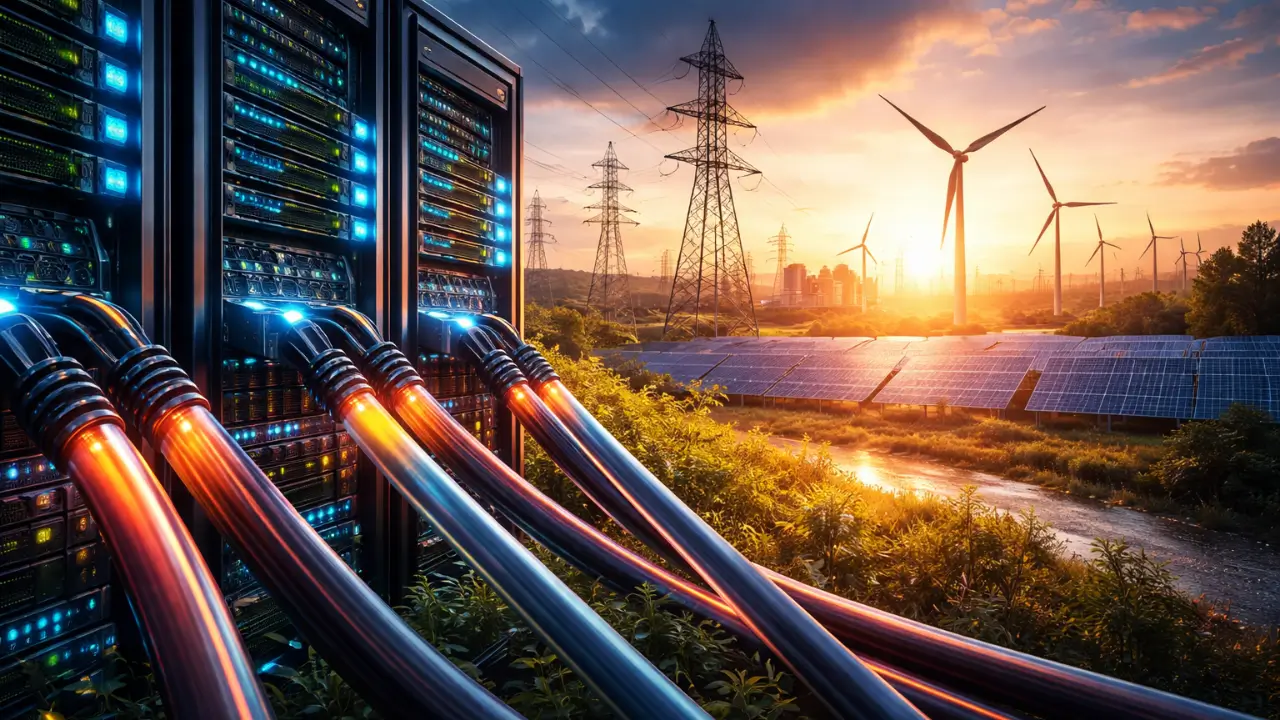
Artificial intelligence now drives the next phase of digital infrastructure expansion. Yet behind every AI model sits an enormous physical system: racks of GPUs, high-density servers, cooling equipment, and the electricity required to run them. As demand for compute accelerates, the conversation around who pays for the energy powering AI infrastructure has become unavoidable.

Recently, technology leaders including Google and Meta signaled a notable shift. Both companies said they are prepared to shoulder the cost of powering the data centres that support their artificial intelligence systems. Their statements arrive at a moment when electricity prices and grid stability have become political and economic flashpoints.
The issue goes beyond corporate sustainability commitments. It sits at the intersection of technology policy, national competitiveness, and consumer affordability. As AI infrastructure scales rapidly, the question is no longer whether the sector will consume more power. Instead, the real debate focuses on how that energy demand should be financed, and by whom.
AI Infrastructure Is Now an Energy Policy Issue
Artificial intelligence once appeared as a purely digital innovation. However, the infrastructure behind modern AI tells a different story. Training and running large-scale models requires vast clusters of specialized processors. These systems operate continuously, drawing substantial electricity and producing intense heat that must be managed through advanced cooling systems.
As a result, data centres increasingly resemble industrial-scale energy consumers. New facilities often require power levels comparable to those used by small cities. Utilities must therefore plan new grid capacity, upgrade transmission infrastructure, and ensure stable supply.
This surge in demand has arrived during a period of heightened sensitivity to electricity prices. Rising utility bills already weigh heavily on households. Consequently, policymakers face growing pressure to ensure that the rapid expansion of AI infrastructure does not shift costs onto everyday consumers.

In this context, statements from major technology firms carry significant policy implications.
Tech Companies Signal Willingness to Pay
By publicly stating that they will cover the costs associated with powering their AI data centres, companies such as Google and Meta aim to address a key concern: the possibility that ordinary electricity customers could subsidize corporate computing operations.
The commitment suggests a clearer alignment between digital growth and infrastructure accountability. Rather than relying on rate structures that distribute grid expansion costs broadly across customers, technology companies appear ready to fund the power required for their facilities. Such positioning reflects several strategic realities.
First, these companies rely heavily on reliable electricity to operate their AI services. They therefore have a direct incentive to ensure stable energy supply. Second, taking responsibility for energy costs helps maintain public trust at a time when large data centre projects increasingly face scrutiny from regulators and communities. Finally, proactive engagement with energy policy allows technology firms to shape the rules that will govern AI infrastructure for the next decade.
Political Pressure Shapes the Debate
Energy economics rarely operate in isolation from politics. In the United States, rising electricity prices have become a central cost-of-living issue for voters. As a result, policymakers have begun examining how data centre growth might affect grid capacity and consumer bills.
The issue carries particular significance as the country approaches the midterm election cycle. Utility costs often translate quickly into political pressure, especially when households already face inflation across other essential services.
At the same time, the federal government continues to promote artificial intelligence development as a national priority. Donald Trump has embraced the AI sector and positioned technological leadership as a pillar of economic competitiveness.
This dual reality creates a delicate balance. Policymakers want to accelerate AI investment while ensuring that infrastructure expansion does not trigger higher energy costs for voters. The willingness of technology firms to pay for the power they consume helps ease that tension.
The Grid Faces a Structural Shift
Even with corporate commitments in place, the broader challenge remains substantial. The scale of AI-driven electricity demand could reshape energy planning across several regions.
Data centres increasingly cluster near areas with abundant power generation and strong transmission networks. However, grid operators must still plan years ahead to accommodate large new loads. Utilities must secure generation capacity, upgrade substations, and maintain reliability as demand patterns evolve.
The speed of AI infrastructure deployment complicates this process. Technology companies can build large facilities within relatively short timelines, while energy infrastructure often requires longer development cycles. As a result, coordination between tech firms, utilities, and regulators will become more important than ever.
Renewable Energy and Long-Term Strategy
Energy sourcing also plays a crucial role in the AI power debate. Many technology companies have invested heavily in renewable energy procurement, signing long-term agreements to support wind, solar, and other clean energy projects. These initiatives serve multiple purposes. They reduce the environmental footprint of large-scale computing while also providing stable power pricing over long time horizons.
For AI operators, predictable electricity costs matter enormously. Training large models or operating inference clusters requires consistent energy supply. Long-term renewable energy contracts can therefore act as both sustainability measures and financial hedges. The combination of corporate funding and renewable energy investment may help stabilize the broader ecosystem surrounding AI infrastructure.
The Economics of Compute
Ultimately, the debate around AI electricity costs highlights a deeper shift in the digital economy. For decades, cloud computing allowed organizations to treat infrastructure as an abstract resource. Developers focused on software while hyperscale operators handled the physical systems behind the scenes. Artificial intelligence changes that equation.
Compute density now defines competitive advantage. Companies with access to large clusters of GPUs and reliable power can train more sophisticated models, deliver faster inference, and scale new AI services globally.
Energy therefore becomes a strategic input to innovation.When companies such as Google and Meta acknowledge responsibility for powering their AI systems, they implicitly recognize this new reality. Electricity is no longer just an operational expense. It has become a core element of technological leadership.
A New Social Contract for AI Infrastructure
As AI adoption spreads across industries, society will increasingly depend on the data centres that support it. These facilities enable everything from productivity tools to scientific research and national security applications.
However, infrastructure growth always raises questions about fairness, sustainability, and public benefit. If technology companies absorb the costs associated with powering their facilities, they help establish a clearer social contract around AI infrastructure. The model suggests that companies generating value from AI should also fund the physical systems required to operate it.
That principle does not eliminate every challenge. Grid upgrades, regulatory oversight, and community engagement will remain essential. Nevertheless, corporate responsibility for energy consumption represents a meaningful step toward aligning technological progress with public interest.
The Road Ahead for AI Energy Economics
The global AI race continues to accelerate. Governments view artificial intelligence as a strategic capability, while companies compete to build increasingly powerful models and services.
In this environment, energy demand will rise alongside compute capacity. The question of who pays for that power will therefore remain central to policy debates. Recent signals from leading technology firms suggest a pragmatic approach: those who benefit most from AI infrastructure should help finance the energy required to run it. That stance may not resolve every tension surrounding electricity prices or grid capacity. However, it does provide an important foundation for responsible AI expansion.
The future of artificial intelligence will depend not only on algorithms and chips, but also on the power plants, transmission lines, and energy markets that sustain them. Recognizing that reality marks an essential step toward building a durable digital infrastructure economy.











