
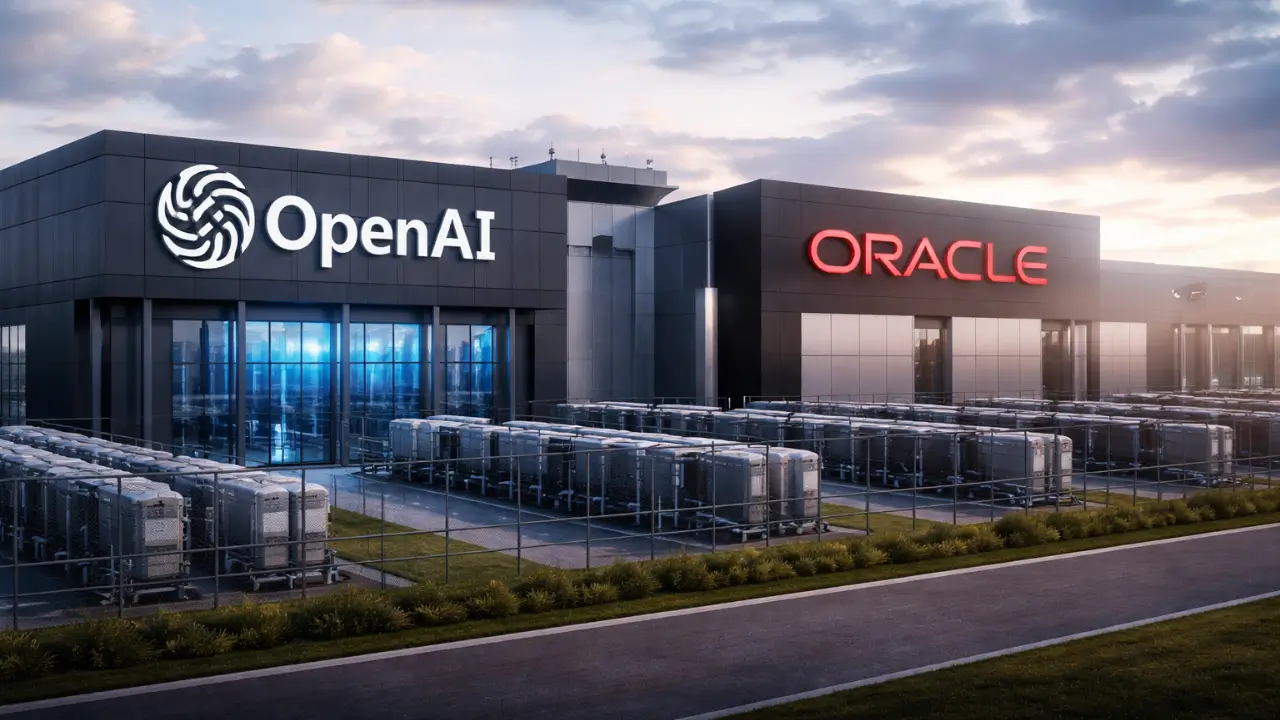
Months after publicly rejecting speculation of trouble, Oracle and OpenAI have abandoned plans to expand their flagship AI data center campus in Abilene, Texas, marking a significant setback for one of the most closely watched infrastructure projects tied to the Stargate initiative.

Negotiations over the expansion dragged on for months without resolution. Ultimately, disagreements over financing and evolving compute capacity requirements forced the companies to walk away from the deal, according to a Thursday report by Bloomberg.
The decision arrives after Oracle spent weeks defending the strength of its relationship with OpenAI. In early February, the company posted on X that a stalled Nvidia-OpenAI investment deal had “zero impact” on its financial ties with Sam Altman’s company. However, the statement triggered the opposite reaction in financial markets. Oracle shares slid nearly 3% following the post, as investors questioned the stability of the AI infrastructure partnership.
Venture capitalist Alex Kolicich described the message as “literally bank-run language.”
Expansion Talks for the Abilene AI Campus Break Down
The Abilene campus stands as one of the most visible infrastructure projects tied to the Stargate initiative. The facility, developed by energy-focused cloud infrastructure company Crusoe, was expected to become a major hub for AI training capacity in the United States.
Oracle, Crusoe, and OpenAI had been negotiating since mid-2025 to nearly double the campus capacity. The proposed expansion aimed to scale the facility from 1.2 gigawatts to roughly 2 gigawatts of computing power.

Nevertheless, discussions repeatedly stalled. Financing challenges complicated the project structure, while OpenAI’s rapidly evolving demand forecasts introduced further uncertainty around long-term capacity commitments. As a result, the expansion plan has now been scrapped. Despite the collapse of expansion talks, the broader Abilene project remains active.
The 1,000-acre campus already hosts several operational buildings. In addition, Oracle’s larger infrastructure agreement with OpenAI remains intact. The two companies still plan to build 4.5 gigawatts of AI data center capacity across multiple U.S. locations, according to Bloomberg and Reuters. However, the abandoned expansion has opened the door for another technology giant. Reports indicate that Meta is evaluating whether to lease the proposed expansion site from Crusoe, potentially stepping into the gap left by OpenAI. Such a move would underscore how aggressively major tech companies are competing to secure next-generation AI compute infrastructure.
Reliability Problems Strained Relations Between Oracle and Crusoe
Operational challenges at the Abilene campus have also contributed to tensions between Oracle and Crusoe.
Earlier this year, several data center buildings reportedly went offline for days after winter weather disrupted parts of the liquid-cooling systems. The outages intensified scrutiny of the complex infrastructure required to support large-scale AI clusters. In response, Oracle emphasized the broader progress of the project.
The company said it is “very proud of our relationship and our progress in bringing capacity online.” Notably, the statement avoided any direct reference to OpenAI. Crusoe, meanwhile, struck a more collaborative tone, stating that the companies are operating in lockstep to deliver one of the world’s largest AI factories in Abilene.
Oracle’s Expensive AI Infrastructure Bet Faces Investor Pressure
The breakdown in Abilene negotiations also arrives during a turbulent financial period for Oracle. The company has accumulated more than $100 billion in debt while scaling its AI infrastructure footprint. At the same time, investor sentiment has deteriorated sharply. Oracle’s stock has lost roughly half its value since peaking in September 2025, erasing around $463 billion in market capitalization.
Meanwhile, investment bank TD Cowen warned this week that Oracle could cut 20,000 to 30,000 jobs as part of a cost-reduction effort tied to its infrastructure spending. Credit pressure has also intensified. S&P Global recently placed Oracle’s credit rating on negative watch.
Questions have also surfaced around the Stargate initiative itself. A prior report from The Information revealed that the joint venture has remained largely inactive. The project reportedly has no staff hired and no construction underway, even as OpenAI continues to pursue infrastructure capacity through separate bilateral deals. Oracle has not publicly commented on the reported layoffs or the financing challenges surrounding its AI infrastructure expansion.
For the broader AI ecosystem, the Abilene reversal highlights a deeper reality: building the physical backbone of the AI economy has become as complex and capital-intensive as the technology it supports.











