 Skip to content
From Parallel Cooling to Cascaded Thermal Architectures
Traditional data center cooling systems evolved around parallel architectures where multiple cooling loops operate independently to maintain stable operating temperatures for servers, networking equipment, and storage infrastructure. Each loop typically receives chilled water or refrigerant from centralized cooling plants, distributing the coolant across racks and heat exchangers before returning it to be cooled again in a closed cycle. Engineers historically designed this structure to prioritize reliability, redundancy, and uniform thermal performance across the entire facility, because compute workloads rarely demanded differentiated thermal strategies across subsystems.

As compute density increases across modern AI clusters, however, this design approach reveals structural limitations because the architecture does not efficiently capture or reuse the heat generated inside high-density hardware environments. Engineers increasingly observe that heat from computing equipment often leaves the facility at temperatures too low to support practical reuse applications in surrounding energy systems. As a result, large volumes of recoverable thermal energy dissipate into the environment through cooling towers and dry coolers rather than contributing to broader energy networks.
Sequential Heat Exchange and Multi-Stage Cooling Systems
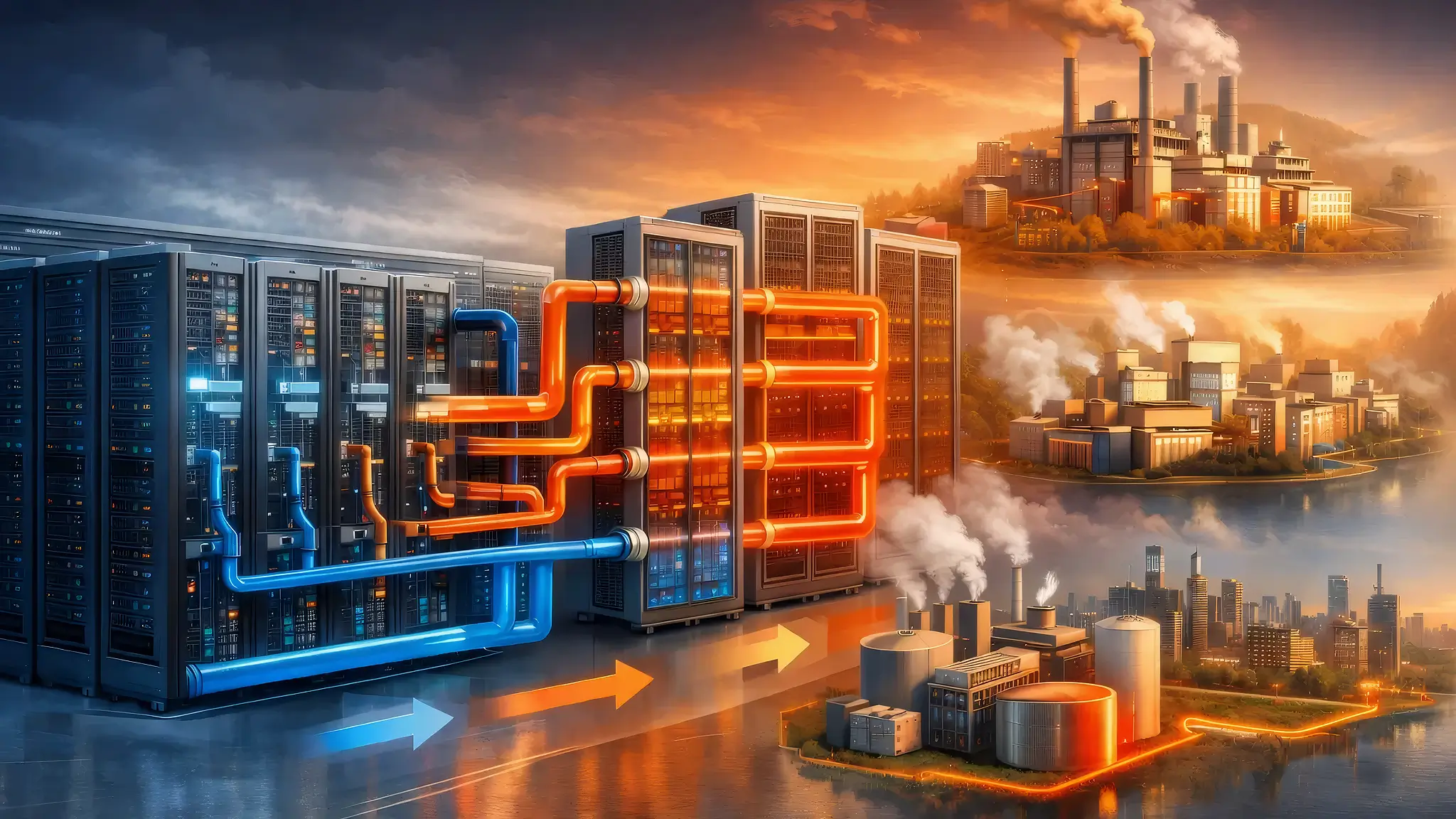
A cascaded thermal architecture reorganizes this traditional structure by connecting multiple cooling stages sequentially rather than running them independently, allowing coolant temperatures to increase progressively as heat moves through different layers of the infrastructure. This configuration creates a thermal pathway where lower temperature stages handle sensitive electronics while later stages process warmer fluids that remain suitable for downstream reuse. Cooling engineers often implement multi-stage heat recovery loops and sequential heat exchange systems in which coolant from one stage transfers energy to another stage before returning to the primary cooling plant. The strategy enables higher outlet temperatures at the end of the thermal chain, which significantly improves the usability of recovered heat for district heating systems, industrial processes, and building energy networks.
Facilities that adopt cascaded thermal systems can operate cooling infrastructure at elevated return temperatures while maintaining stable chip performance through localized cooling methods. Designers now evaluate cooling architectures not only by their ability to remove heat efficiently but also by their capacity to preserve thermal quality throughout the entire cooling process. This shift reflects a broader transition toward integrated energy thinking within digital infrastructure planning.

The Thermal Ladder Inside AI Compute Facilities
Modern AI compute environments create highly varied thermal conditions across the hardware stack because different components operate at distinct power densities and temperature tolerances. Graphics processing units that power machine learning training workloads often exceed several hundred watts per chip, while supporting memory modules, networking switches, and storage systems operate under different thermal profiles. Engineers increasingly model these environments as layered temperature ecosystems rather than uniform thermal spaces because the hardware produces heat at multiple levels of intensity.
Within this framework, designers construct what industry specialists describe as a thermal ladder, where different tiers of cooling infrastructure correspond to different temperature bands inside the facility. The lowest rung of the ladder typically focuses on direct chip cooling where liquid interfaces remove heat immediately from processors and accelerators. Higher levels of the ladder gradually transition toward facility-level cooling infrastructure that manages aggregated heat from entire racks or clusters. This hierarchical structure allows engineers to maintain optimal thermal control at the component level while still enabling heat recovery further downstream in the system.
Thermal Diversity Across AI Hardware Components
Temperature tiers within this ladder structure often follow a progression from highly controlled micro-scale cooling at the silicon interface to broader thermal management at the building level. Cold plates or immersion cooling systems stabilize processor temperatures while producing coolant streams that exit the server racks at significantly higher temperatures than traditional air-cooled environments. These warmer coolant streams then move into secondary loops that may support absorption chillers, heat pumps, or building heating systems. Engineers design these intermediate stages to maintain stable thermal gradients while preserving the usable energy content within the coolant.
Each step of the ladder therefore acts as a controlled transfer point that manages both temperature and flow characteristics across the system. This layered approach allows data center operators to convert localized chip heat into a structured thermal resource that flows through the facility like an energy network. Thermal modeling software now plays an increasingly important role in designing these multi-tiered infrastructures because engineers must predict temperature behavior across multiple interconnected systems. The concept of the thermal ladder ultimately reflects the growing complexity of managing heat in large-scale AI infrastructure.
Matching Heat Quality with Industrial Demand
Recovered heat from computing infrastructure varies widely in temperature and usability depending on the cooling technologies deployed inside the facility. Low-temperature heat streams produced by conventional air cooling typically remain unsuitable for most industrial processes because they fall below the temperature thresholds required for practical energy reuse. District heating networks, however, often accept moderate temperature heat streams that can support residential heating or building hot water systems when integrated with heat pumps.
Engineers therefore increasingly analyze the concept of heat quality, which refers to the temperature level and energy density associated with recovered thermal output. Higher temperature heat streams carry greater potential for industrial reuse because they require less additional energy input to reach operational thresholds. Facilities that deploy temperature cascading systems gain the ability to generate multiple grades of heat rather than a single uniform thermal output. This capability allows operators to align thermal supply with the specific requirements of nearby industries or urban infrastructure systems.
Industrial Applications for Recovered Data Center Heat
Industrial sectors often require specific temperature bands for manufacturing processes such as drying, washing, sterilization, and chemical treatment. Food processing facilities may operate in the range of sixty to ninety degrees Celsius, while certain manufacturing processes demand even higher temperatures. Temperature cascading enables computing facilities to produce heat streams that align with these requirements because the sequential cooling architecture preserves thermal gradients across multiple stages. Operators can therefore channel higher temperature outputs toward industrial customers while lower temperature streams feed district heating or building heating systems.
This structured allocation improves overall energy efficiency because the recovered heat directly supports external processes without requiring excessive temperature amplification. Thermal integration between computing infrastructure and surrounding industries has already emerged in several European projects where data center heat supports municipal heating networks. These developments illustrate how structured thermal management can transform computing facilities into active participants within regional energy ecosystems. The alignment between heat supply and industrial demand ultimately defines the practical value of temperature cascading strategies.
Liquid Cooling as the Enabler of High-Grade Heat Recovery
Air cooling dominated early generations of computing infrastructure because it offered simplicity, standardized equipment, and relatively predictable airflow management. However, air possesses limited thermal capacity compared with liquids, which restricts its ability to transport heat efficiently at high power densities. Modern AI accelerators generate thermal loads that exceed the practical limits of large-scale air-based cooling systems, particularly when server racks approach power densities above thirty kilowatts.
Liquid cooling technologies address this limitation by transferring heat directly into fluid systems with significantly higher heat absorption capacity. Direct-to-chip cooling systems circulate coolant through cold plates attached to processors and accelerators, removing heat at the source before it disperses into the surrounding environment. Immersion cooling systems take this concept further by submerging entire servers in dielectric fluid that captures heat across all electronic components simultaneously. Both approaches produce coolant streams that exit the hardware environment at higher temperatures than those generated by air cooling systems.
Future Pathways for Thermal Integration in Data Centers
Higher outlet temperatures fundamentally improve the feasibility of temperature cascading because they preserve the energy quality necessary for downstream reuse. Cooling loops that operate at elevated temperatures allow engineers to route recovered heat directly into secondary energy systems without extensive reheating. Heat pumps may still adjust temperature levels depending on the final application, yet the overall efficiency improves when the starting temperature remains relatively high.
Liquid cooling technologies therefore function as the foundational layer that enables structured thermal networks within modern computing infrastructure. Designers increasingly treat liquid cooling loops not only as thermal control mechanisms but also as energy transport systems that move usable heat across the facility. Facilities that integrate immersion or direct liquid cooling can maintain stable chip temperatures while producing coolant streams suitable for district heating integration. The convergence of high-density computing and advanced liquid cooling technologies continues to reshape how engineers view thermal management in digital infrastructure. This evolution marks a decisive shift toward energy-aware data center design.












