 Skip to content
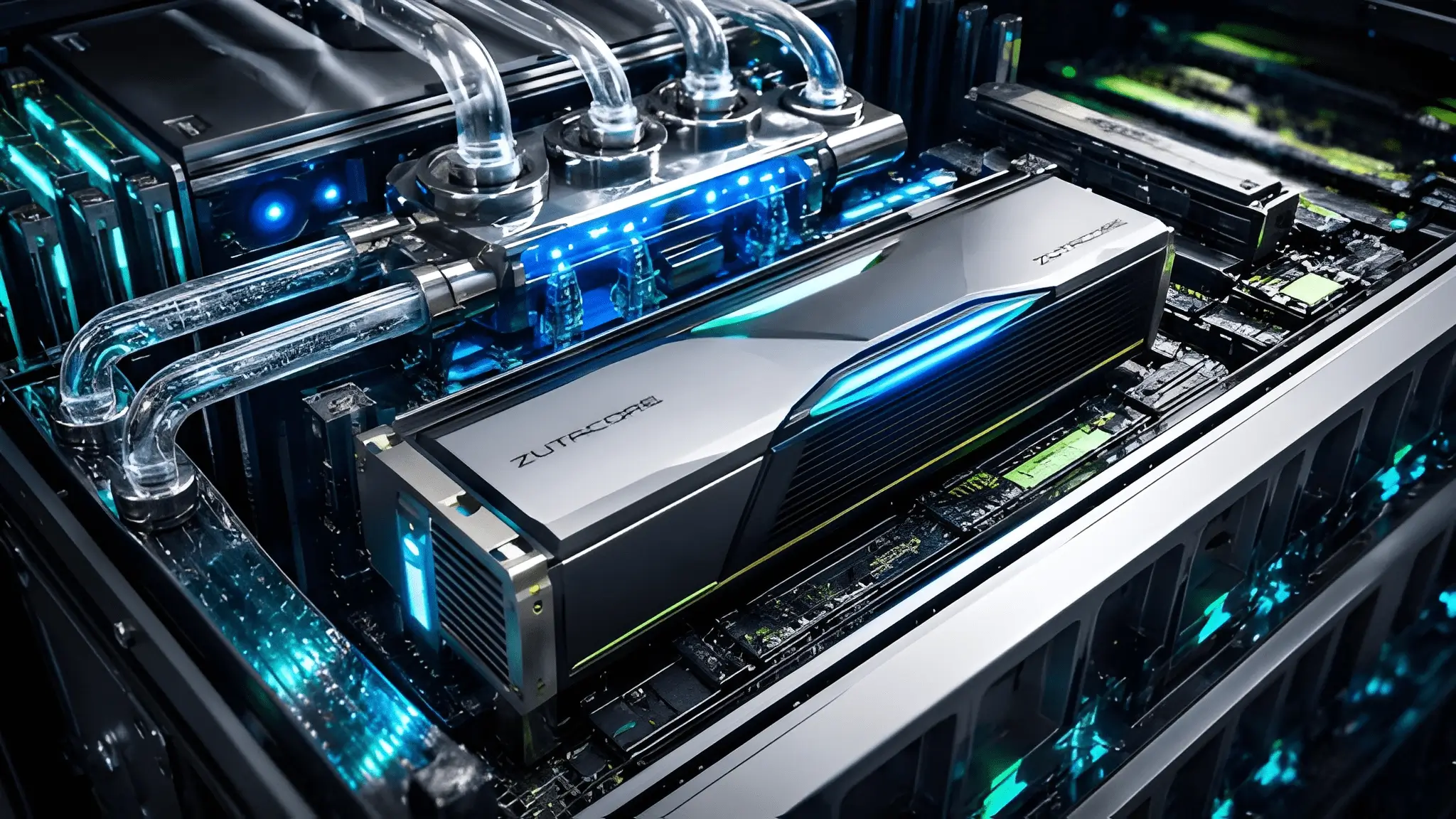
ZutaCore has introduced a single-slot liquid cooling system designed for PCIe-based AI servers, marking a strategic push into a segment still dominated by air-cooled infrastructure. The launch targets deployments built on Nvidia’s RTX PRO 6000 Blackwell Server Edition GPUs, where operators increasingly face thermal and density constraints.

The product, OmniTherm, adopts a waterless two-phase cooling method tailored for enterprise and cloud environments. It enters a market where PCIe GPU servers continue to dominate due to compatibility with existing racks, procurement models, and operational workflows. However, rising power densities now challenge those legacy advantages.
Air Cooling Limits Drive Shift Toward Liquid Designs
Air cooling has begun to show structural limitations in high-performance AI systems. As GPU power consumption rises, operators must allocate more space for airflow, which reduces accelerator density within a chassis. At the same time, higher fan speeds increase energy consumption and generate significant acoustic pressure across data halls.
Consequently, operators face a trade-off between maintaining performance and scaling infrastructure efficiently. PCIe-based systems, while operationally familiar, struggle to sustain peak workloads under thermal pressure, particularly in inference-heavy environments with fluctuating utilization patterns.

ZutaCore positions OmniTherm as a direct response to these constraints. The company claims its system enables full-power GPU operation while maintaining a single-slot form factor, preserving compatibility with existing server architectures.
“Enterprise and cloud operators want the flexibility of PCIe GPUs, but they also need density and sustained performance as power levels rise,” said My D. Troung, CTO, ZutaCore.
Two-Phase Cooling Without Facility Water Integration
OmniTherm leverages a sealed-loop, two-phase cooling system that uses a dielectric fluid to absorb and dissipate heat. Unlike traditional liquid cooling systems, it avoids introducing facility water into the server chassis, an important consideration for operators concerned with maintenance complexity and risk exposure.
This design allows heat to transfer efficiently through phase change while maintaining electrical safety. Moreover, it aligns with enterprise preferences for contained systems that minimize operational disruption. “OmniTherm delivers waterless two-phase cooling in a single-slot form factor, helping data centers increase accelerator density while maintaining stable thermals for 24/7 AI workloads,” said Troung.
ZutaCore extends the cooling footprint beyond the GPU die, incorporating adjacent components such as CPUs and high-bandwidth memory. This broader thermal coverage reflects a shift in AI infrastructure design, where performance depends on tightly integrated compute, memory, and interconnect systems.
As inference workloads run continuously and fluctuate in intensity, thermal stability across all components becomes critical. Therefore, cooling solutions must address not only peak heat loads but also cyclical stress that can degrade hardware over time.
Operational Efficiency and Reliability at Scale
Cooling architecture increasingly shapes operational efficiency in modern data centres. High fan usage contributes to elevated power draw and affects working conditions for on-site personnel. In contrast, liquid-based systems can reduce reliance on airflow, lowering both energy consumption and noise levels.
ZutaCore emphasizes reliability as a key differentiator. Thermal stress impacts hardware lifespan, and operators must balance performance gains with long-term maintainability. OmniTherm’s sealed design aims to simplify servicing while supporting continuous deployment across production environments.
Alongside the hardware launch, ZutaCore introduced HyperCool Cloud, a platform designed to manage liquid cooling infrastructure at scale. The system provides near real-time telemetry for coolant distribution units and enables centralized monitoring across deployments. Additionally, it supports alarm-to-resolution workflows, reflecting a broader shift toward standardized operations in liquid-cooled environments. As adoption grows, operators increasingly require software-defined visibility and control to manage distributed infrastructure efficiently.
Public Demonstration at Nvidia GTC
ZutaCore will showcase OmniTherm at Nvidia’s GTC event, where it plans to demonstrate a system built around the RTX PRO 6000 Blackwell Server Edition GPU. The company will also present an interactive 3D visualization of its HyperCool two-phase cooling architecture, developed in collaboration with Smart Spatial. Troung is expected to deliver a session focused on two-phase cooling strategies for high-density PCIe AI deployments, underscoring the company’s broader ambition to influence next-generation data centre design.
As AI workloads intensify, infrastructure decisions increasingly hinge on thermal efficiency and scalability. ZutaCore’s entry into single-slot liquid cooling reflects a deeper industry shift, one where performance gains will depend not just on compute power, but on how effectively systems manage heat at scale.












