 Skip to content
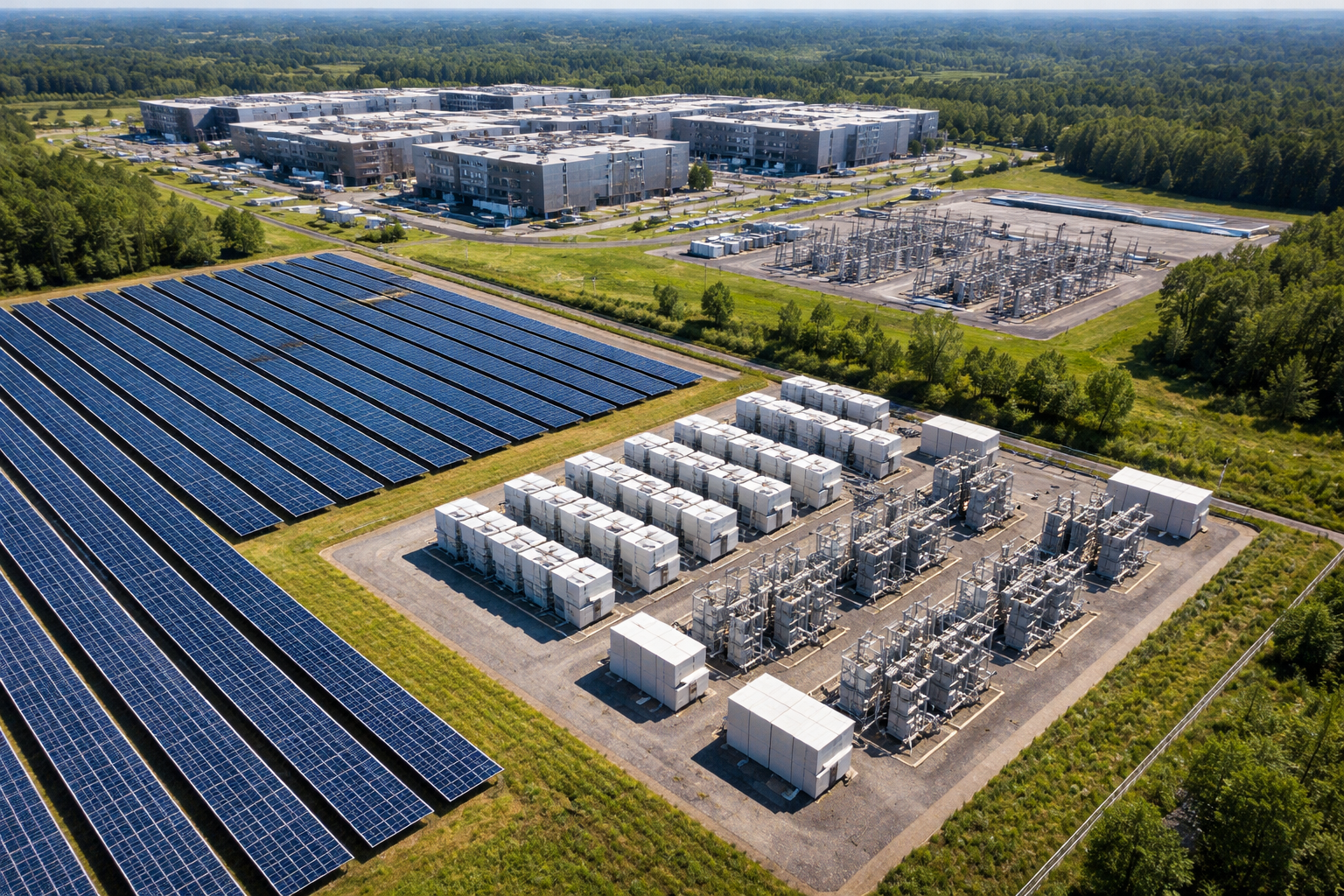
The relationship between AI infrastructure and the power grid is undergoing a structural transformation. For decades, data center developers treated grid connectivity as a given — a utility to be procured rather than a constraint to be engineered around. That assumption no longer holds. Grid interconnection queues across North America now stretch for years, and the volume of power required by modern AI campuses far exceeds what most utilities can deliver on short timelines. Developers that wait for grid access are falling behind those who bring their own energy to the site. Behind-the-meter power has shifted from a niche workaround to the defining competitive advantage in large-scale AI infrastructure development.

The model works by co-locating power generation directly with compute, bypassing the need to draw energy through the public grid for primary operations. Solar arrays, gas turbines, and increasingly, long-duration battery storage systems can be deployed on or adjacent to a data center campus. This approach gives operators direct control over their energy supply, insulating them from grid congestion, rate volatility, and interconnection delays. It also allows developers to move faster, as securing land and building generation assets can often happen in parallel with data center construction. The result is a compressed timeline from planning to operational capacity that grid-dependent facilities simply cannot match.
The Grid Queue Problem Is Not Going Away
The interconnection backlog facing AI infrastructure developers reflects a systemic imbalance between demand growth and grid expansion capacity. Utilities and grid operators have not built transmission and distribution infrastructure at the pace required to absorb gigawatt-scale compute loads. Approval processes, permitting requirements, and physical construction timelines create delays that can extend well beyond the planning horizons of AI infrastructure projects. Developers announcing campuses today face a real risk of waiting years before sufficient grid power becomes available. This gap has accelerated the push toward energy self-sufficiency as a strategic necessity rather than an optional preference. Behind-the-meter infrastructure directly addresses the bottleneck that conventional development models cannot resolve.
The problem is particularly acute in regions that have attracted concentrated AI investment. Texas, Virginia, and parts of the Midwest have seen grid capacity tighten significantly as hyperscale demand has outpaced utility planning cycles. Developers that secured grid access early hold a structural advantage, while newcomers face a constrained environment that rewards creative energy solutions. The competitive dynamics of AI infrastructure now include energy origination as a core capability alongside land acquisition and construction execution. Firms that can source, finance, and build behind-the-meter generation are operating in a different risk and timeline profile than those relying on utility procurement. This divergence is reshaping the landscape of who can credibly build at scale.
Long-Duration Storage Changes the Reliability Equation
One of the core challenges with behind-the-meter power has historically been intermittency. Renewable generation sources such as solar and wind produce energy on variable schedules that do not always align with compute demand curves. Early behind-the-meter deployments often required gas generation as a reliability backstop, which limited the sustainability credentials of the approach. Long-duration energy storage is now changing that calculus by enabling multi-hour and multi-day buffering of renewable output. Iron-air batteries, flow batteries, and other emerging storage technologies can store energy during periods of surplus and discharge it during periods of peak demand. This capability allows behind-the-meter systems to deliver firm, reliable power without depending on fossil fuel backup for routine operations.
The practical implication for AI infrastructure developers is significant. A campus powered by a combination of renewable generation and long-duration storage can operate with high reliability while maintaining energy independence from the grid. Storage systems also provide a buffer against seasonal and weather-related variability, which has been a concern for large-scale renewable deployments in certain geographies. Developers are beginning to treat storage capacity as a core infrastructure requirement rather than an optional enhancement. This shift in procurement strategy mirrors how the industry previously approached redundant power and cooling systems — as non-negotiable elements of a reliable facility. The convergence of renewable generation and long-duration storage is making behind-the-meter power viable at the scale that frontier AI workloads demand.

Energy Origination Is Becoming a Core Developer Competency
The behind-the-meter model requires a set of capabilities that traditional data center developers have not historically maintained. Sourcing land with favorable energy resources, negotiating with power generation partners, structuring energy offtake agreements, and managing on-site generation assets all require expertise that sits outside conventional construction and operations. Developers that have built these capabilities are increasingly differentiated in the market. Those without them face a choice between developing the competency organically, acquiring it through partnerships, or accepting the constraints of grid-dependent development. The market is beginning to reward energy origination capability as a first-class competitive asset in AI infrastructure.
This trend is also changing the profile of who enters the AI infrastructure market. Energy companies, utilities, and industrial conglomerates bring energy origination expertise that positions them as credible infrastructure developers alongside traditional data center operators. Their ability to control power supply from generation through delivery creates a vertically integrated model that compresses timelines and improves cost predictability. Adani Group, for example, has built its data center strategy explicitly around its renewable energy portfolio, treating energy control as the foundation of its infrastructure proposition. Similarly, Crusoe has pioneered co-located power and compute as the basis of its AI factory model. These examples illustrate how the boundary between energy company and infrastructure developer is dissolving under the pressure of AI demand.
The Economics Favor Vertical Integration at Scale
Behind-the-meter power also changes the economics of AI infrastructure in ways that favor large-scale, vertically integrated operators. Energy costs represent one of the most significant components of data center operating expenses, and direct control over generation creates opportunities to reduce cost per unit of compute. Operators that own or contract generation assets can optimize dispatch based on workload schedules, shifting energy-intensive operations to periods of lowest cost. This flexibility is not available to facilities that draw power at utility tariff rates without the ability to influence pricing or timing. The economic advantage compounds over time as compute workloads grow and energy costs become an increasingly important differentiator in competitive pricing.
The capital requirements of behind-the-meter infrastructure are substantial, but the economics increasingly justify the investment for large-scale deployments. Financing structures that treat generation assets as infrastructure — with long-term contracted revenue streams — have made it possible to fund these systems at lower costs of capital than early projects faced. Institutional investors, including infrastructure funds and sovereign wealth vehicles, have shown appetite for energy assets tied to AI data centers. This capital availability has made behind-the-meter development more financially accessible, accelerating its adoption across the industry. The model that once required pioneering risk tolerance is now attracting mainstream infrastructure capital.
A New Infrastructure Paradigm Is Taking Hold
The behind-the-meter power model represents more than a tactical response to grid constraints. It signals a fundamental shift in how AI infrastructure gets conceived, financed, and operated. Developers are no longer passive consumers of utility power — they are active participants in energy markets, with generation assets, storage systems, and offtake agreements forming the foundation of their infrastructure strategy. This shift aligns the incentives of compute operators with the broader challenge of energy system modernization, as distributed generation and storage contribute to grid resilience even while serving private loads.
For the AI infrastructure sector, the transition to behind-the-meter power is accelerating a consolidation of capabilities that favors well-capitalized, vertically integrated operators. Developers that combine land, energy, and compute into a single integrated offering are setting the terms of competition for the next generation of hyperscale AI facilities. The grid will remain relevant — particularly for facilities that require flexibility and redundancy — but it will no longer be the primary determinant of where and how fast AI infrastructure gets built. Behind-the-meter power has moved from the edge of the industry to its center, and the implications for data center development, energy markets, and AI competition are only beginning to unfold.












