
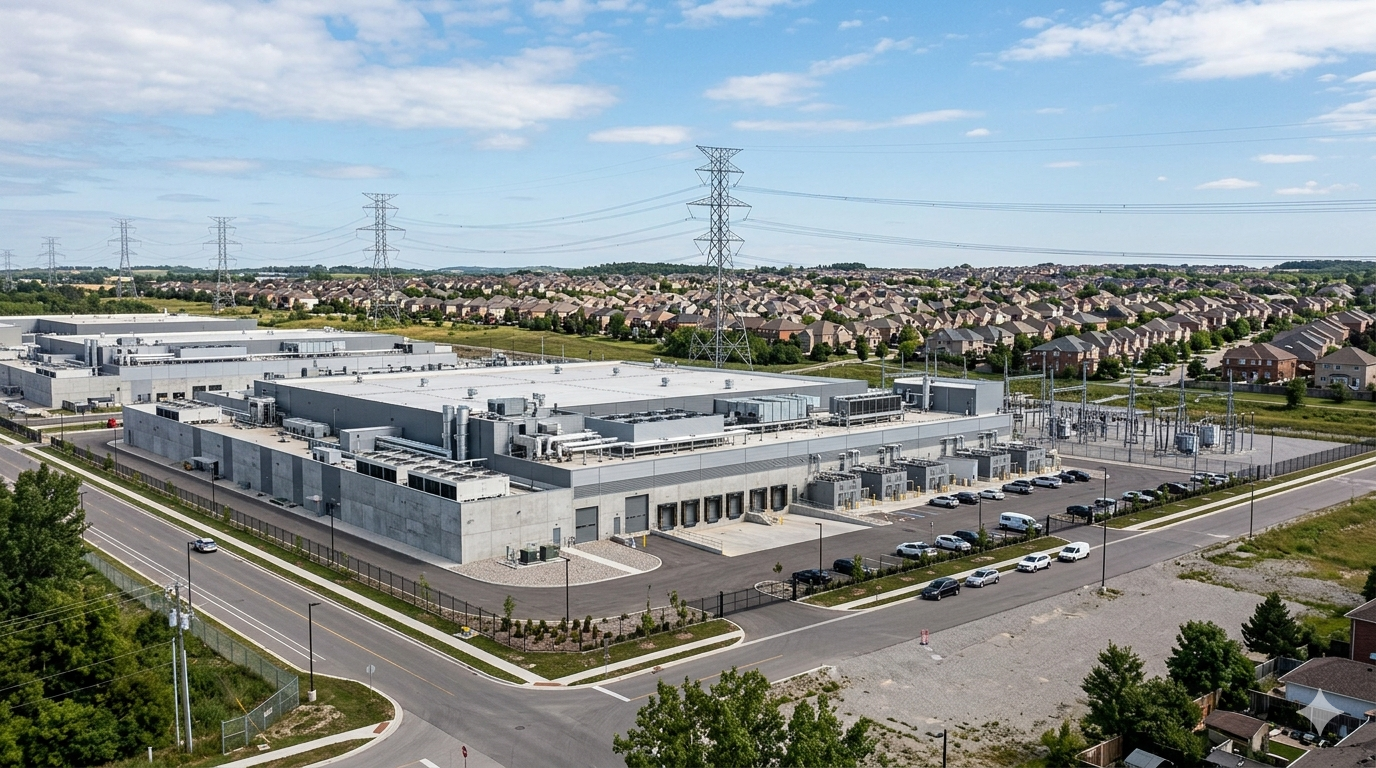
The data center industry has a story it tells about itself. It creates jobs, brings investment and, puts struggling municipalities on the map. That story is not entirely false. But it is incomplete in ways that are becoming harder to ignore. AI infrastructure investment has moved from billions to hundreds of billions. The communities hosting these facilities are starting to understand what they actually signed up for. The gap between the pitch and the reality is widening, and the industry has not yet decided how to close it.

The pattern is consistent enough to be a model. A hyperscaler identifies a market with available land, accessible power, and a local government hungry for economic development. Incentive packages follow. Tax abatements, expedited permitting, utility rate concessions. The community competes against other communities for the investment. The data center gets built. The ribbon gets cut. Then the community discovers that a facility drawing hundreds of megawatts from a grid not designed for that load has consequences the announcement never mentioned.
The Grid Cost Nobody Talks About
Grid infrastructure upgrades triggered by large load additions do not pay for themselves. In most utility regulatory frameworks, the cost of upgrades required to serve a new large industrial customer is socialized across the existing customer base. Residential and commercial ratepayers in the region absorb infrastructure costs created by a facility that the local government recruited with public subsidies. The economic development framing local governments use rarely includes an honest accounting of this cost transfer. Most voters and local officials never see the regulatory mechanism that makes it happen. The interconnection queue bottleneck that operators complain about is the same infrastructure constraint that communities end up paying to resolve.
Water stress follows the same pattern. AI data centers consume water at rates that strain municipal supplies in already constrained markets. Facilities pay market rates for the water they draw, so everything looks legitimate on paper. However, market rates in water-stressed regions do not reflect the full cost of that resource to the community. When a hyperscale AI campus draws millions of gallons annually from a region where drought conditions are intensifying, the cost appears elsewhere. It shows up in reduced agricultural yields, in municipal water restriction programs, and in the political cost of managing a resource crisis that the facility’s arrival accelerated. The water scarcity pressures that operators treat as a site selection variable are a daily operational reality for the communities around them.

Voluntary Commitments Are Not Structural Solutions
The industry’s response to this criticism follows a predictable script. Renewable energy commitments. Water recycling programs. Community benefit agreements. These are not nothing. Some represent genuine investments in reducing negative externalities. However, they are voluntary. Operators make them when and where they choose. They do not reflect the actual cost burden that AI infrastructure places on host communities. A renewable energy commitment that offsets a fraction of a facility’s power consumption, while the rest draws from a grid whose carbon intensity the operator does not control, is a communication strategy as much as a sustainability program. The self-regulation debate the industry keeps having with itself has not produced binding standards. It has produced press releases.
The more honest framing is this. The AI industry extracts resources from communities, pays market rates for some of them, and imposes unpriced costs for the rest. The economic value of AI workloads does not flow back to the communities providing the infrastructure foundation those workloads depend on. Jobs created by data center operations are real but modest in number relative to the scale of the facilities. Tax revenue is real but frequently discounted by the incentive packages used to attract the investment in the first place. As data centers increasingly operate as power infrastructure companies, the communities hosting them are effectively subsidizing private power infrastructure with public grid capacity.
The Reckoning That Is Already Arriving
Opposition to data center development is emerging in markets from Virginia to Singapore to the Netherlands. This is not purely NIMBY sentiment. It reflects a rational response to a growing recognition that the terms of the deal are not as favorable as the original pitch suggested. Communities are doing the math. They are discovering that fiscal benefits are smaller than projected and infrastructure costs are larger. The mechanisms through which those costs transfer to local ratepayers were never clearly explained. That discovery produces political opposition that no community engagement program can fully offset once it takes hold. The energy reporting mandates moving through legislatures in multiple jurisdictions reflect exactly this growing political pressure.
This is not an argument against AI infrastructure development. The world needs compute capacity. However, the current model, in which communities compete to offer the most favorable terms for investments whose costs they partially absorb, is not stable. The industry that wants continued access to the land, power, and water it needs would be well served to get ahead of that recognition. A genuine commitment to pricing community costs into the investment model, rather than transferring them to ratepayers, is not just the ethical position. It is the strategically rational one. Regulation that forces this reckoning will be less favorable to the industry than a voluntary standard the industry sets for itself. That window is narrowing.











