
The default assumption in AI infrastructure has always favoured greenfield. Build new, build big, build for the future. When hyperscalers announce gigawatt campuses in Texas or the Gulf, they are building from scratch on land chosen for power access, not legacy infrastructure. That model made sense when the primary constraint was design flexibility.

The constraint has shifted. Power access, permitting timelines, and grid connection queues now define how quickly new capacity reaches the market. In that environment, the existing data center footprint looks a lot more attractive than it did two years ago.
The Greenfield Problem Nobody Is Talking About
Building a new AI-ready data center from scratch takes time that most operators no longer have. Grid connection timelines in major markets now stretch years. Permitting processes in established data center hubs face community opposition, environmental review, and regulatory scrutiny that add months to development cycles. Land with available power is increasingly scarce in the markets where AI demand is concentrated.
Greenfield sites offer design freedom, but that freedom comes at a cost. Every system must be built from the ground up, every permit obtained, every utility connection negotiated. In a market where speed to power is the primary competitive variable, starting from zero is a disadvantage. Site readiness now begins with energy availability, and brownfield sites that already have grid connections and operational permits carry a head start that greenfield cannot match.

What Brownfield Brings to the Table
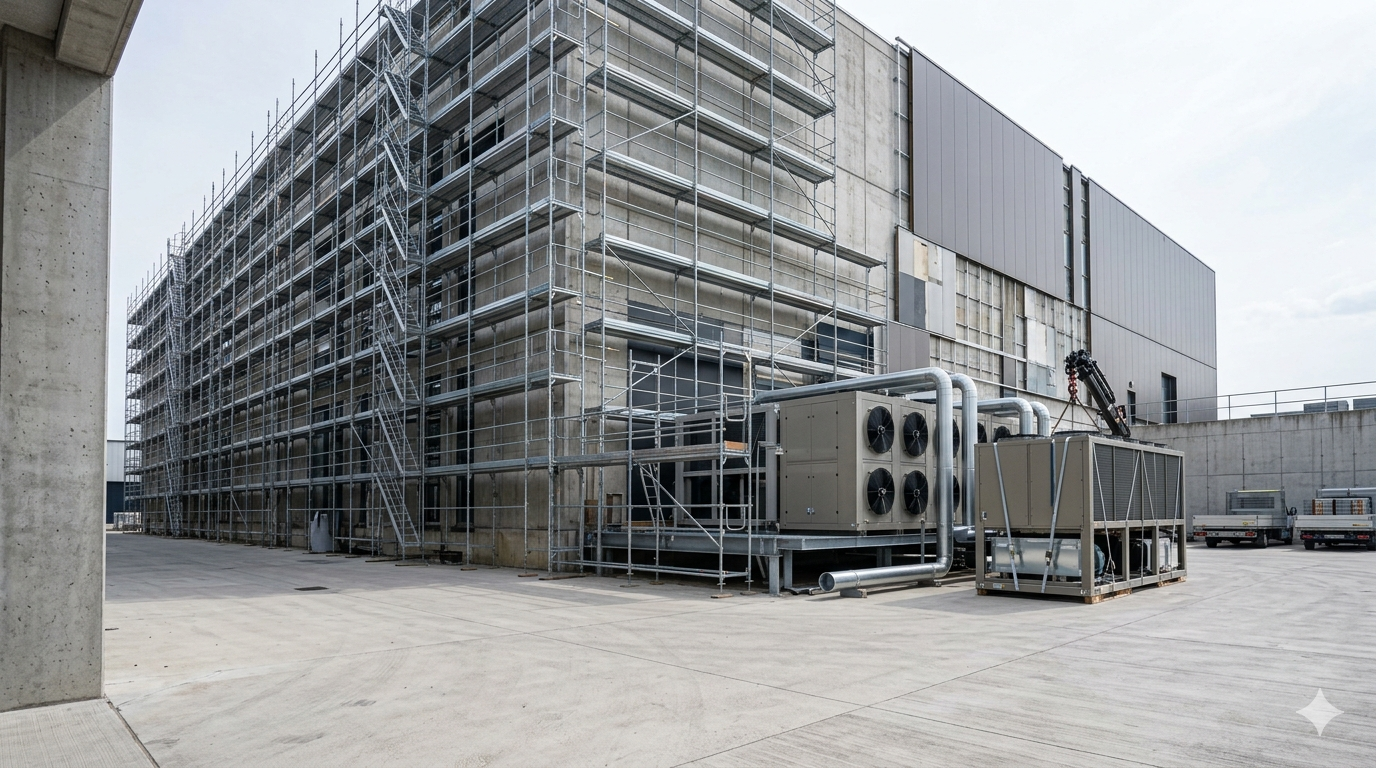
Existing data centers have infrastructure that took years to put in place. Grid connections are live. Permits cover the site. Roads, fibre, and cooling water infrastructure already exist. In many cases, the facilities carry unused capacity that operators built ahead of demand and never fully utilised. That stranded capacity is now a strategic asset in a market where power certainty commands a premium.
Brownfield builds also inherit operational track records. Lenders and colocation customers evaluating a facility have years of uptime data, utility relationships, and regulatory compliance history to assess. A greenfield site offers none of that. For operators trying to secure financing or sign anchor tenants before a facility opens, the credibility of an established site matters more than it did when capital was flowing freely into any AI infrastructure project.
The Retrofit Challenge Is Real but Solvable
Retrofitting an existing facility for AI workloads is not straightforward. Legacy data centers were designed for conventional enterprise IT loads, typically 5 to 10 kilowatts per rack. Modern AI training clusters demand 50 to 100 kilowatts per rack or more. The power distribution, cooling infrastructure, and structural loading of existing buildings were not built for that density. Converting air-cooled facilities to liquid cooling requires engineering work that varies enormously depending on the age and design of the original facility.
The solvable part is that operators do not always need to retrofit every hall to AI-grade density. Many brownfield strategies involve designating specific zones or pods within an existing facility for high-density AI workloads while retaining lower-density areas for conventional cloud and enterprise IT. That hybrid approach lets operators capture the site advantages of brownfield without bearing the full cost of upgrading every square foot to AI specifications. It also allows phased investment, matching capital deployment to customer demand rather than building ahead of it.
Speed to Revenue Is the Deciding Factor
The case for brownfield ultimately comes down to time. A greenfield campus that takes three years to reach first power loses to a brownfield retrofit that reaches the same customer in 18 months. In a market where hyperscalers are signing capacity agreements years in advance, getting operational ahead of the construction timeline creates a durable advantage.
Operators who can identify existing facilities with available power headroom, upgrade the highest-density sections for AI workloads, and bring capacity to market faster than greenfield alternatives are competing on the variable that matters most right now. The AI infrastructure race rewards speed above nearly everything else. Brownfield is not the glamorous answer. However, in 2026, it may well be the right one.











