 Skip to content
Industrial Solar Moves From Margin To Core Strategy
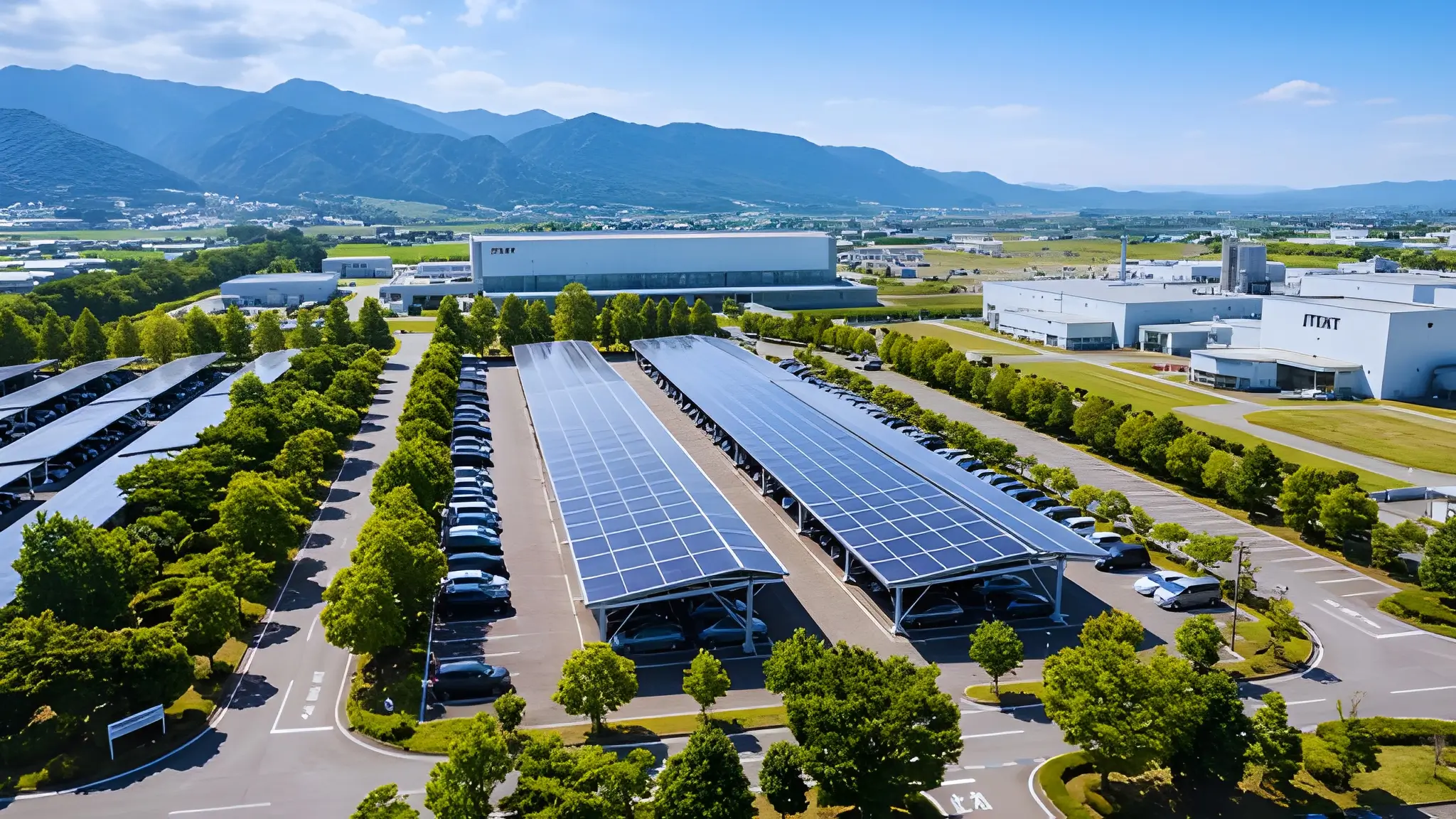
JTEKT Corporation, a critical supplier within the Toyota Group ecosystem, has activated a large-scale solar carport at its Tadotsu manufacturing base in Kagawa Prefecture. The deployment signals a deeper structural shift in how industrial players secure energy moving from procurement to embedded generation.

The system ranks among Japan’s largest onsite solar carport installations tied to an industrial facility. It reflects a broader pivot where manufacturers treat energy infrastructure as a strategic lever rather than a fixed cost center. The project operates under a 20-year power purchase agreement with Peak Energy, which financed, built, and will operate the system. JTEKT will procure electricity at a pre-agreed rate across the contract lifecycle.
This structure eliminates upfront capital burden while locking in long-term price visibility. For manufacturers navigating volatile energy markets, the model converts uncertainty into a managed operating expense.
Moreover, the arrangement aligns with a growing industry preference for asset-light decarbonization strategies, where third-party developers shoulder infrastructure risk.
The solar carport will generate approximately 2,500 MWh annually, equivalent to powering several hundred households. By installing panels over parking infrastructure, JTEKT avoids land acquisition constraints that continue to limit renewable expansion in Japan. The dual-use design also enhances workforce experience by providing shaded parking, embedding sustainability into daily operations without disrupting industrial throughput.
The installation will reduce carbon dioxide emissions by roughly 1,200 tons per year, reinforcing JTEKT’s broader carbon neutrality roadmap. The initiative integrates into a supply chain-wide decarbonization push across the automotive sector, where emissions accountability now extends beyond vehicle output to manufacturing processes.

As OEMs tighten sustainability requirements, suppliers face increasing pressure to align operational footprints with low-carbon benchmarks. Japan’s dense geography has constrained large-scale ground-mounted solar expansion. As a result, rooftop systems and carport-based installations are emerging as viable alternatives for industrial decarbonization.
However, adoption is no longer just about feasibility, it is about optimization. Companies are now engineering energy systems that maximize existing assets while minimizing spatial trade-offs.
The partnership between JTEKT and Peak Energy underscores a growing convergence between industrial operators and renewable developers. These alliances accelerate deployment timelines while distributing financial and operational risk.
Consequently, the Tadotsu facility will draw a portion of its power from solar generation for the next two decades, embedding renewable energy into its operational baseline. This move positions JTEKT not only as a participant in the clean energy transition but as a strategic actor shaping how industrial ecosystems adapt to constrained resources and rising sustainability expectations.












