 Skip to content
AI Can’t Run on Intermittent Power
AI infrastructure operates on continuous execution cycles that demand uninterrupted electrical supply across training, inference, and storage layers. High-performance clusters rely on synchronized GPU utilization, and abrupt power delivery interruptions caused by intermittency can lead to system-level instability and forced workload restarts rather than continuous degradation. Solar and wind generation introduce variability tied to diurnal cycles and weather patterns, which creates gaps that storage systems cannot fully buffer at scale. Data centers designed for AI workloads require deterministic power profiles to maintain throughput consistency and avoid cascading system inefficiencies. Intermittent energy sources force operators to overprovision capacity, rely on backup systems, or accept operational risk under constrained conditions rather than directly causing continuous performance degradation. This mismatch between variable generation and constant compute demand defines a structural limitation in current energy strategies.

Energy intermittency also introduces operational uncertainty in workload scheduling and infrastructure planning across hyperscale environments. AI training jobs often run for extended durations, requiring stable power delivery to prevent checkpoint failures and recomputation overhead. Renewable generation variability disrupts these cycles, increasing system-level inefficiencies that compound at scale. Battery storage mitigates short-duration fluctuations but struggles with multi-hour or multi-day variability without significant cost escalation. Grid operators cannot guarantee uninterrupted renewable supply without backup generation, which reintroduces fossil dependency or requires alternative dispatchable solutions. Compute operators face a trade-off between sustainability targets and reliability requirements under current renewable deployment models. This dynamic places pressure on infrastructure architects to explore energy sources that align with continuous demand patterns.
Energy Is Now a Compute Bottleneck
AI scaling depends not only on semiconductor advancements but also on the availability of reliable power infrastructure that can sustain high-density compute environments. Modern GPU clusters consume megawatts of power within compact footprints, which shifts energy from a background utility to a primary constraint in system design. Power delivery limitations directly cap the number of deployable racks, regardless of available compute hardware or networking capacity. Data center expansion increasingly depends on securing energy contracts rather than acquiring additional processors or storage systems. This shift redefines infrastructure planning, where energy access dictates deployment timelines and geographic location decisions. Compute growth trajectories now align closely with power provisioning capabilities rather than purely technological innovation.
The integration of AI workloads into enterprise and cloud environments amplifies the pressure on existing power systems. High-density racks generate significant thermal loads, which further increase energy consumption through cooling requirements. Power distribution units, transformers, and backup systems must scale proportionally, creating additional infrastructure complexity. Energy constraints also influence workload placement strategies, as operators prioritize regions with surplus capacity or faster interconnection approvals. Capital allocation increasingly reflects energy procurement costs alongside hardware investments. This rebalancing highlights energy as a critical factor in determining competitive advantage within the AI ecosystem.
The Grid Is Failing AI’s Growth Curve
Grid infrastructure development has not kept pace with the rapid expansion of AI-driven data center demand across major markets. Interconnection queues for new power projects extend for years in several regions, delaying the availability of additional capacity required for large-scale deployments. Transmission bottlenecks limit the ability to deliver energy from generation sites to consumption hubs, constraining expansion even when generation capacity exists. Utilities face regulatory and logistical challenges that slow grid upgrades and new project approvals. Data center operators encounter increasing difficulty in securing reliable grid connections within acceptable timelines. This disconnect between grid readiness and compute demand growth creates structural friction in scaling AI infrastructure.
Grid instability also introduces risks related to voltage fluctuations, frequency deviations, and localized outages that impact high-performance computing environments. AI systems require tightly controlled electrical conditions to maintain hardware efficiency and prevent component degradation. Aging infrastructure and rising demand increase the likelihood of disruptions that propagate through interconnected systems. Backup generators provide resilience but often rely on fossil fuels, which conflicts with sustainability objectives. Utilities struggle to balance decarbonization goals with reliability requirements under increasing load conditions. Consequently, operators explore alternative energy sourcing strategies that reduce dependence on centralized grid systems.

AI Workloads Break When Power Isn’t Predictable
AI training processes depend on consistent power delivery to maintain synchronization across distributed computing nodes. Variability in power supply more commonly results in system interruptions or failover events, which indirectly impact workload execution rather than directly introducing latency spikes in GPU communication. Training interruptions force checkpoint reloads and recomputation, increasing time-to-completion and energy consumption. Inference workloads, particularly in real-time applications, require low-latency responses that become unreliable under fluctuating power conditions. Hardware components operate optimally within stable voltage and frequency ranges, and deviations reduce performance and lifespan. Predictable energy supply therefore becomes essential for maintaining operational integrity across AI systems.
Unstable power environments also complicate resource allocation and workload orchestration within data centers. Scheduling algorithms rely on predictable system availability to optimize utilization and minimize idle capacity. Power variability introduces uncertainty that forces conservative scheduling strategies, reducing overall efficiency. Thermal management systems respond dynamically to power fluctuations, which creates additional variability in cooling performance. Infrastructure designed for steady-state operation struggles to adapt to rapid changes in energy input. These challenges highlight the importance of aligning energy characteristics with the deterministic requirements of AI workloads.
The Rise of Hybrid Power Stacks for AI Infrastructure
Hybrid energy architectures combine multiple generation sources to balance sustainability, reliability, and cost considerations in AI infrastructure. Solar and wind contribute low-carbon energy during favorable conditions, while storage systems provide short-term buffering capabilities. Dispatchable sources such as biomass offer controllable output that can fill gaps when renewable generation declines. This layered approach creates a more resilient energy profile that aligns with continuous compute demand. Data center operators design power stacks that integrate these elements to optimize performance and reduce reliance on any single source. Hybridization emerges as a necessary evolution in energy strategy for large-scale AI deployments.
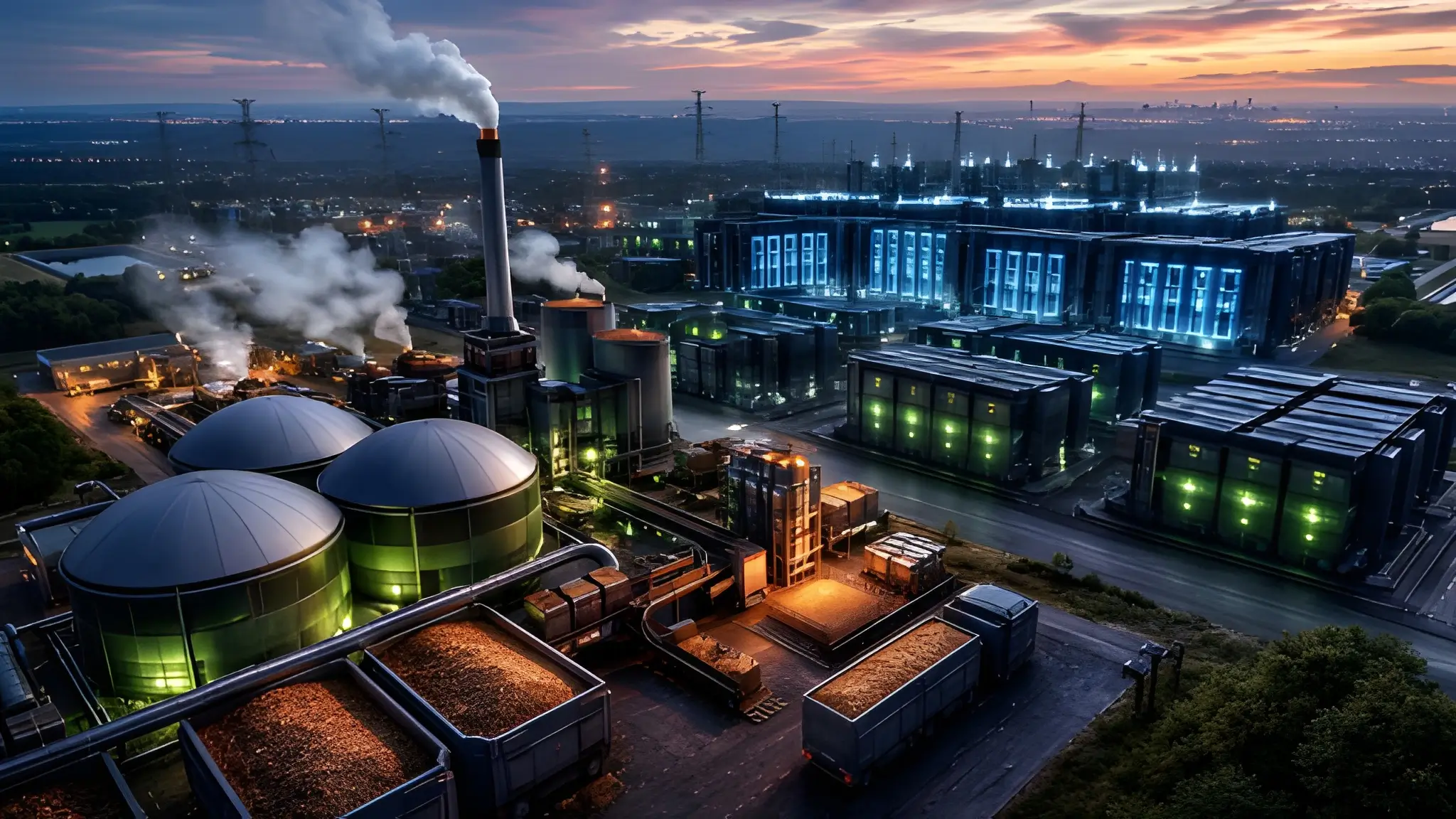
Biomass energy systems provide a unique advantage through their ability to generate power on demand using organic feedstocks. Unlike intermittent renewables, biomass plants operate with predictable output levels that support base-load requirements. Fuel supply chains for biomass can be managed to ensure consistent availability, which enhances reliability. Integration with existing infrastructure allows biomass to complement renewable generation without extensive redesign. Operators can leverage this capability in specific deployments to stabilize power supply and support continuous operation of compute workloads, although adoption remains limited across hyperscale environments. The inclusion of dispatchable bioenergy within hybrid stacks addresses the limitations of purely intermittent systems.
The Future of AI Is Power-Constrained, Not Compute-Constrained
AI development continues to push the boundaries of computational capability, yet energy availability increasingly defines the limits of achievable scale. Semiconductor innovation delivers higher performance per watt, but total energy demand rises as workloads expand in complexity and volume. Infrastructure planning now prioritizes access to reliable power sources as a prerequisite for deploying advanced compute systems. Regions with abundant dispatchable energy resources gain a strategic advantage in attracting data center investments. Energy strategy becomes inseparable from compute strategy in the next phase of AI growth. This shift indicates an emerging change in how the industry approaches scaling challenges, where energy constraints increasingly complement existing compute limitations.
Control over dispatchable energy resources will determine which operators can sustain continuous AI operations without performance degradation. Biomass and other controllable generation sources provide a pathway to meet these requirements while supporting decarbonization efforts. Energy procurement strategies evolve to include long-term agreements and on-site generation capabilities that ensure stability. Investment flows increasingly target integrated solutions that combine compute and energy infrastructure within unified frameworks. The competitive landscape shifts toward organizations that can secure reliable power at scale. Ultimately, energy reliability is becoming a critical factor alongside computational hardware availability in defining the ceiling of AI advancement.












