
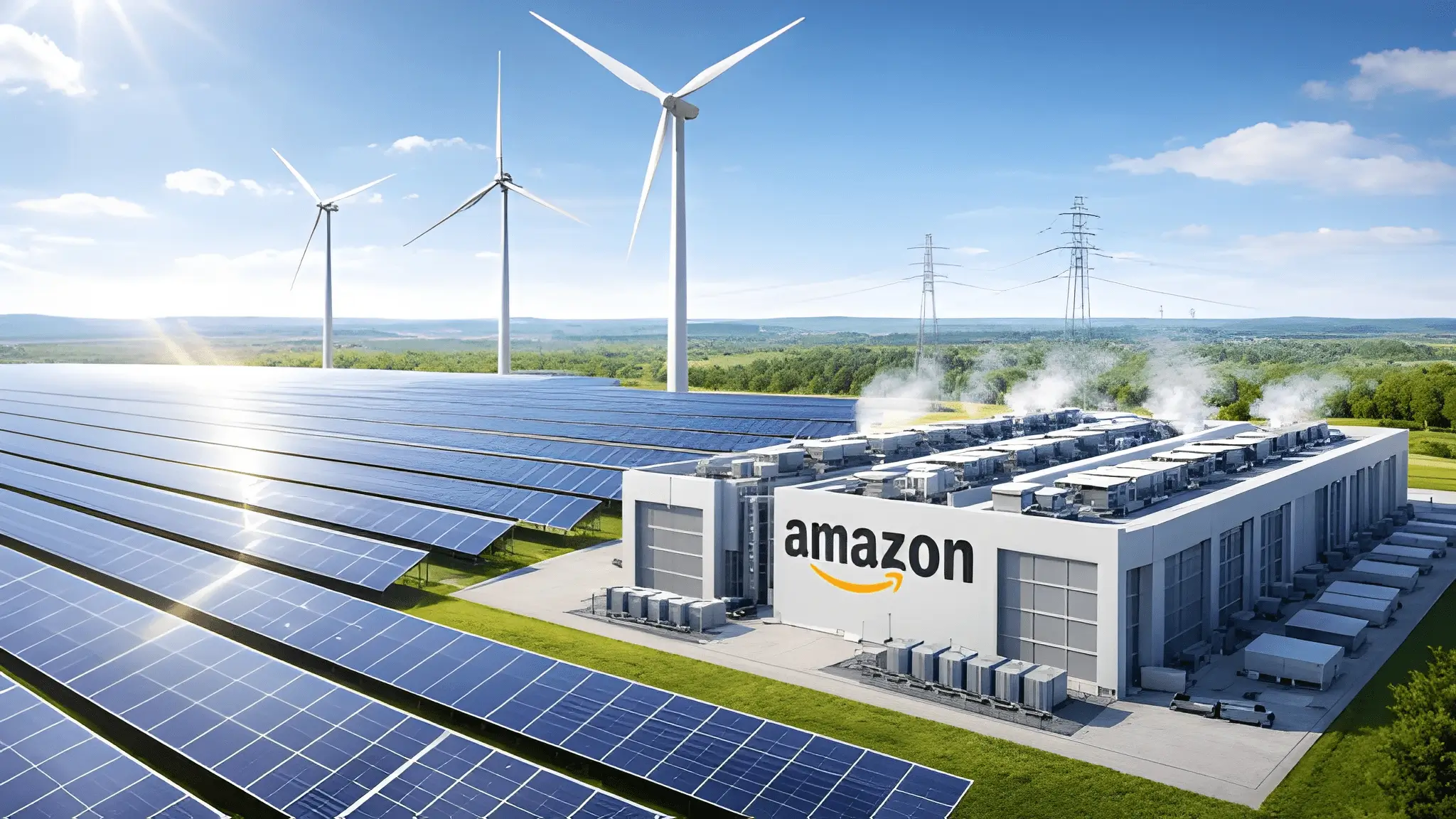
Amazon has deepened its infrastructure strategy in Australia, signing nine new renewable energy agreements that will inject 430 megawatts into the national grid. The move pushes the company’s total contracted clean energy capacity in the country to nearly 1 gigawatt, positioning its data center expansion alongside a parallel energy transition strategy.

The portfolio spans one wind project, multiple solar-plus-storage assets, and distributed hybrid installations. These assets will operate across New South Wales and Victoria, two regions increasingly central to hyperscale infrastructure growth. The company is not just procuring power, it is shaping grid resilience where compute demand is accelerating.
Battery-first approach reshapes renewable deployment
The standout element in this announcement lies in storage. Eight of the nine agreements include battery energy storage systems, marking Amazon’s first solar-battery hybrid deployments in Australia and its first such projects beyond the United States.
This shift reflects a broader recalibration in hyperscale energy strategy. Intermittent renewables alone cannot support latency-sensitive workloads tied to AI and cloud services. However, integrated storage changes that equation, enabling more predictable energy delivery aligned with data center uptime requirements.

By embedding storage directly into generation assets, Amazon moves closer to dispatchable clean energy, an increasingly critical requirement as compute intensity rises.
Land use strategy blends energy, restoration, and agriculture
Several projects highlight a layered approach to land utilization. The Muswellbrook solar farm, for instance, occupies rehabilitated brownfield land that once supported coal mining operations. This redevelopment aligns energy generation with environmental restoration goals.
Other sites integrate agricultural co-use, allowing livestock grazing between solar arrays. This dual-use model reduces land conflict while maintaining local economic activity. It also reflects a growing trend where renewable infrastructure must coexist with existing ecosystems and industries, not displace them.
Amazon’s renewable expansion directly complements its previously announced AU$20 billion data center investment across Australia, set to unfold through 2029. That capital injection aims to strengthen cloud and AI capabilities nationwide, with infrastructure designed to support high-performance workloads and enterprise-scale deployments.
The energy agreements ensure that compute growth does not outpace sustainable supply. Instead, both layers of energy and infrastructure, scale in tandem. According to BloombergNEF data, Amazon ranked as the largest corporate buyer of carbon-free energy in Australia in 2025. Globally, it continues to lead corporate renewable procurement, signaling a long-term commitment to decarbonizing digital infrastructure.
Company statement underscores grid-wide impact
“When companies like Amazon invest in new renewable energy projects, we’re not just helping to power our own operations; we’re adding brand-new sources of carbon-free energy to the power grid that everyone uses, the same grid that powers homes, hospitals, and schools. Since 2020, Amazon has invested an estimated AU$2.8 billion in renewable energy projects across Australia. Once operational, these 20 renewable energy projects will provide almost 1GW (990MW) of new renewable energy capacity, enough to power the equivalent of more than half a million Australian households annually.”
This framing positions Amazon’s investments as systemic contributions rather than isolated corporate procurement. It also underscores how hyperscale demand can catalyze broader grid decarbonization.
The nine projects distribute capacity strategically across high-demand zones. In New South Wales, developments include solar farms with integrated battery storage in Muswellbrook, Forest Glen, and Stanbridge. In Victoria, the portfolio expands to include the Golden Plains 2 wind farm alongside multiple solar-battery hybrid installations in Laceby, Indigo, Barnawartha, and Mooroopna. A dedicated battery installation will also enhance the Mokoan Solar Farm.
This geographic spread strengthens grid stability while aligning generation with consumption hubs.
Water sustainability and cooling innovation in parallel
Alongside energy investments, Amazon Web Services is advancing water sustainability initiatives tied to its infrastructure footprint. The company aims to become water positive by 2030, deploying treated wastewater solutions for data center cooling systems.
This dual focus, energy and water, signals a more holistic sustainability framework for hyperscale operations, where resource efficiency extends beyond electricity consumption.
Amazon’s latest move in Australia reflects a broader industry shift: energy is no longer a supporting layer for data centers, it is a defining constraint. By integrating renewable generation, storage, and infrastructure planning, the company is building a vertically aligned model for sustainable compute growth. The result is not just additional capacity, but a blueprint for how hyperscalers can scale responsibly in energy-constrained markets.











