
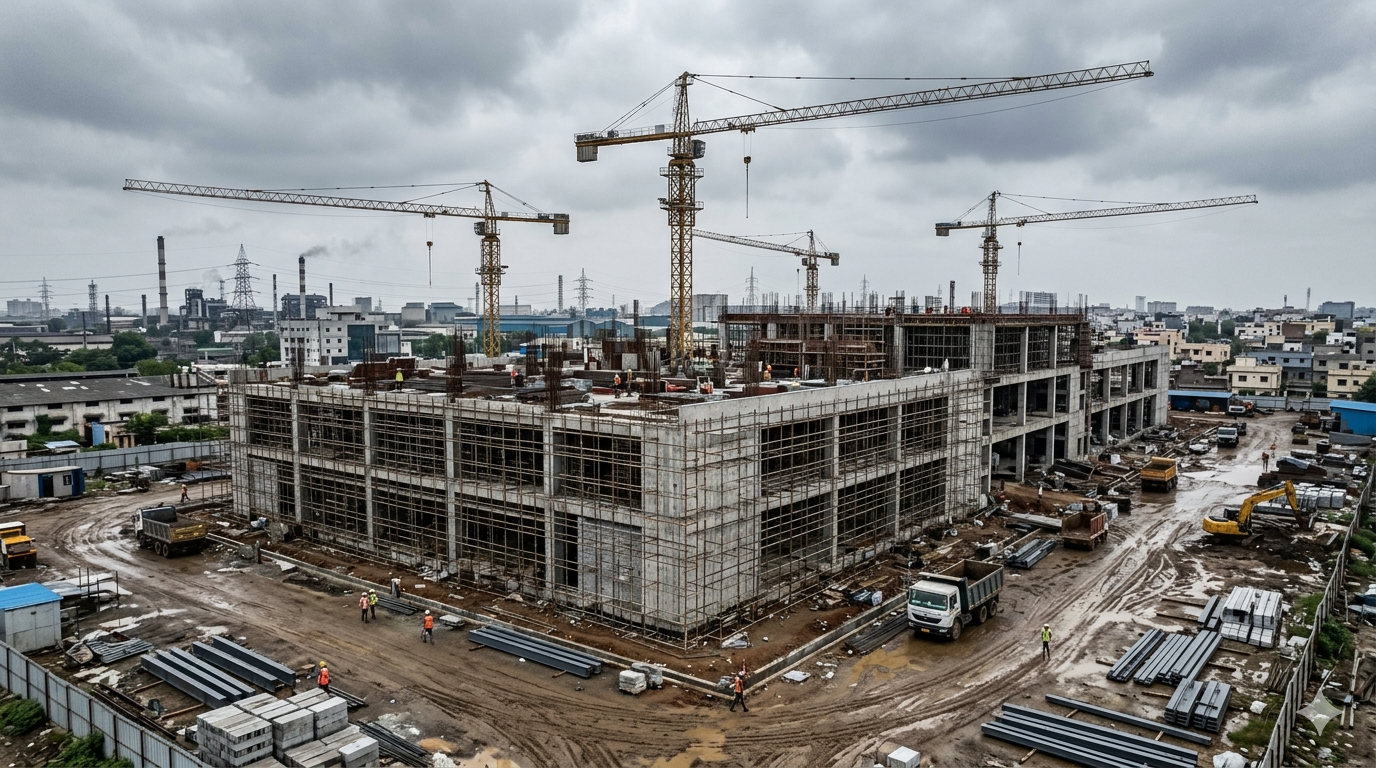
For the past two years, every major conference in the AI infrastructure space has featured the same set of panels. Power availability. Grid constraints. Interconnection queue backlogs. The physical limits of electricity delivery in markets where AI infrastructure is concentrating. The message has been consistent and urgent. Power is the binding constraint. The grid cannot keep up. The bottleneck is not GPUs or capital. It is electrons and the infrastructure required to deliver them reliably at scale.

Then the same companies delivering that message went back to their boards and committed more capital than the industry had ever seen. Alphabet, Amazon, Meta, and Microsoft collectively projected capital expenditure approaching $700 billion in 2026, the overwhelming majority directed at data center construction and the AI hardware that fills it. The industry declared power its biggest problem and responded by accelerating the build at a pace that makes the power problem significantly worse. That contradiction deserves examination that it has not yet received.
The Gap Between What the Industry Says and What It Does
The cognitive dissonance at work here is not hard to understand at the individual company level. Each major hyperscaler faces the same competitive logic. If a rival builds more AI infrastructure and captures the enterprise market for AI workloads, the cost of catching up later exceeds the cost of overbuilding now. That logic is sound at the individual level. It produces collective behavior that is difficult to defend at the system level, because the simultaneous acceleration of every major player compounds precisely the infrastructure constraints that all of them publicly identify as the binding limit on AI growth.
The result is a market where announcements vastly outpace physical deliverability. Roughly half of planned US data center builds in 2026 face delays or cancellations. Not because capital has dried up. Not because hyperscaler demand has softened. Because the electrical equipment required to power those facilities takes longer to manufacture and deliver than the timelines the announcements assumed. The industry knows this. It has known it for two years. It kept announcing anyway.

Why Acknowledgment Without Accountability Is Not Enough
There is a version of this story that presents the power constraint as an honest challenge that the industry is working to address. Companies are investing in behind-the-meter generation. They are signing nuclear power agreements. They are exploring geothermal and long-duration storage as firm clean power alternatives. That investment is real and it matters. However, acknowledging a constraint while simultaneously taking actions that deepen it is not a coherent strategy. It is a performance of concern that leaves the underlying dynamic unchanged.
The underlying dynamic is that AI infrastructure investment decisions operate on a competitive logic that discounts physical constraints. A hyperscaler that slows its build because transformers are unavailable loses competitive position to hyperscalers that find ways to source equipment anyway. A developer that announces a realistic timeline loses commercial conversations to developers that announce aggressive timelines they cannot meet. The incentive structure rewards acceleration and announcement over accuracy and execution. As covered in our earlier analysis of America’s AI growth being held hostage by supply chains, this pattern has been visible for some time. The industry’s response has been to acknowledge it publicly and ignore it operationally.
What a Coherent Response Would Actually Look Like
A coherent industry response to the power constraint would look different from what is currently happening. Hyperscalers would publish realistic capacity delivery timelines that reflect actual electrical equipment lead times rather than aspirational construction schedules. Developers would refuse to sign tenant agreements on timelines that their procurement positions cannot support. Pricing execution risk of development pipelines based on electrical equipment commitment status rather than announced capacity figures would become standard investor practice.
None of these things are happening at meaningful scale. The incentives do not support them. A hyperscaler that publishes realistic timelines invites competitive disadvantage. A developer that refuses aggressive timelines loses deals. An investor that prices execution risk conservatively underperforms peers who price it optimistically until the delays materialize. The system produces optimistic announcements and delayed delivery as predictable outputs of its incentive structure, not as failures of individual judgment.
The Cost That Nobody Is Accounting For
The delays that result from this dynamic carry costs that the industry’s public accounting does not capture. Enterprise customers who plan AI deployments around capacity commitments that slip face operational disruptions and competitive disadvantages that they absorb silently rather than publicizing. Communities that approved data center projects on the basis of promised timelines and economic benefits experience prolonged construction periods that deliver neither the disruption nor the benefit on schedule. Grid operators who planned capacity upgrades around data center load additions that did not materialize on schedule face planning problems that cascade through their investment cycles.
These costs are real. They are distributed across stakeholders who have limited ability to hold the industry accountable for them. The enterprise customer renegotiates quietly. The community absorbs the disruption without recourse. The grid operator adjusts its plans without public attribution. The hyperscaler announces a revised timeline without acknowledging the original was unrealistic. The cycle repeats.
The Reckoning That Is Coming
The power constraint will not stay invisible indefinitely. The gap between announced AI infrastructure capacity and delivered capacity is large enough and growing fast enough that it will eventually force a market reckoning that individual company incentives cannot prevent. When enterprise customers who planned AI deployments around specific capacity timelines begin experiencing delays at scale, the commercial consequences will be visible in ways that earnings calls cannot absorb quietly. When the cumulative cost of delay-driven equipment premiums, renegotiated tenant agreements, and missed deployment windows shows up in development economics, the financial case for announcement-first strategy will weaken.
That reckoning may arrive as a correction or as a maturation. A correction would involve a sharp repricing of development timelines and a consolidation of the market around operators with genuine procurement positions and executable pipelines. A maturation would involve the industry voluntarily adopting more honest timelines, more rigorous procurement discipline, and more transparent communication about the physical constraints that actually govern delivery. The difference between the two outcomes depends on whether the industry chooses to address the contradiction between its stated concerns and its actual behavior before the market forces it to. The contradiction is not hidden. It is stated openly at every major industry conference, acknowledged in every earnings call, and then acted upon in precisely the opposite direction. At some point, the physics stops waiting for the incentive structure to catch up.











