 Skip to content
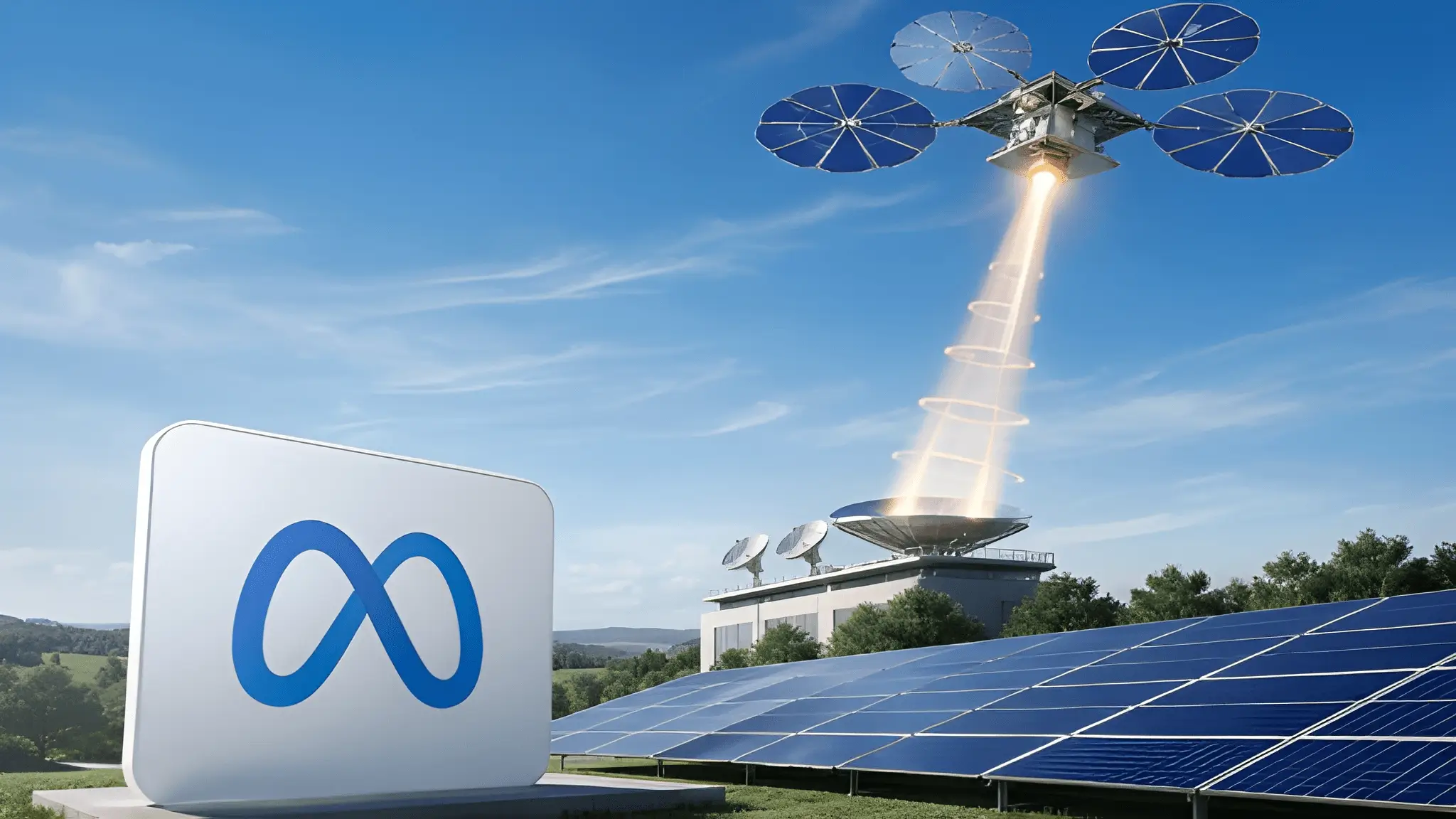
Meta Platforms is moving beyond terrestrial energy constraints, securing a landmark partnership to source solar power from space for its expanding AI data centre footprint. The agreement signals a structural shift in how hyperscalers approach energy reliability as compute demand accelerates.

Meta confirmed it has struck a deal with Overview Energy for up to 1 gigawatt of space-derived solar capacity. The reservation places Meta among the earliest technology companies to lock in orbital energy supply, effectively treating space as the next frontier of infrastructure.
Overview Energy continues to develop and validate its core systems, targeting an initial orbital demonstration in 2028. Meta expects access to the energy by the end of the decade, aligning with projected surges in AI-driven workloads.
Unlocking the Limits of Terrestrial Solar
Meta framed the partnership as a response to a fundamental limitation: Earth-based solar generation remains intermittent. Solar farms operate only during daylight hours, leaving capacity underutilised for significant portions of the day.

Overview Energy is attempting to “unlock these idle hours” through a radically different architecture. Its satellites operate in geosynchronous orbit, approximately 22,000 miles above the equator, where sunlight remains constant. From this vantage point, energy is captured continuously and transmitted to Earth as low-intensity, near-infrared light.
This model allows existing solar facilities to extend production cycles. As a result, infrastructure that would otherwise remain inactive overnight can generate electricity around the clock, improving output efficiency and grid contribution.
Meta emphasised that these ground facilities convert the transmitted energy into electricity without requiring additional land or new grid infrastructure. “Because the technology will build on solar infrastructure that’s already in place rather than requiring new facilities, it can come online faster at scale than traditional buildouts,” Meta stated.
Infrastructure Without Footprint Expansion
The appeal of orbital solar lies not just in continuity but in deployment speed. Traditional energy projects often face land acquisition challenges, permitting delays, and grid integration bottlenecks. By contrast, Meta’s approach leverages existing solar assets as receiving nodes, effectively bypassing these constraints.
This positions space solar as a modular overlay rather than a ground-up buildout. It also aligns with hyperscaler priorities: rapid scaling, predictable output, and minimal friction with local infrastructure ecosystems.
Long-Duration Storage Completes the Stack
However, generation alone does not solve the intermittency challenge at grid scale. Meta is pairing its orbital solar strategy with energy storage to stabilise supply across extended periods.
The company has partnered with Noon Energy to deploy up to 1GWh of long-duration energy storage capacity. The system aims to deliver consistent, clean power to next-generation AI data centres, even when supply fluctuations occur.
Meta noted that grids require storage capable of holding energy not just for hours, but for multiple days. This capability becomes critical as renewable penetration increases and workloads demand uninterrupted uptime.
The agreement includes a reserved capacity allocation, alongside a 2.5GWh pilot demonstration project expected to complete in 2028. The timeline mirrors the orbital solar rollout, suggesting a coordinated infrastructure stack that integrates generation and storage simultaneously.
A New Energy Layer for AI Scale
Meta’s dual investment in space-based generation and long-duration storage reflects a deeper recalibration of energy strategy in the AI era. Data centres are no longer passive consumers of grid power; they are becoming active participants in shaping energy ecosystems.
By securing early access to orbital solar capacity, Meta is effectively hedging against terrestrial constraints while positioning itself for sustained compute expansion. The approach also signals a broader industry shift, where energy innovation becomes inseparable from infrastructure design.
Meanwhile, the convergence of orbital generation and advanced storage introduces a new operational paradigm: always-on renewable energy tailored for high-density compute environments. For AI infrastructure, where downtime translates directly into lost value, that reliability could become a defining competitive edge.












