
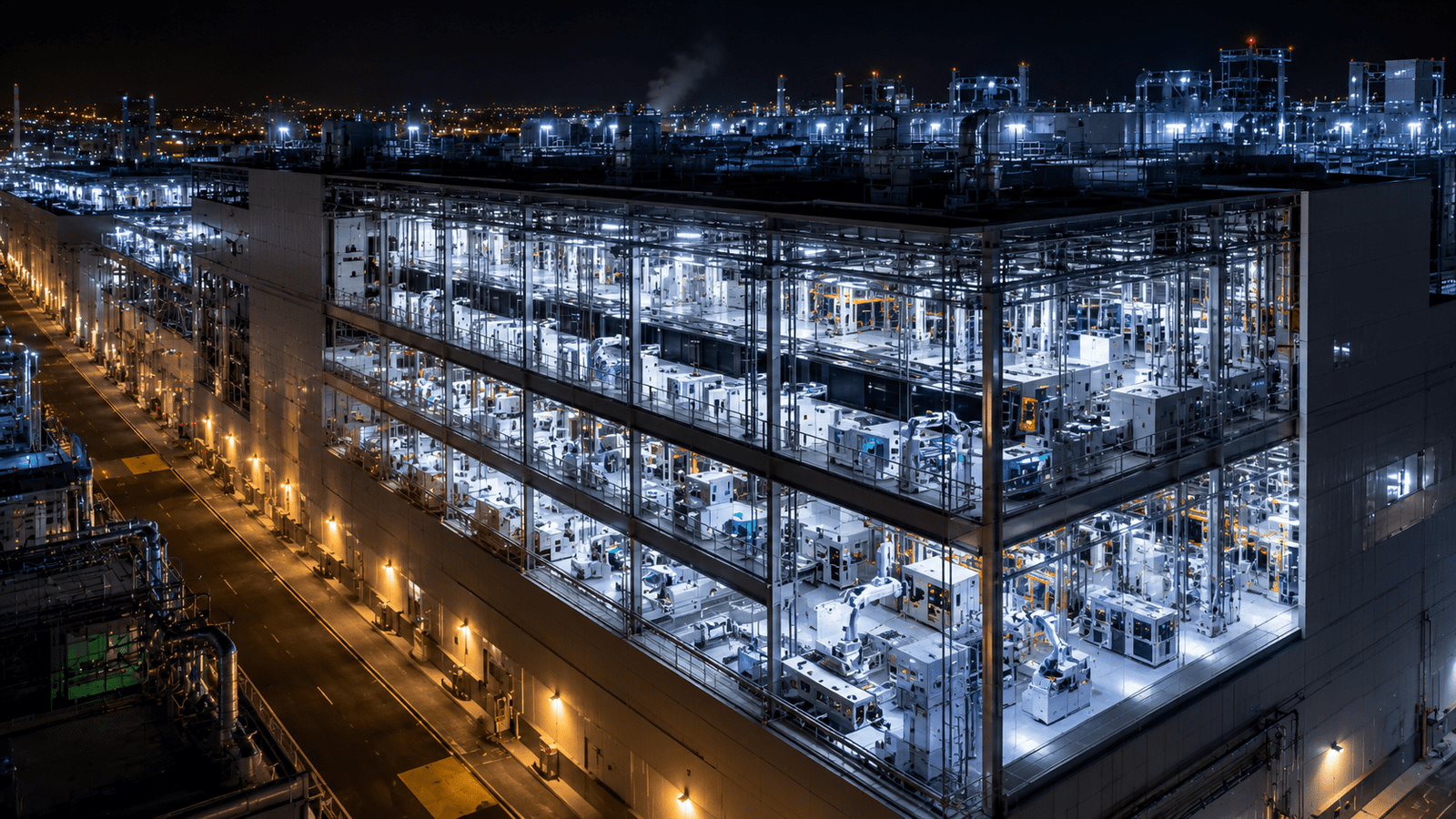
The AI infrastructure industry has constructed a sustainability narrative around operational emissions. Data centers powered by renewable energy. PPAs with wind and solar providers. Net-zero commitments timed to 2030 or 2040. These are real commitments and some are being met. They are also the most visible and most easily measured dimension of what the AI buildout actually costs the atmosphere, and the dimension that captures the smallest share of the total problem.

The carbon that the industry is not discussing — the carbon that has been accumulating in the supply chain, in the semiconductor fabrication facilities, in the steel and concrete of data center construction, and in the GPU hardware that gets replaced every 18 months — is the hidden debt. Only 60% of corporations disclose Scope 3 emissions, which account for more than 50% of total emissions. The AI infrastructure market, which is among the most capital-intensive and hardware-intensive industries in history, has been building its sustainability case on the 40% of emissions it discloses while leaving the majority unreported, unmeasured, and unaccounted. That accounting gap is narrowing, and the policy and regulatory developments that are forcing it to close will create accountability problems for an industry that has not yet reckoned with what full disclosure actually reveals.
The Supply Chain Emissions That Dwarf Operational Carbon
The scale of the supply chain carbon problem in AI infrastructure is not widely appreciated because the companies responsible for AI hardware have not disclosed it. A 2025 Greenpeace East Asia report found that Nvidia attributes 84% of its total emissions to its supply chain, and AMD attributes 98%. These figures mean that for every tonne of carbon that Nvidia’s operational activities generate directly — its offices, its test labs, its owned vehicles — its supply chain generates between five and sixteen tonnes more. Semiconductor fabrication facilities in Taiwan, South Korea, and China manufacture the GPUs that support the AI buildout and rely primarily on fossil-fuel electricity because renewable energy infrastructure in those regions cannot yet meet the baseload power requirements of advanced-node semiconductor fabrication.
A Blackwell GPU carries substantial embedded carbon before operators ever switch it on, yet the industry continues building sustainability credentials around renewable-powered data centers while purchasing one of the most carbon-intensive manufactured components in the modern economy.

The Emissions That Renewable Power Does Not Eliminate
For data centers powered by very low-carbon electricity, Scope 3 embodied emissions can represent 40% of total lifetime greenhouse gas emissions. In AI data centers specifically, chips and memory account for 67% of embodied emissions, structural materials 17%, with server power supplies and other components making up the remaining 16%. The implication is that a hyperscaler that achieves 100% renewable energy for its operations and celebrates its Scope 2 emissions achievement is still carrying the embodied carbon of its server fleet as an unaccounted liability. A renewable energy certificate does not offset the carbon emitted in Hsinchu or Pyeongtaek during the manufacture of the GPU running inside the renewable-powered data center. The industry’s sustainability narrative is accurate about what it measures. It is silent about what it does not.
The Regulatory Pressure That Is Forcing Disclosure
The disclosure gap that has protected the AI industry from full carbon accounting scrutiny is closing under regulatory pressure from multiple directions simultaneously. A 2025 Greenpeace East Asia report found that Scope 1 and 2 filing in 2026. The EU’s Corporate Sustainability Reporting Directive and the associated European Sustainability Reporting Standards require companies to report on material impacts across their entire value chain, which explicitly includes the embodied carbon of server hardware for companies whose AI strategies depend on GPU-intensive computing. The SEC’s climate disclosure rule, despite its legal challenges, has established a directional framework that treats Scope 3 emissions as material information for public companies.
The practical challenge for AI infrastructure companies preparing to comply with these requirements is significant. Most cloud service agreements do not currently provide workload-level emissions data. Semiconductor manufacturers including Nvidia and AMD do not release granular embodied carbon data for their products, making it impossible for their customers to calculate the embodied carbon of their owned hardware fleets with the precision that CSRD and SB 253 will require. The measurement infrastructure that the AI industry would need to produce defensible Scope 3 disclosures does not currently exist at the level of specificity that emerging reporting requirements demand. The industry is approaching a period in which regulators will require companies to account for emissions they have never measured, apply methodologies they have not yet developed, and comply with regulatory frameworks whose penalty regimes are becoming increasingly specific.
The Hardware Refresh Cycle That Compounds the Debt
The AI hardware upgrade cycle creates a specific and compounding embodied carbon problem that has no equivalent in conventional data center operations. A conventional data center server has a useful life of five to seven years. Operators replace AI GPU clusters every 18 to 24 months as Nvidia’s product roadmap moves from H100 to Blackwell to Rubin, with each generation delivering materially better price-performance that makes the previous generation economically uncompetitive for frontier AI workloads. Servers embody 1,200 to 2,000 kg of CO2 equivalent per unit. Multiplied across a hyperscaler fleet of millions of servers turning over on a 24-month cycle, the embodied carbon of hardware procurement is generating emissions at a rate that the operational decarbonisation story does not address.
The secondary market for retired AI GPUs provides partial mitigation by extending the useful life of hardware beyond the frontier deployment cycle. A hyperscaler that replaces its H100 fleet with Blackwell hardware and sells the H100s into the enterprise secondary market is reducing the total embodied carbon cost per inference by spreading the upfront manufacturing emissions across a longer aggregate utilisation period. But the scale of hardware turnover in the current AI upgrade cycle exceeds the secondary market’s ability to absorb it, which means operators retire a significant fraction of AI hardware before the computational work it performs fully offsets its embodied carbon. The industry that is proud of its renewable energy procurement has not yet accounted for the embodied carbon of the hardware churn that its competitive dynamics are producing.
The Carbon Debt That Cannot Be Undone by Future Efficiency
The most uncomfortable dimension of the AI buildout’s hidden carbon debt is the irreversibility of embodied emissions. Embodied emissions are unique in one crucial way: they occur before operations even begin. Once the concrete is poured and the hardware installed, the carbon cost is already sunk. The hyperscaler that builds a 500-megawatt data center campus in 2026 has already incurred the embodied carbon of that facility’s construction materials, electrical infrastructure, and server hardware regardless of how efficiently the facility operates or how much renewable energy it uses. Future operational efficiency cannot retroactively reduce the upfront carbon debt that the construction and hardware procurement process generates.
Embodied carbon can account for 50% of a building’s total lifecycle emissions when powered by clean electricity, according to One Click LCA framework analysis. As the AI buildout transitions more data center power to renewables and the operational carbon profile improves, the embodied carbon share of total lifecycle emissions grows proportionally. As the industry successfully decarbonises its operations, it simultaneously increases the relative importance of embodied carbon that it has not yet had to address. The faster operational decarbonisation proceeds, the more visible the embodied carbon debt becomes as a share of total lifecycle impact.
The AI industry’s sustainability progress is real. It is also creating the conditions under which the dimensions of its footprint it has not addressed become the primary story. The policy, regulatory, and investor attention that is now moving toward embodied carbon and supply chain emissions will not find a sector that has been preparing for it. It will find a sector that has been building a carbon debt it assumed would remain invisible.











