
.Nscale Locks $3.5 Billion Figure Robotics Compute Deal  ·Qatar’s Meeza Lands Major Hyperscaler Deal for 8MW ·Qualcomm Strikes Amazon AI Chip Deal, Opens Door to $4 Billion Stock ·Hitachi Energy Bets $300M on China Grid Manufacturing Corvex Builds Toward 8MW Cloud Infrastructure Footprint LITEON Bets $176 Million on DCX Liquid Cooling EdgeConneX Backs Singapore’s AI-Ready Tropical Data Center Testbed

The Hyperscaler That Wins the Next Decade Will Win It on Energy, Not Chips

The AI infrastructure coverage of the past three years has been a story about chips. Who has the most H100s.

Share
Hyperscaler energy strategy competitive advantage AI infrastructure 2026

The AI infrastructure coverage of the past three years has been a story about chips. Who has the most H100s. Who got Blackwell allocations first. Which neocloud is closest to Nvidia. The chip narrative makes intuitive sense. Nvidia controls the dominant hardware for frontier AI. Access to its hardware has been a genuine constraint.

But Nvidia sells to everyone. Amazon, Google, Microsoft, and Meta all buy from the same supplier. CoreWeave, Lambda, and Crusoe all buy from the same supplier. The chip is not a differentiator when every serious operator can access it with sufficient lead time and capital. The variable that actually separates the hyperscaler that dominates 2030 from the ones that follow is hyperscaler energy strategy. And the decisions that determine that outcome are being made right now.

The Constraint Has Shifted

Microsoft has $80 billion in unfulfilled Azure orders because it cannot find enough power. Not because it cannot access Nvidia hardware. The binding constraint in the AI buildout has moved from chips to electricity. Approximately 40% of announced AI data center projects face construction delays due to power infrastructure, not chip supply. The operators who understood this shift earliest are the ones signing energy deals that their competitors will spend years trying to match.

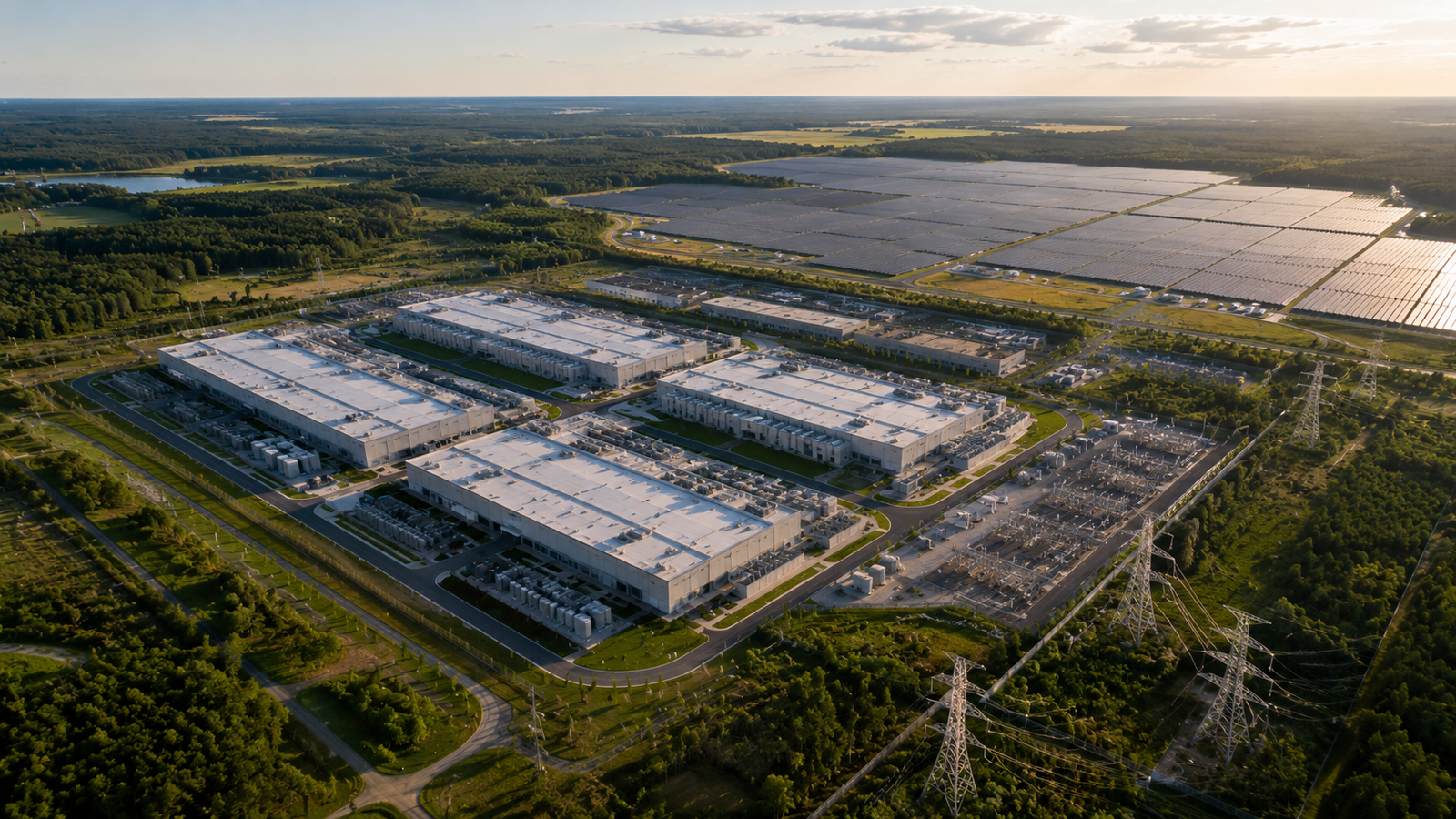
Google acquired Intersect Power for $4.75 billion in late 2025. That is the first time a hyperscaler has bought a major clean energy developer outright rather than signing a purchase agreement. The deal gives Google direct control over energy parks that co-locate data centers with generation and storage. It bypasses grid interconnection delays that now stretch 7 to 12 years in some regions. That is not a power procurement decision. It is a competitive moat decision.

The PPA Portfolio Is the New GPU Allocation

A power purchase agreement signed at scale in 2023 or 2024 at fixed prices is now worth substantially more than its face value. Electricity costs for AI data centers are rising as grid demand increases and as the most accessible power has already been reserved. The hyperscaler that locked in 10.5 gigawatts of renewable capacity at fixed prices through the Brookfield deal, as Microsoft did, is holding a cost structure its competitors cannot replicate at the same price today.

This is exactly how competitive advantage compounds in infrastructure markets. The operator who secures the best resource at the best price before the market prices in the scarcity holds a position that is simultaneously a cost advantage and a barrier to competition. GPU procurement does not work this way. Hardware prices fall over time. Power purchase agreements for the best sites at the best prices get more expensive as competition increases, not less.

Nuclear as the Clearest Signal

Microsoft’s 20-year agreement with Constellation Energy to restart Three Mile Island is the clearest statement in the market about what hyperscaler energy strategy looks like when operators are thinking on the right timescale. A 20-year contract is not a power procurement decision. It is a declaration that Microsoft expects to be running AI workloads that require baseload nuclear power for the next two decades and is willing to fund the restart of a nuclear plant to secure it.

Meta’s agreement with Vistra for Comanche Peak nuclear power follows the same logic. Amazon’s nuclear energy deal with Talen Energy does the same. The operators signing 20-year nuclear contracts in 2025 and 2026 are not optimising for 2027 earnings. They are building the energy infrastructure that will determine their cost structure and capacity ceiling in 2035.

The Operators Without an Energy Strategy Are Already Behind

The hyperscalers and neoclouds that treated energy procurement as an operational function rather than a strategic one are discovering the consequences. Grid interconnection queues in the US now stretch years. The most attractive power markets, those with cheap generation, reliable transmission, and available interconnection capacity, are already heavily subscribed. The sites that combine power access, water availability, and fibre connectivity at the density AI campuses require are genuinely scarce.

Combined hyperscaler capex for 2026 sits in the $680 to $720 billion range. According to analyst estimates, competitive differentiation at that scale increasingly resolves at the silicon and energy layers. Silicon is Nvidia’s call. Energy is the hyperscalers’ own. The operator that built the deepest, longest, cheapest energy position before the scarcity fully priced in is the one whose margin structure in 2030 will reflect decisions made years earlier when the opportunity was still available.

Why Energy Advantage Compounds Differently Than Hardware Advantage

Hardware advantage is real but temporary. Nvidia ships a new architecture every 12 months. The H100 fleet that gave early operators a training advantage in 2023 is now a commodity. Blackwell will follow the same trajectory. Every hardware advantage resets with the next generation.

Energy advantage does not reset. A 20-year fixed-price nuclear PPA signed in 2024 generates the same cost advantage in 2034 as it does today, and more so if electricity prices rise as grid demand from AI continues to grow. The Intersect acquisition gives Google a generation asset whose value increases as the scarcity of co-located power and data center capacity deepens. These are positions that companies cannot replicate by writing a bigger check in 2027. Competitors have already secured the land, signed the contracts, and claimed the interconnection queue positions.

What This Means for the Operators Who Did Not Move Early

The operators who did not build deep energy positions in 2023, 2024, and 2025 are not necessarily finished. But they are competing for a resource that is more expensive and more constrained than when the window was open. The behind-the-meter gas strategy, the offshore wind PPAs, and the SMR commitments that operators are now announcing are the right moves. They are also more expensive versions of moves that the early movers made when the market had not yet priced in the scarcity.

The hyperscaler energy strategy divergence between operators is not a short-term trading opportunity. It is a structural divergence in competitive position that will be visible in margin structures, capacity ceilings, and market share for the full decade ahead. Chips matter. Chips are table stakes. The operators who understood that energy was the moat, not the input, are the ones building the position that actually determines who wins.


[simple-author-box]

More from AI Infrastructure

The most important number attached to a proposed data center may no longer be

A company can sign for GPUs, reserve a data hall and approve an AI

Europe’s AI infrastructure debate increasingly centers on power, land, permitting and financing, but another

COMPUTE WEEKLY

The briefing that 40,000+ tech leaders read every Monday. Sharp, fast, essential.

Building an AI Startup Without Owning GPUs

Not owning GPUs has become the default, deliberate strategy for building an AI company — not a compromise founders accept reluctantly. H100 rental rates fell 64-75% in fifteen months, a dense ecosystem of neoclouds and inference-as-a-service providers now lets startups skip infrastructure entirely, and credit programs can fund a company’s first year before a founder writes a check
Most Read

A compute node sitting behind a garage door can perform the same basic computational

A project can leave a site without leaving behind the conditions that made the

A commercial operation date can look precise long before the underlying project is capable

A 5 GW AI infrastructure plan can satisfy every conventional site-selection requirement and still

A fire strategy becomes expensive when the building has already decided where walls, equipment,

Disruptor Spotlight

Cerebras Systems

The chip that makes Nvidia nervous. Cerebras’ Wafer Scale Engine is rewriting the rules of AI inference at scale.
Faster
0 x
YoY Revenue
0 x
Transistors
0 T
Market Pulse
MSFT
+1.02%
NVDA
+0.66%
AMZN
-0.078%
AMD
-6.95%
TSMC
-2.98%
Indicative only · Not financial advice
Upcoming Events
SEP
The AI Infrastructure Race (India)
WEBINAR · ONLINE
The AI Infrastructure Race: Won on Power, Land and Trust — Not Capital
MAY
0
AI Infrastructure Summit
DUBAI · IN PERSON
MEA’s premier AI infrastructure event.
JUN
0 0
Compute Forecast Summit
SINGAPORE · IN PERSON
Our flagship APAC event. Early bird open.
Latest Moves
Live
ecolab
Ecolab Deepens Cooling Strategy With $4.75B CoolIT Acquisition
Ecolab is making one of its biggest moves yet into AI infrastructure after completing its $4.75 billion acquisition of liquid cooling specialist CoolIT Systems
Pure DC AVK Europe data center microgrid Dublin 110MW AI infrastructure Ireland 2026
Pure DC and AVK Deploy Europe’s First 110 MW Data Center Microgrid in Dublin
The Pure DC Dublin microgrid has made history as Europe’s first large-scale on-site data center microgrid, launched in partnership with power solutions provider AVK at Pure DC’s campus in Ireland.
Pace Digitek
Pace Digitek Partners With MEGMEET to Expand AI Data Center Power Business
India’s AI infrastructure ecosystem continues to mature as domestic technology manufacturers move beyond traditional telecommunications and industrial markets toward high-growth digital infrastructure opportunities
Follow Compute Forecast
11K followers
1200 followers
Companies to Watch
CW
CoreWeave
Neo Cloud · $19B · IPO Watch
CB
Cerebras Systems
AI Hardware · $4.25B · Pre-IPO
G42
G42
Sovereign AI · Abu Dhabi
H
Humain
Saudi AI · $40B Fund
Latest Podcast
AI Capex, Cloud Margins & the Nuclear Bet
48 MIN · 25 APR 2026

The Hyperscaler That Wins the Next Decade Will Win It on Energy, Not Chips

The AI infrastructure coverage of the past three years has been a story about chips. Who has the most H100s.

Share
Hyperscaler energy strategy competitive advantage AI infrastructure 2026
30
847 SHARES

0
SHARES

[simple-author-box]

More from AI Infrastructure

A compute node sitting behind a garage door can perform the same basic computational

A project can leave a site without leaving behind the conditions that made the

A commercial operation date can look precise long before the underlying project is capable

A 5 GW AI infrastructure plan can satisfy every conventional site-selection requirement and still

COMPUTE WEEKLY

The briefing that 40,000+ tech leaders read every Monday. Sharp, fast, essential.

Great! We’ve received your information.

Global AI Infrastructure Outlook 2026

The briefing that 40,000+ tech leaders read every Monday. Sharp, fast, essential.
Download Free
Most Read

A compute node sitting behind a garage door can perform the same basic computational

A project can leave a site without leaving behind the conditions that made the

A commercial operation date can look precise long before the underlying project is capable

A 5 GW AI infrastructure plan can satisfy every conventional site-selection requirement and still

A fire strategy becomes expensive when the building has already decided where walls, equipment,

Disruptor Spotlight

Cerebras Systems

The chip that makes Nvidia nervous. Cerebras’ Wafer Scale Engine is rewriting the rules of AI inference at scale.
Faster
0 x
YoY Revenue
0 x
Transistors
0 T
Market Pulse
NVDA
$924.60
+2.4%
MSFT
$421.30
+1.1%
AMZN
$192.80
-0.6%
NVDA
$924.60
+2.4%
NVDA
$924.60
+2.4%
Indicative only · Not financial advice
Upcoming Events
MAY
0 0
DCD Global — London
LONDON · IN PERSON
World’s largest DC event. CF is media partner.
MAY
0
AI Infrastructure Summit
DUBAI · IN PERSON
MEA’s premier AI infrastructure event.
JUN
0 0

Compute Forecast Summit

SINGAPORE · IN PERSON
Our flagship APAC event. Early bird open.
Latest Moves
  • Live
Sam Altman
OpenAI appoints new Chief Infrastructure Officer to lead $100B DC programme
27 APR · OPENAI
Sam Altman
OpenAI appoints new Chief Infrastructure Officer to lead $100B DC programme
27 APR · OPENAI
Sam Altman
OpenAI appoints new Chief Infrastructure Officer to lead $100B DC programme
27 APR · OPENAI
Follow Compute Forecast
18.4K followers
12.1K followers
9.3K subscribers
41 episodes
Companies to Watch
CW
CoreWeave
Neo Cloud · $19B · IPO Watch
CB
Cerebras Systems
AI Hardware · $4.25B · Pre-IPO
G42
G42
Sovereign AI · Abu Dhabi
CW
Humain
Saudi AI · $40B Fund
Latest Podcast
AI Capex, Cloud Margins & the Nuclear Bet
48 MIN · 25 APR 2026
Scroll to Top








