 Skip to content
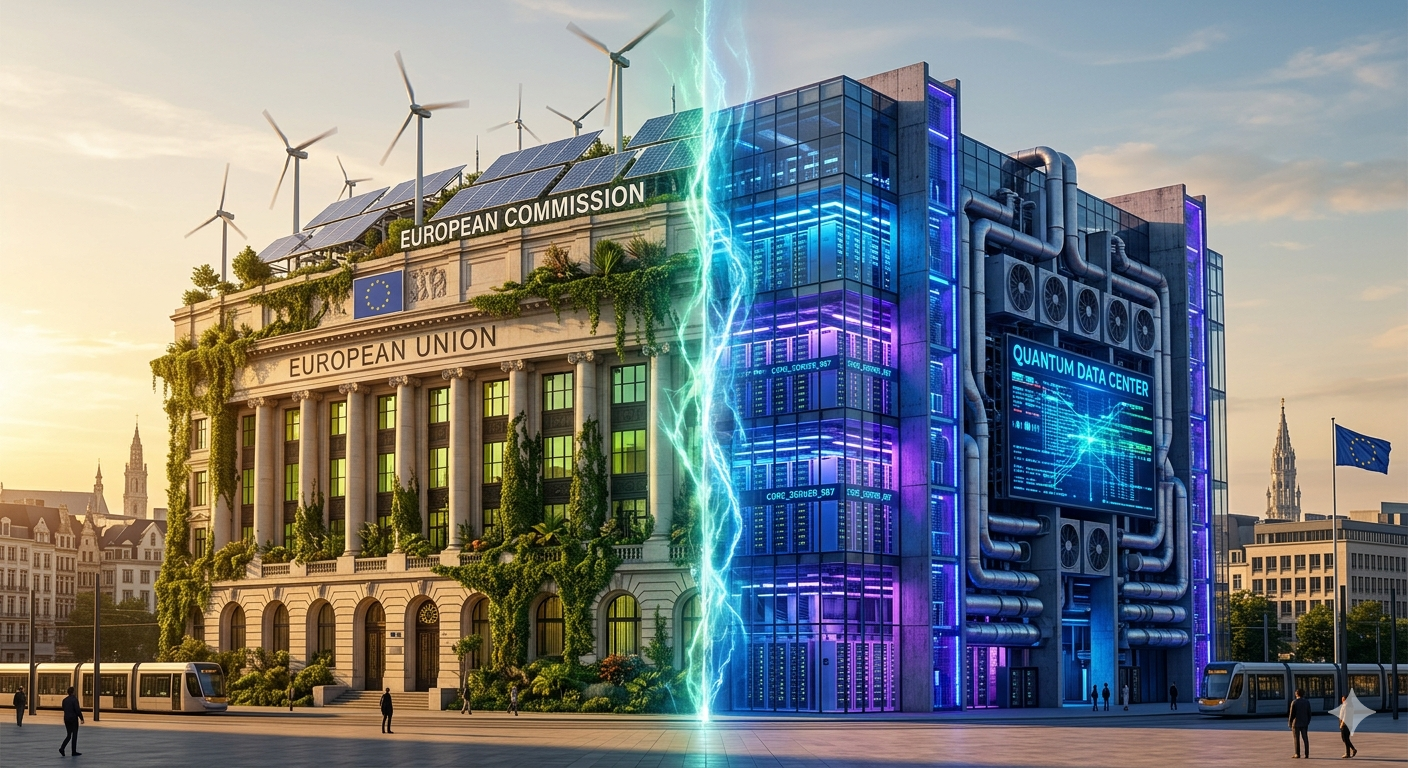
On June 3, 2026, the European Commission formally proposed the Cloud and AI Development Act its most ambitious infrastructure legislation yet, targeting a tripling of EU data center capacity within five to seven years, backed by an estimated €200 billion in primarily private investment. The same Commission simultaneously holds binding commitments to reduce EU energy consumption by 11.7% by 2030, achieve carbon neutrality for data centers that same year, and deliver on the Green Deal. EU data center power demand stood at 70 TWh in 2024. The IEA projects 115 TWh by 2030; Ember’s analysis puts it at 168 TWh. These three goals cannot all be achieved simultaneously as currently framed and nobody in Brussels is saying so out loud. Meanwhile, the sustainability label meant to create accountability for this expansion has been delayed because ten member states are fighting over whether nuclear counts as clean energy. The EUDCA’s own secretary general warned publicly at Datacloud 2026 that prescriptive EU efficiency regulation is already driving investment away from Europe. The contradiction is structural and it is accelerating.

The Most Ambitious Contradiction Brussels Has Ever Proposed
On June 3, 2026, the European Commission formally proposed what it described as a landmark step toward technological independence. The Cloud and AI Development Act introduced a four-tier cloud sovereignty framework, plans to triple EU data center capacity, and new requirements for how public institutions procure cloud and AI services. The proposal forms part of the Commission’s broader tech sovereignty package, alongside the Chips Act 2.0 and an updated EU Open Source Strategy. The ambition is genuine and the strategic rationale is sound. Europe’s dependence on U.S. hyperscalers for cloud and AI infrastructure represents a structural vulnerability that regulators and policymakers across member states have identified as incompatible with the bloc’s long-term digital autonomy. The Commission’s stated infrastructure target tripling EU data center capacity within five to seven years, supported by an estimated €200 billion in primarily private investment reflects the scale of structural change the package envisions.
What the proposal does not contain is any credible account of how that target coexists with the EU’s equally binding sustainability commitments. CADA aims to triple data center capacity within five to seven years. The EU simultaneously aims to reduce final energy consumption by 11.7% by 2030, achieve carbon neutrality for data centers by 2030, and deliver on the Green Deal. These goals are in direct conflict. EU data center power demand was approximately 70 TWh in 2024. The IEA projects 115 TWh by 2030; Ember’s analysis is more aggressive at 168 TWh. That is not a rounding error. It is a structural contradiction embedded in the architecture of EU policy and it remains unresolved as CADA moves into the legislative process.
The Numbers That Do Not Add Up
The mathematics of the EU’s simultaneous commitments are not complicated. They are, however, inconvenient. A tripling of data center capacity the stated CADA target implies, absent transformative efficiency gains deployed at unprecedented speed, a substantial increase in absolute energy consumption. In 2018, the energy consumption of data centers in the EU was 76.8 TWh. With the development of AI, a two or even three-fold increase is foreseen for some countries by 2030. That baseline trajectory predates CADA’s tripling target. Add the acceleration of AI workloads, the shift toward higher-density compute architectures, and the planned expansion of capacity into secondary and emerging markets beyond the traditional FLAP-D hubs, and the gap between the Commission’s energy reduction commitment and its infrastructure ambition becomes very difficult to close on paper let alone in practice.

The EUDCA’s 2026 State of European Data Centres report forecasts cumulative investment of €176 billion between 2026 and 2031, but warns that future capacity growth will be constrained primarily by grid readiness rather than access to capital. Notably, the same report found that the vast majority 90 percent of energy consumed by European data centers is now generated from renewable energy sources, with strong progress on water usage effectiveness, renewable procurement, and heat reuse integration. That progress is real and the industry deserves credit for it. It does not, however, resolve the absolute consumption challenge that a tripling of capacity creates. Greening the energy source addresses carbon intensity. It does not address the volume of energy that a much larger installed base will require.
The Accountability Tool That Stalled Before It Started
The instrument designed to create performance accountability for this expansion the EU sustainability label for data centers has itself become a casualty of the policy contradictions it was meant to help manage. The European Commission postponed its planned sustainability label for data centers amid a dispute over nuclear energy. The label, part of the broader tech sovereignty package, was set to apply from August 2027. Two industry representatives confirmed the delay to POLITICO, citing significant pushback following the publication of a draft on March 27. A central point of contention is nuclear energy’s role in the rating criteria. Ten EU member states, including France and Italy, demanded the Commission recognize nuclear as a clean power source for data centers, arguing the draft text fails to respect technological neutrality.
The legal incoherence underlying the dispute is significant. Nuclear already appears on the EU’s official list of sustainable energy sources. In March 2026, the Commission published a strategy for small modular reactors, flagging data centers as one of the key markets for nuclear-generated electricity. Yet under the sustainability label’s current draft methodology, the energy source’s status as renewable or non-renewable matters more than its actual emissions profile. Solar and wind get credit. Nuclear does not, even though it produces almost no carbon emissions. The label was the Commission’s primary proposed mechanism for creating competitive pressure on operators to improve performance across energy, water, and waste heat metrics. Its delay does not merely postpone an accountability instrument. It removes the near-term incentive structure that was meant to ensure CADA’s capacity expansion produced genuinely sustainable infrastructure rather than simply more infrastructure.
The Industry’s Own Warning
The clearest statement of the investment risk embedded in this regulatory environment did not come from a think tank or an academic paper. It came from the secretary general of the European Data Centre Association, speaking directly at Datacloud Global Congress 2026 in Cannes. Michael Winterson, secretary general of the EUDCA, explained that the industry had tried to head off tighter efficiency regulation by developing its own set of actions via the Climate Neutral Data Centre Pact. “Guess what? We failed,” he said. “But we tried as an industry to preempt this legislation. Regulations add complexity and cost to your operations, which ultimately means you have to pass it on to your customers which means they will take that project somewhere else.”
That statement is not a threat. It is a description of how capital allocation decisions actually work in a globally competitive infrastructure market. The United States is building AI infrastructure at scale with fewer regulatory constraints. The Gulf states are offering favorable permitting, power access, and fiscal conditions. Europe’s data center footprint is rapidly decentralizing beyond the traditional FLAP-D hubs as operators look to secure power, land and permitting capacity in secondary and emerging markets. Some of that decentralization reflects healthy market diversification. Some of it reflects operators routing around the regulatory complexity that Winterson described.
What Genuine Strategic Coherence Requires
Europe wants AI capacity, cloud sovereignty and cleaner growth at the same time. The data center debate shows that those goals are connected. If Brussels wants to build a stronger European digital economy, it must also show how that economy will be powered, cooled and connected without placing additional pressure on consumers, grids and climate targets. That framing is correct. The problem is that showing how requires acknowledging the trade-offs that the current policy architecture obscures. Tripling capacity while cutting energy consumption while achieving carbon neutrality by 2030 while attracting the private investment needed to fund the buildout these goals can be pursued simultaneously only if the Commission specifies, with analytical rigor, which efficiency gains it is counting on, at what deployment rate, verified by what measurement framework.
EUDCA Secretary General Winterson argued that all of the energy needed to grow and build out an AI infrastructure in Europe can be more than offset by energy savings through the adoption of AI into sectors like energy. “We’re also saying to the grids and energy generators to look at adopting technology faster your savings will outweigh our burden,” he said. That argument may prove correct over a long enough horizon. As a basis for reconciling the 2030 targets with the CADA capacity ambition, it requires a level of specificity and verification that the current policy framework does not provide. Europe’s AI sovereignty ambition is legitimate. Its sustainability commitments are binding. The policy architecture that holds both simultaneously, without resolving the energy arithmetic that sits between them, is not a strategy. It is a deferral. The Commission that proposed CADA on June 3 has until the legislative process concludes to produce an honest account of how the numbers work or to acknowledge that some of the targets require revision. Neither option is comfortable. Both are more credible than the current silence on the question.










