 Skip to content
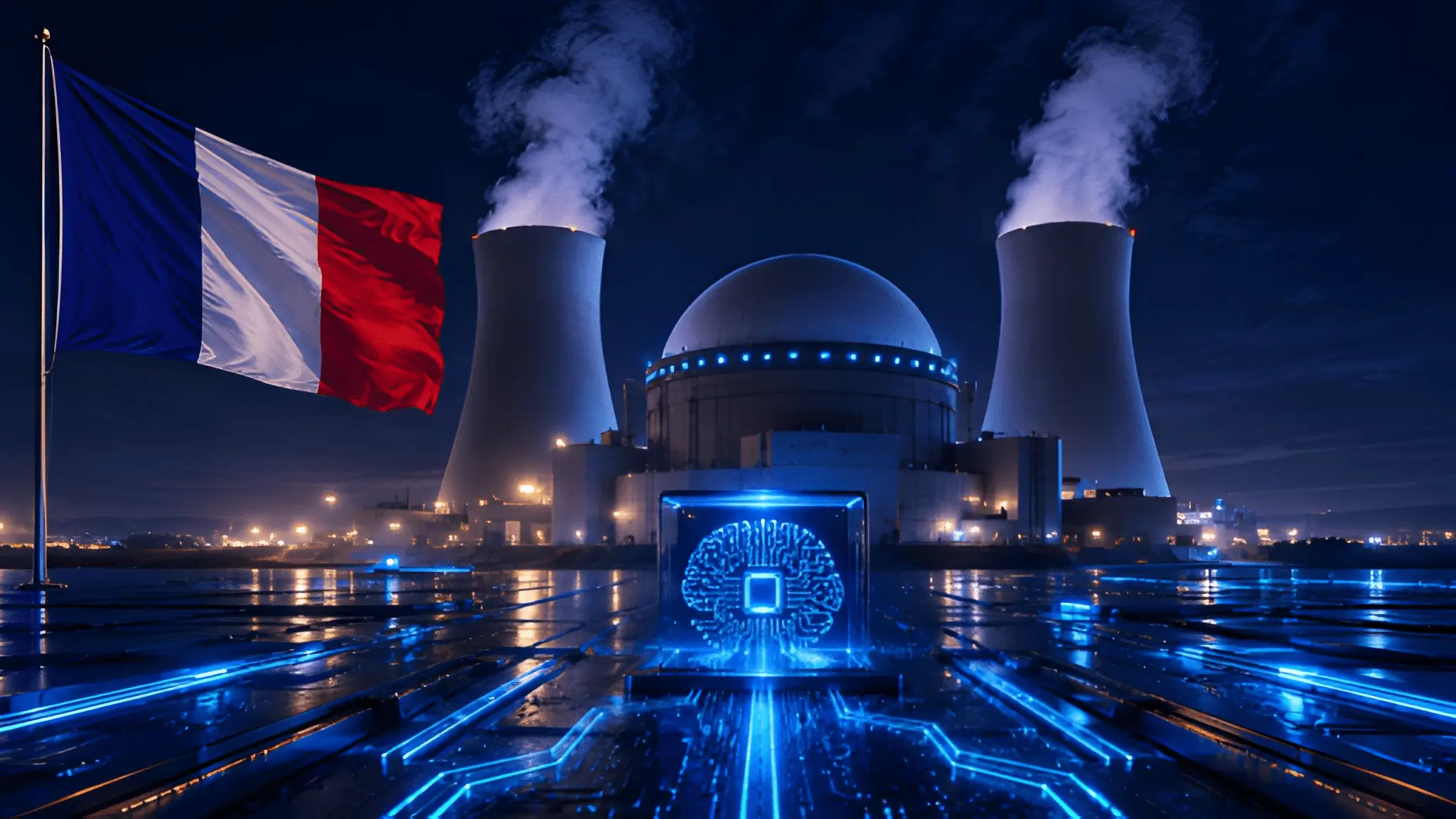
With the final phase of his presidency approaching, Emmanuel Macron is attempting to secure a place in history not through traditional industrial policy but through artificial intelligence. The French leader increasingly views AI as the sector capable of reshaping France’s economic trajectory while strengthening Europe’s technological standing in a world dominated by American and Chinese platforms. Rather than positioning France solely as a developer of algorithms, Macron has built his strategy around an asset few European nations possess at comparable scale: a large nuclear-powered electricity system. That advantage has become central to France’s pitch for attracting data centers, computing infrastructure, and AI investment. As global competition intensifies around access to energy for advanced computing, France is seeking to translate its abundant nuclear-powered electricity supply into a competitive advantage for attracting AI infrastructure investment. The result is an ambitious effort that links national energy policy, industrial competitiveness, and digital sovereignty into a single strategic vision.

The timing is significant because Macron enters the closing chapter of his administration amid mounting economic pressures. Public finances remain strained, unemployment concerns persist, and several of the president’s broader industrial ambitions have produced mixed outcomes. Against that backdrop, artificial intelligence offers a narrative of future growth capable of attracting investors and projecting confidence. Government officials increasingly frame AI as a sector where Europe can strengthen its technological competitiveness rather than rely exclusively on innovations developed elsewhere. The strategy therefore extends beyond economics and into questions of influence, competitiveness, and long-term national positioning. Success could reinforce France’s standing as Europe’s leading technology destination. Failure could add another chapter to a long list of ambitious modernization projects that struggled to achieve their intended scale.
Project Marengo Reflects a Race Against Time
Inside French policy circles, advisers have reportedly attached symbolic significance to the AI initiative through the codename “Project Marengo.” The reference evokes speed, decisive execution, and strategic advantage at a moment when governments worldwide are competing to secure positions within the AI value chain. For Macron, the challenge involves accelerating infrastructure development quickly enough to attract capital before competing jurisdictions establish stronger footholds. Data centers, semiconductor supply chains, cloud infrastructure, and AI model development increasingly depend on long-term commitments that can shape national competitiveness for decades. Policymakers therefore view timing as a critical variable rather than a secondary consideration. Every major investment decision influences where future innovation ecosystems emerge. Consequently, France is attempting to move faster than many of its European counterparts. The urgency also reflects political realities. French law prevents Macron from seeking another presidential term in 2027, meaning the current administration has limited time to transform commitments into visible outcomes. Investors evaluating billion-euro infrastructure projects often prioritize political continuity, regulatory stability, and long-term policy certainty. Yet the French political landscape remains fragmented, creating questions about how future governments would approach AI development, energy expansion, and foreign investment. Potential successors across the political spectrum have offered differing views on industrial policy and economic openness. Those uncertainties matter because AI infrastructure requires decades-long planning horizons. Strategic investors therefore remain focused not only on announced projects but also on the durability of the policy environment supporting them.
Global Technology Leaders Gather Around France’s AI Vision
Macron’s effort has attracted attention from some of the most influential figures in artificial intelligence. Technology executives, researchers, entrepreneurs, and investors increasingly view France as one of Europe’s most ambitious efforts to build AI infrastructure and attract investment while reducing dependence on foreign technology providers. The French government has worked to position international gatherings and technology forums as opportunities to showcase its ambitions. By bringing together leading industry voices, Paris aims to demonstrate that Europe can participate in the next wave of computing infrastructure rather than merely consume technologies developed elsewhere. Such engagement also helps strengthen France’s reputation among global investors evaluating future expansion plans. The broader objective extends beyond publicity and toward attracting tangible commitments. Those commitments ultimately determine whether national AI strategies become operational realities. Chris Lehane, OpenAI’s policy chief, highlighted Macron’s early engagement with generative AI and the willingness of French policymakers to dedicate public resources toward the sector. “It fundamentally changed the conversation in Europe,” said Lehane. “And I believe he’s approaching the G7 in a similar vein.” The statement reflects growing recognition that governments now play a larger role in AI development than they did during earlier technology cycles. Regulatory frameworks, energy infrastructure, educational systems, and research funding increasingly influence where AI ecosystems emerge. France has sought to position itself as a proactive participant in that process. Its approach contrasts with strategies that focus primarily on regulation without simultaneously expanding infrastructure capacity. Therefore, Paris is attempting to balance governance objectives with industrial competitiveness.
India Emerges as a Strategic Technology Partner
A notable element of France’s AI strategy involves strengthening technological relationships beyond traditional Western alliances. Macron has invested significant political capital in expanding ties with India, viewing the country as an increasingly important partner in emerging technology sectors. Cooperation in AI, research, education, and digital infrastructure aligns with broader efforts to diversify strategic relationships amid intensifying competition between the United States and China. France sees opportunities to deepen collaboration with one of the world’s fastest-growing digital economies while simultaneously broadening its international technology network. Such partnerships may help create alternative channels for innovation and investment. They also support Paris’ long-standing ambition to increase Europe’s strategic autonomy. The relationship extends beyond diplomatic symbolism. France has prioritized attracting Indian students, encouraging technology collaboration, and facilitating engagement between business communities. These initiatives complement the country’s broader objective of establishing itself as a hub where international talent, capital, and infrastructure converge. Moreover, stronger ties with India provide access to a vast pool of engineering expertise and entrepreneurial activity. As AI becomes increasingly globalized, countries capable of building diverse innovation networks may enjoy competitive advantages. France’s outreach therefore reflects both economic calculations and geopolitical considerations. The strategy recognizes that AI leadership will depend as much on partnerships as on domestic capabilities.
Mistral AI Becomes the Centerpiece of France’s Ambition
No discussion of France’s AI aspirations is complete without examining Mistral AI. Founded by former researchers from major technology companies, the startup has rapidly emerged as one of Europe’s most prominent AI contenders. French policymakers view Mistral as evidence that Europe can still produce globally relevant AI companies despite intense competition from American and Chinese firms. The company has become a focal point in national discussions about technological sovereignty and industrial policy. Its development offers France a domestic champion capable of attracting international attention and investment. That role carries significance beyond commercial performance. It also serves as a symbol of Europe’s broader technological ambitions. Macron has consistently encouraged support for domestic AI innovation, including efforts to strengthen relationships between major corporations and French technology firms. The administration views locally developed AI capabilities as strategically important in a world where foundational technologies increasingly influence economic and geopolitical power. Furthermore, the government has worked to cultivate a supportive environment for entrepreneurs, researchers, and investors. France’s AI strategy, launched in 2018, reflected an early recognition that machine learning would become a defining technology platform. Officials frequently point to the country’s strong mathematics tradition, growing startup ecosystem, and low-carbon nuclear energy supply as foundational advantages. Together, those elements form the basis of France’s long-term AI narrative.

Nuclear Power Gives France a Distinct Competitive Advantage
Energy has become one of the defining constraints in the global AI race. Advanced AI systems require enormous computing resources, and those computing resources require vast amounts of electricity. As demand for data centers accelerates, energy availability increasingly influences where infrastructure investments are deployed. France enters this competition with a substantial nuclear fleet that generates a significant portion of its electricity. That characteristic differentiates the country from several European rivals facing higher energy costs and tighter supply constraints. Investors evaluating large-scale AI infrastructure therefore see France as a potentially attractive destination. The country’s energy profile has become one of its most powerful competitive assets. The advantage becomes clearer when compared with alternative locations. While some countries offer strong research ecosystems, they may struggle to provide affordable electricity at the scale required for future AI growth. France, by contrast, combines engineering expertise with an established power-generation base capable of supporting energy-intensive projects. Additionally, nuclear generation aligns with growing corporate interest in lower-carbon electricity sources. Companies seeking to meet sustainability objectives increasingly consider energy sourcing when selecting data-center locations. Consequently, France’s electricity infrastructure offers a combination of relatively stable power availability and a lower-carbon generation profile that appeals to some AI infrastructure developers. This combination has strengthened the country’s position in discussions surrounding future AI investment.
Investment Momentum Faces Political and Economic Tests
Despite growing enthusiasm, significant uncertainties remain. Large infrastructure announcements do not automatically translate into completed projects, and France has experienced setbacks in previous industrial initiatives. Some high-profile investment proposals have failed to progress as initially envisioned, highlighting the gap that can exist between commitments and implementation. Investors continue to assess financing structures, permitting processes, construction timelines, and long-term profitability. Those factors become especially important as AI infrastructure projects grow in size and complexity. Capital markets remain supportive of AI, yet investors increasingly demand evidence of sustainable returns. As a result, execution risk remains a central consideration. Political uncertainty adds another layer of complexity. The next French presidential election could influence the regulatory and economic environment facing technology investors. Different political movements have expressed varying views on globalization, industrial policy, foreign investment, and digital sovereignty. Businesses making long-term commitments must therefore evaluate not only current policies but also potential future shifts. Meanwhile, communities hosting data-center developments have begun raising questions about electricity consumption, water use, housing pressures, and local economic benefits. These concerns mirror debates unfolding across multiple countries experiencing rapid infrastructure expansion. Accordingly, public acceptance may become just as important as investor confidence.
Macron’s Legacy May Depend on AI Infrastructure
The success of France’s AI strategy ultimately rests on whether infrastructure materializes at the scale envisioned by policymakers. Data centers, computing facilities, energy projects, educational programs, and startup ecosystems must move from planning documents into operational reality. Macron has argued that France possesses the ingredients necessary to become a leading AI nation, including talent, energy resources, and industrial capabilities. Yet assembling those ingredients into a globally competitive ecosystem remains a complex undertaking. The coming years will determine whether France can convert strategic advantages into sustained technological leadership. Much depends on execution, financing, and political continuity. For Macron, the stakes extend beyond economics. The AI initiative has become one of the most visible expressions of Macron’s broader vision for France’s role in a rapidly changing world. It combines longstanding themes from his presidency, including modernization, innovation, industrial renewal, and European competitiveness. However, ambitious visions are often judged by outcomes rather than intentions. If major investments proceed and France secures a durable position in the global AI economy, the project could define Macron’s legacy long after he leaves office. If momentum fades, critics may view it as another grand promise that failed to achieve transformational impact. Either way, France’s attempt to leverage nuclear power into AI leadership has become one of the most consequential technology experiments underway in Europe today.












