
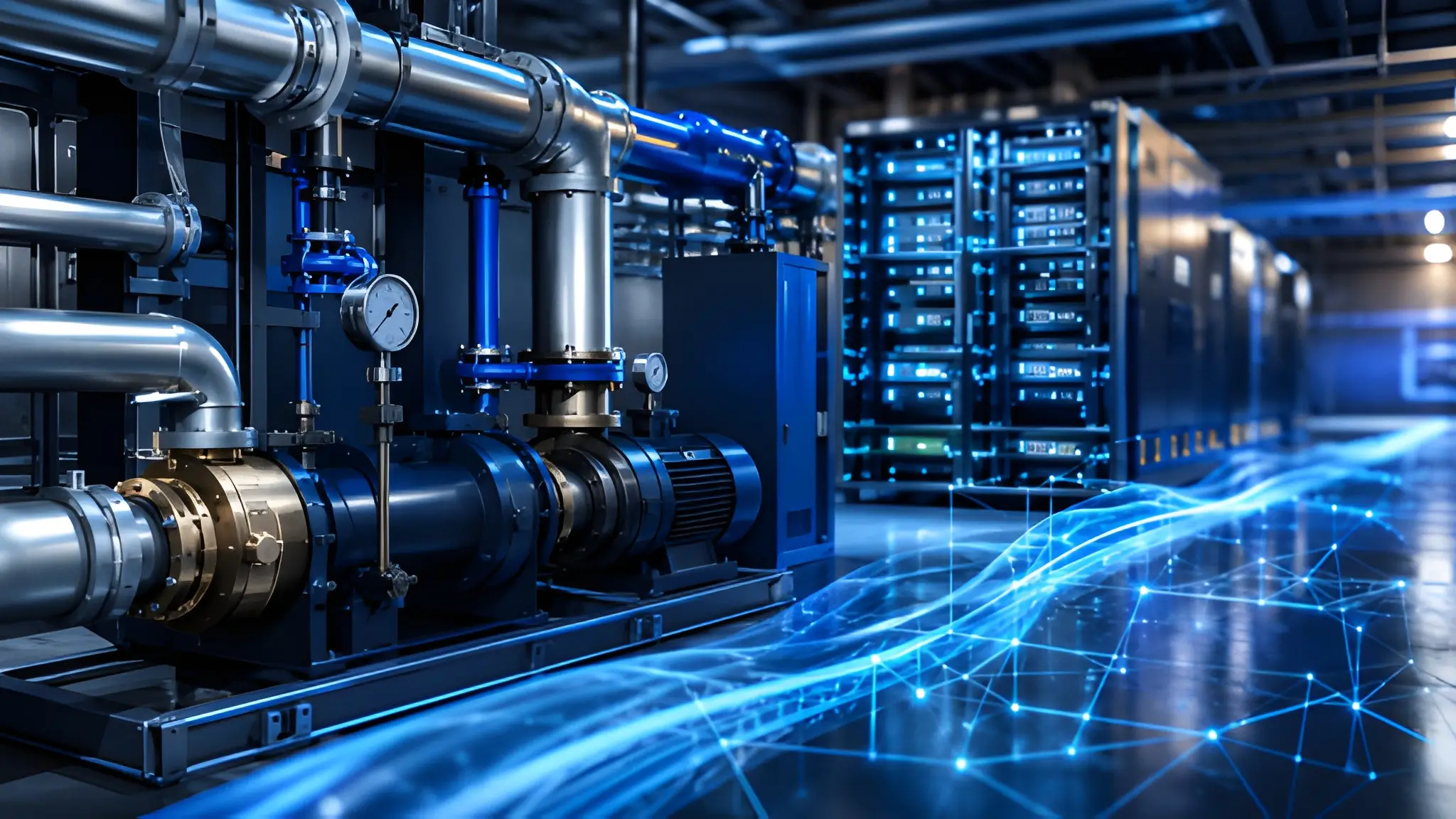
Hydraulic design rarely attracts attention until a facility approaches the limits of what its cooling architecture can absorb. AI infrastructure has now pushed liquid cooling systems into operating conditions that few commercial building engineers anticipated when foundational hydronic design practices became industry standards. Rack densities exceeding 100kW have transformed coolant distribution from a supporting utility into a primary operational constraint that directly influences uptime, efficiency, and expansion planning. Traditional assumptions around pump behavior, flow balancing, and pressure control require more detailed system-level analysis when applied to high-density liquid-cooled environments operating under rapidly changing thermal loads. Engineering teams therefore face a practical challenge rather than a theoretical one because thermal stability now depends on hydraulic behavior that changes dynamically with computational demand. The result is a growing realization that established cooling frameworks require significant revision before they can support the next generation of AI infrastructure.

Affinity Laws Were Written for Office Buildings, Not AI
Pump affinity relationships remain valuable engineering tools because they provide a predictable connection between flow, pressure, rotational speed, and power consumption. Their usefulness depends on assumptions involving dynamic similarity, stable operating conditions, and system characteristics that remain reasonably constant across operating ranges. Commercial office towers and many institutional facilities often operated under load profiles that changed more gradually than the highly concentrated and rapidly varying thermal conditions observed in AI computing environments. AI clusters operate under very different conditions where large heat loads concentrate within small physical footprints and thermal changes emerge rapidly across liquid loops. Engineers applying legacy calculations often discover that real operating behavior diverges from projected performance once liquid-cooled racks approach sustained high-power operation. Hydraulic networks that appear stable during commissioning can therefore display nonlinear responses as utilization increases and cooling demand intensifies.
Large direct-to-chip deployments also alter the relationship between flow and heat removal because elevated temperature differentials become operationally desirable rather than undesirable. Instead of minimizing temperature rise across equipment, operators increasingly seek higher delta-T performance to reduce pumping requirements and improve heat rejection efficiency. That shift introduces flow and temperature operating conditions that differ from those commonly encountered in traditional commercial building hydronic applications. Friction losses, localized restrictions, manifold behavior, and equipment-specific flow requirements begin interacting in ways that produce outcomes not reflected by standard pump curves alone. System performance consequently becomes influenced by network dynamics rather than solely by individual component specifications. Designers evaluating liquid-cooled AI environments must therefore model the entire hydraulic ecosystem rather than assuming classical scaling relationships will accurately predict operational behavior.
The Turndown Trap Killing Part-Load Savings
Variable frequency drives historically delivered compelling energy savings because reducing pump speed produced disproportionately large reductions in power consumption. Building operators benefited from this relationship because occupancy and cooling demand frequently declined during evenings, weekends, and seasonal transitions. Liquid-cooled AI facilities introduce a different operating profile where inactive racks often remain connected to hydraulic networks that still require minimum circulation thresholds. Cooling equipment manufacturers frequently specify flow requirements to maintain temperature uniformity, protect components, and ensure reliable operation across varying computational workloads. As a result, operators cannot always reduce flow in proportion to reduced rack utilization even when large sections of the facility remain underused. Energy savings predicted during design phases may therefore be reduced when practical operating constraints such as minimum flow requirements limit pump turndown capability.

The challenge becomes particularly visible in large deployments where a centralized CDU supports extensive liquid distribution infrastructure. In facilities where a portion of installed rack capacity remains inactive while infrastructure stays fully connected, cooling systems may still need to maintain circulation across significant portions of the hydraulic network. Traditional control logic would normally reduce pump speed to align with the lower cooling requirement and capture significant efficiency gains. Operational reality often prevents that response because minimum flow thresholds across branches, manifolds, and cold plates establish hydraulic limits that cannot be ignored. Energy consumption consequently remains higher than expected despite substantial reductions in computational activity. Furthermore, interactions among multiple variable-speed pumps can create additional inefficiencies that conventional control strategies struggle to resolve without deeper hydraulic awareness.
When Water Behaves Like a Solid at Scale
Fluid dynamics textbooks describe water as a continuously flowing medium that responds rapidly to changes in pressure and control inputs. Very large liquid cooling networks reveal a different operational reality because substantial water volumes introduce forms of hydraulic inertia that influence system responsiveness. Massive header pipes, extensive distribution loops, and high circulation rates create momentum that cannot change instantaneously when valves open or close. Facilities supporting high-density AI clusters increasingly encounter these effects as cooling networks expand to accommodate concentrated thermal loads. The hydraulic system itself begins acting as a dynamic participant rather than a passive transport mechanism. Engineers therefore must account for the time required for flow adjustments to propagate throughout the network.
Thermal events generated by AI workloads can develop on timescales that challenge the response characteristics of large hydraulic systems. A workload transition may increase heat output almost immediately while the associated cooling response requires additional time to redistribute flow across the network. Valve commands, pump adjustments, and pressure changes travel through systems constrained by physical fluid mass and network geometry. Consequently, cooling infrastructure may temporarily operate behind thermal demand despite functioning exactly as designed. Traditional regulatory frameworks and design methodologies largely evolved around slower building loads where such delays rarely created operational concerns. High-density AI deployments now expose these timing mismatches because thermal transients occur on timescales that challenge established hydraulic assumptions.
Pressure Independence Faces New Limits in High-Density AI Cooling
Pressure-independent control valves earned widespread adoption because they simplified balancing and maintained stable flow across varying differential pressure conditions. Their effectiveness depends on maintaining sufficient authority to regulate flow within intended operating ranges. High-density liquid cooling environments can introduce operating conditions where overall network interactions become increasingly important to achieving the intended performance of these devices. Large clusters can generate simultaneous demand across numerous racks, creating systemwide hydraulic interactions that challenge localized control strategies. Each valve continues attempting to maintain target flow while competing for hydraulic resources shared throughout the network. Stability therefore becomes dependent on collective system behavior rather than individual valve performance.
When hundreds of liquid-cooled servers accelerate workload execution simultaneously, cooling demand can rise across entire rows or halls within short periods. Pressure-independent devices cannot operate independently from broader network conditions because flow availability remains finite. Multiple control actions occurring simultaneously may create oscillations, flow redistribution effects, or pressure fluctuations that propagate through connected infrastructure. Operators often discover that maintaining stability requires coordinated management across pumps, valves, and distribution equipment rather than relying solely on autonomous local regulation. Meanwhile, traditional balancing approaches were primarily developed around building systems with different load distribution characteristics than those observed in highly concentrated AI computing environments. Systemwide coordination increasingly complements component-level control strategies as operators seek stable performance across large liquid-cooling networks.
Control Theory Needs a Rewrite for AI Loads
Conventional cooling systems frequently rely on PID controllers because they offer simplicity, reliability, and proven performance across a wide range of HVAC applications. Those controllers perform best when responding to systems with predictable dynamics and relatively gradual changes in demand. AI infrastructure introduces thermal profiles that differ significantly from office buildings, laboratories, and traditional enterprise computing environments. Training workloads, inference clusters, and accelerated computing applications can produce rapid fluctuations in heat generation that outpace assumptions embedded within legacy control strategies. Feedback loops designed for steady-state operation often react only after temperatures begin moving outside desired ranges. Control quality therefore becomes increasingly dependent on anticipation rather than reaction.
Emerging control architectures increasingly incorporate predictive models capable of evaluating future system states before temperature excursions occur. Model-predictive control frameworks use system behavior, operating constraints, and forecasted conditions to determine optimal actions across multiple variables simultaneously. Integration with IT telemetry introduces an additional layer of intelligence because cooling systems can receive indications of workload changes before thermal effects fully develop. Feed-forward strategies allow pumps, valves, and cooling equipment to begin adjusting in anticipation of future demand rather than waiting for measurable temperature deviations. Consequently, hydraulic infrastructure becomes more closely aligned with computational activity occurring inside the facility. Research across cooling and pumping applications has demonstrated that predictive control approaches can improve efficiency and system responsiveness when compared with conventional reactive control strategies under suitable operating conditions.
From Static Laws to Fluid Intelligence
Engineering principles governing hydronic systems remain fundamentally sound, yet their implementation requires adaptation to operating conditions that differ substantially from those that shaped traditional cooling practices. High-density AI deployments expose limitations in methodologies that assume stable loads, predictable flow behavior, and loosely coupled thermal responses. Operators increasingly encounter situations where classical calculations describe only part of the system reality because network interactions influence outcomes as strongly as individual equipment characteristics. Hydraulic infrastructure now functions as an active operational layer that directly affects performance, resilience, and efficiency. Design decisions therefore require greater visibility into dynamic behavior across the entire cooling ecosystem.
Digital hydraulic models offer a practical path forward because they transform cooling infrastructure from a static asset into a continuously evaluated system. Real-time representations of pumps, valves, headers, thermal loads, and distribution networks can reveal emerging constraints before they become operational problems. These capabilities support more informed decisions regarding capacity expansion, redundancy planning, control optimization, and energy management. Financial evaluations also benefit because infrastructure investments can be assessed against realistic operating conditions rather than idealized assumptions. Ultimately, facilities designed for sustained high-density computing are expected to make greater use of continuously updated operational intelligence alongside established hydraulic design principles to support efficient system operation.











