
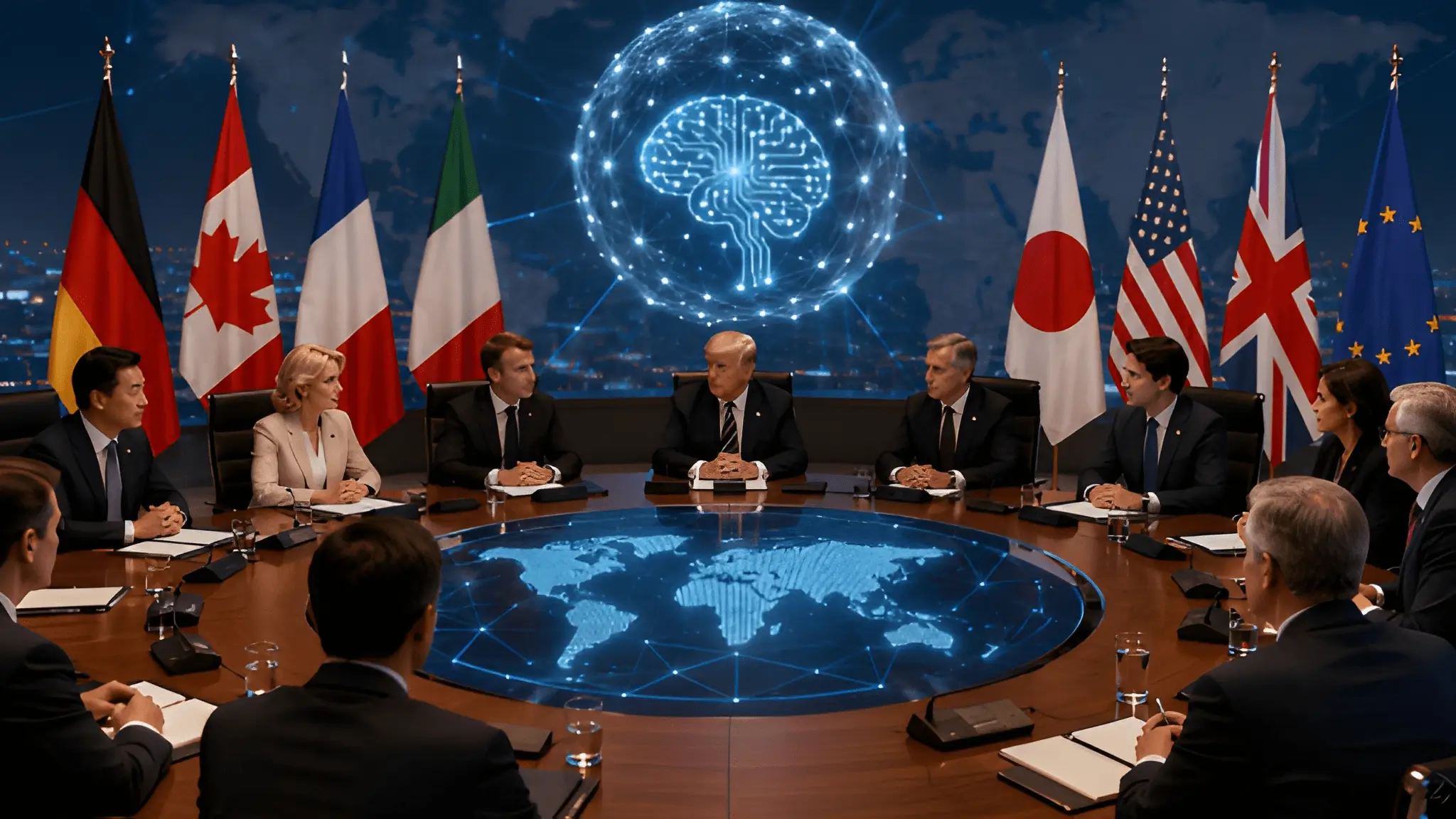
The global race to govern artificial intelligence entered a new phase this week as leading AI executives urged G7 nations to establish a coordinated framework for standards, safety, and access. Discussions took place during a closed-door session at the G7 Summit in Évian-les-Bains, France, where technology leaders met with heads of state to address the accelerating influence of frontier AI systems. The meeting reflected a growing recognition that AI governance is becoming as strategically important as energy security, semiconductor supply chains, and critical infrastructure. Industry executives argued that the next generation of AI models will require greater international coordination than previous technology cycles.

Among those participating in the discussions were Anthropic Chief Executive Officer Dario Amodei, OpenAI Chief Executive Officer Sam Altman, Google DeepMind Chief Executive Officer Demis Hassabis, and U.S. President Donald Trump. According to reports from attendees, both Amodei and Hassabis advocated for a coalition led by the United States to establish common principles governing advanced AI systems. Their proposal centered on reducing governance fragmentation while creating mechanisms to address emerging risks. The discussion highlighted increasing concern that inconsistent regulations could complicate global deployment of advanced models.
AI Sovereignty Moves From Policy Debate to Strategic Imperative
The proposal arrives as governments around the world intensify efforts to reduce dependence on foreign AI providers. Policymakers increasingly view access to advanced AI models as a matter of national competitiveness, economic resilience, and technological independence. This shift has accelerated investments in domestic compute infrastructure, sovereign cloud environments, and locally developed foundation models. As a result, the governance conversation is now closely linked to broader debates around digital sovereignty.
Recent developments involving Anthropic’s most advanced models have reinforced those concerns. The company recently restricted access to its newest systems, Fable 5 and Mythos 5, after the U.S. government imposed export controls citing national security considerations. The move triggered discussions across Europe, the United Kingdom, and India regarding reliance on a small number of U.S.-based AI providers. Government officials and industry stakeholders increasingly view access restrictions as a potential vulnerability within national AI strategies.

The debate has been particularly visible in India, where founders, investors, and policy experts renewed calls for stronger domestic AI capabilities. Questions surrounding sovereign infrastructure, open-source development, and frontier-model dependence have gained urgency amid broader geopolitical tensions. Consequently, governments are beginning to assess whether access to advanced AI systems should be treated similarly to strategic access to energy, telecommunications, or semiconductor technologies.
Industry Leaders Call for Shared Standards and Risk Controls
During the summit discussions, Amodei reportedly outlined several areas where international cooperation could help reduce systemic risk. Those areas included structured access to frontier AI models, coordinated oversight of advanced capabilities, and cooperation on the trade of critical chips and components outside China’s technology ecosystem. He also emphasized collaboration around threats involving cybersecurity, bioterrorism, and intelligence applications.
Altman delivered a broader governance message focused on institutional coordination among democratic nations. According to OpenAI, he called for: “an international forum for discussion that establishes globally accepted standards for testing, provides expert and impartial analysis of capabilities and risks, and serves as a venue for cooperation among nations,”
Altman also urged governments to take primary responsibility for AI governance as model capabilities continue advancing. He argued that future systems could significantly influence economic productivity, scientific research, and industrial competitiveness. However, he stressed that democratic governments, not technology companies must determine the rules governing deployment and oversight. “Do not cede your responsibilities to AI labs like mine. We develop the technology, and the citizens of the free world make the rules,” Altman was quoted as saying by Reuters.
H2: Trusted Partner Access Emerges as a New Policy Mechanism
One of the more significant discussions centered on the creation of a “trusted partners” framework that would allow selected non-U.S. nations to gain access to advanced AI systems developed by American companies. The concept reflects growing awareness that limiting access too aggressively could encourage competing ecosystems to emerge. At the same time, policymakers seek safeguards that prevent sensitive capabilities from reaching adversarial actors.
Canadian Prime Minister Mark Carney reportedly expressed support for the United States taking a leading role in shaping such a coalition. According to OpenAI Global Affairs Chief Chris Lehane, several non-U.S. leaders also acknowledged that Washington is positioned to lead efforts aimed at establishing international AI standards. The discussions suggest a potential convergence between national security objectives and broader commercial interests surrounding AI deployment.
French President Emmanuel Macron signaled optimism that broader access arrangements could be achieved in the coming weeks. He reportedly argued that expanding availability of leading U.S. AI models would serve American interests because customers require confidence that critical AI services will remain accessible. The comments underscored a central challenge facing policymakers: balancing security controls with market trust and global adoption.
Financial Stability and Economic Impact Enter the G7 Agenda
Beyond governance and access, G7 leaders expanded their focus to the economic consequences of frontier AI systems. In a joint statement released Wednesday, leaders said finance ministries, regulators, and cybersecurity authorities would assess how advanced AI models could affect financial stability, labor markets, and productivity growth. The decision reflects increasing recognition that AI is evolving from a technology-sector issue into a macroeconomic consideration.
The move signals that governments are preparing for AI-driven disruptions that may extend well beyond software development. Financial systems, workforce dynamics, industrial competitiveness, and national growth strategies could all experience significant changes as increasingly capable models enter commercial deployment. Therefore, policymakers appear determined to establish governance structures before those effects become more difficult to manage.
The discussions also come shortly after Anthropic expanded access to Project Glasswing, its cybersecurity initiative, to selected organizations in India. The program includes engagement with government entities responsible for protecting sectors such as banking, telecommunications, and power infrastructure. That development illustrates how AI security partnerships are becoming intertwined with broader national resilience strategies.
The Strategic Shift Behind the Coalition Proposal
The G7 discussions reveal a deeper shift occurring across the AI ecosystem. Governments no longer view frontier models solely as commercial products; they increasingly regard them as strategic assets capable of influencing economic power, cybersecurity readiness, and geopolitical leverage. That perspective is driving parallel investments in sovereign infrastructure, domestic model development, and international governance frameworks.
A U.S.-led AI coalition remains a proposal rather than a formal initiative. Yet the conversation at Évian demonstrates that leading governments and AI companies are beginning to align around a common challenge: creating rules for technologies whose influence may soon extend across every major sector of the global economy. The next phase of AI competition may not be defined only by who builds the most powerful model, but by who shapes the standards governing its use.











