
AI Infrastructure Is Entering a New Cost Equation
For years, the economics of artificial intelligence revolved around a familiar formula. Organizations invested heavily in accelerators, expanded data center footprints, and pursued larger models to improve performance. Infrastructure teams largely treated cooling systems as a supporting function rather than a strategic variable. That assumption increasingly looks outdated as rack densities continue to climb across hyperscale and enterprise environments. Modern AI deployments now place unprecedented pressure on power distribution, thermal management, and facility design. NVIDIA’s latest infrastructure strategy reflects an industry that is beginning to optimize entire systems rather than individual components.
The transition marks a broader shift in how operators evaluate return on infrastructure investment. Previous generations of data centers focused primarily on maximizing compute density while relying on established cooling methods. New AI clusters introduce thermal loads that challenge designs originally developed for conventional enterprise workloads. Facility operators increasingly measure efficiency across power delivery, cooling effectiveness, and operational flexibility instead of focusing solely on compute performance. Capital allocation decisions now depend on the interaction between these layers rather than on accelerator specifications alone. Market participants across the industry are adjusting strategies to account for those realities.

NVIDIA’s Rubin Platform Signals a System-Level Approach
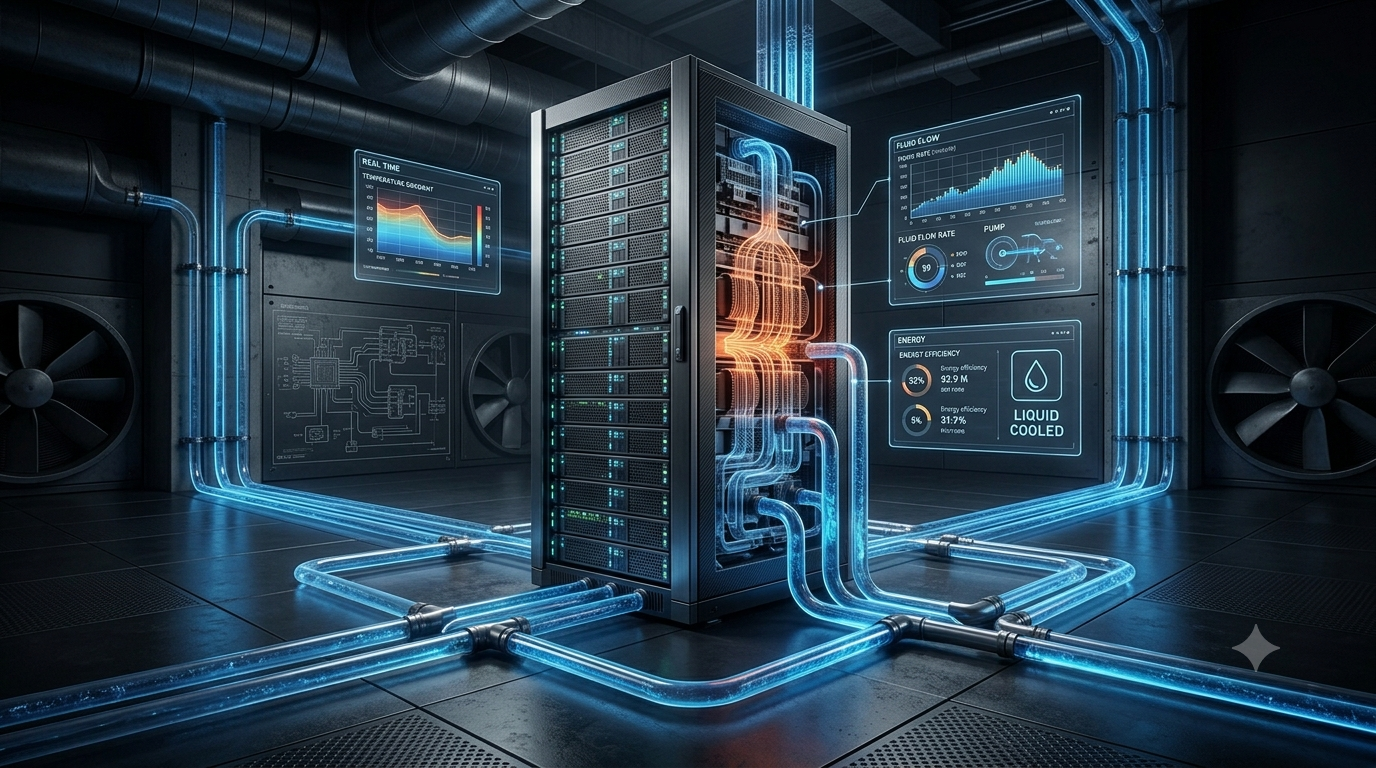
NVIDIA’s Rubin architecture attracted attention because of its compute capabilities, but its infrastructure design may prove equally significant. The company disclosed a fully liquid-cooled rack-scale system that operates without traditional air-cooling dependence across the platform. Engineers designed the architecture around direct thermal management rather than treating cooling as an external challenge. That approach changes how facilities can be planned, operated, and scaled over time. Data center operators evaluating future deployments must now consider whether legacy facility designs remain economically competitive. The discussion increasingly extends beyond silicon performance into broader infrastructure efficiency.
One notable aspect of the Rubin infrastructure design involves coolant operating temperatures. NVIDIA stated that the platform can utilize warm liquid cooling loops that operate around 45 degrees Celsius. Higher coolant temperatures allow facilities to reject heat more efficiently without relying heavily on conventional chiller systems. This design reduces energy consumption associated with thermal management while simplifying certain operational requirements. Infrastructure planners have long sought methods to improve power usage effectiveness without compromising system reliability. The Rubin strategy demonstrates how thermal engineering can directly influence facility economics.
Why Cooling Has Become a Strategic Infrastructure Layer
The increasing relevance of liquid cooling stems from a fundamental change in AI workloads. Advanced accelerators generate substantially more heat than previous generations of enterprise hardware. Air cooling remains effective in many environments, yet extreme rack densities create operational challenges that become more difficult to manage over time. Facilities seeking higher utilization rates often require more advanced thermal solutions to maintain performance consistency. As a result, cooling systems now influence deployment decisions much earlier in the infrastructure planning process. Organizations are beginning to treat thermal architecture as a competitive capability rather than a facility requirement.
Industry analysts increasingly view cooling technology as a factor that can affect long-term operating costs. Electricity consumed by cooling infrastructure directly influences overall efficiency metrics across large facilities. Small gains in thermal management can translate into substantial savings when applied across thousands of servers. Hyperscale operators therefore continue evaluating new methods that improve heat transfer while reducing power overhead. This dynamic helps explain why liquid cooling investments have accelerated across the AI ecosystem. Market attention is shifting toward infrastructure designs that optimize both performance and operational efficiency.
Google’s TPU Strategy Reflects a Similar Industry Shift
NVIDIA is not the only company signaling a change in infrastructure thinking. Google recently expanded its custom silicon strategy by introducing distinct accelerator architectures for different AI workloads. The company unveiled TPU 8t for training tasks and TPU 8i for inference workloads, reflecting growing specialization across AI infrastructure. Training and inference place different demands on memory systems, networking architectures, and performance optimization. Organizations increasingly recognize that a single architecture may not represent the most efficient approach for every workload category. That realization is reshaping infrastructure investment decisions throughout the industry.
The separation between training and inference hardware reflects broader economic considerations. Inference workloads now represent a substantial portion of operational AI demand across commercial deployments. Companies must balance performance objectives with cost efficiency as model usage expands. Specialized architectures can improve utilization rates while reducing operational expenses for specific tasks. Infrastructure providers increasingly design systems around workload characteristics instead of relying on generalized compute environments. Such developments indicate that AI infrastructure is becoming more granular and purpose-built.
The Democratization of Advanced Cooling Infrastructure
The liquid-cooling conversation extends beyond hyperscale operators and cloud providers. Infrastructure vendors increasingly seek to simplify deployment models so that smaller organizations can adopt advanced thermal technologies. Accelsius introduced its NeuCool IR150 platform as an integrated liquid-cooling solution designed to reduce deployment complexity. The system combines cooling infrastructure and rack architecture into a unified package that can be deployed more efficiently than highly customized installations. Simplification matters because many organizations lack dedicated engineering teams capable of managing large-scale thermal integration projects. Easier deployment models can expand access to high-density AI infrastructure across a wider range of institutions.
Historically, advanced cooling projects often required extensive customization and specialized expertise. That requirement limited adoption primarily to hyperscale operators with substantial engineering resources. Integrated systems reduce implementation barriers and allow more organizations to evaluate high-density deployments. Universities, research institutions, healthcare organizations, and regional cloud providers increasingly explore AI infrastructure investments that would have been difficult to justify several years ago. Productization helps transform advanced cooling from a custom engineering exercise into a repeatable deployment model. This shift may influence the pace at which AI infrastructure expands beyond major cloud platforms.

Power Availability Is Becoming the New Competitive Advantage
The geography of AI infrastructure development is changing as operators confront growing power requirements. Traditional data center location strategies often prioritized network connectivity and proximity to major population centers. AI deployments introduce a different set of constraints because large accelerator clusters require significant electrical capacity. Utility access, grid expansion timelines, and long-term power availability increasingly influence investment decisions. Developers evaluating future projects now assess whether regional energy infrastructure can support sustained capacity growth. This trend is gradually redefining how organizations select locations for new facilities.
Growing demand for AI computing has intensified competition for available power across major markets. Utility providers in several regions face increasing requests from data center operators seeking large-scale electrical connections. Infrastructure projects that once required tens of megawatts now frequently target substantially larger capacity levels. Development timelines often depend on transmission upgrades, substation construction, and broader grid planning initiatives. Access to reliable power can therefore influence deployment schedules as much as facility construction itself. Energy infrastructure has become a strategic asset within the broader AI ecosystem.
Dallas Reflects the Industry’s Changing Priorities
Industry data released during 2026 indicated that Dallas surpassed Northern Virginia as the largest data center market by capacity under development. The shift reflects changing priorities rather than a decline in established markets. Northern Virginia remains one of the world’s most important digital infrastructure hubs and continues attracting substantial investment. Dallas, however, has benefited from a combination of available land, favorable development conditions, and significant power expansion opportunities. These factors align closely with the needs of modern AI infrastructure deployments. The market’s growth illustrates how site-selection criteria continue to evolve.
Developers increasingly prioritize regions capable of supporting future expansion rather than simply accommodating current requirements. AI infrastructure planning often involves long-term projections for capacity growth, energy consumption, and operational scaling. Markets that offer flexibility across those dimensions can attract significant capital investment. Regional infrastructure planning therefore plays a critical role in determining future competitiveness. Local governments, utilities, and developers increasingly collaborate to accommodate demand generated by digital infrastructure projects. Such partnerships are becoming an important component of economic development strategies.
Energy Strategy and AI Strategy Are Beginning to Converge
The relationship between energy and computing infrastructure has become increasingly interconnected. Organizations deploying large-scale AI systems must evaluate electricity availability, cost stability, and long-term supply resilience. Infrastructure planning now extends beyond data center construction into broader discussions involving utility partnerships and grid development. This convergence reflects the growing scale of AI deployments rather than any single technological breakthrough. Energy considerations increasingly influence investment decisions at every stage of the infrastructure lifecycle. Strategic planning efforts therefore integrate digital infrastructure objectives with power infrastructure realities.
Many industry participants now view energy security as a critical component of AI competitiveness. Reliable access to power supports infrastructure utilization, operational consistency, and future expansion opportunities. Developers that secure favorable energy arrangements may gain advantages in deployment speed and long-term operating economics. Infrastructure strategies increasingly account for these variables alongside compute performance and networking capabilities. The result is a more integrated view of digital infrastructure planning across the sector. AI development and energy planning are becoming closely linked strategic priorities.
Infrastructure Economics Are Reshaping Investment Decisions
Financial considerations increasingly drive infrastructure design choices throughout the AI industry. Organizations must evaluate not only hardware acquisition costs but also the broader operational implications of deployment decisions. Cooling systems, power distribution architectures, facility layouts, and maintenance requirements all influence total cost of ownership. Investors and operators therefore examine infrastructure holistically rather than focusing on isolated technology components. Economic efficiency has become a central objective as AI deployments continue expanding. Infrastructure innovation increasingly targets cost optimization alongside performance improvement.
Why NVIDIA’s Latest Move Matters Beyond Hardware
NVIDIA’s recent infrastructure direction highlights a broader transformation occurring throughout the AI ecosystem. The company’s focus on integrated system design reflects growing recognition that future gains will come from optimizing entire infrastructure stacks. Compute performance remains important, yet efficiency improvements increasingly depend on interactions between hardware, cooling systems, networking architectures, and facility design. Organizations deploying next-generation AI environments must therefore evaluate infrastructure as a unified platform. This perspective differs from earlier approaches that treated each component as a largely independent variable. The industry appears to be moving toward a more holistic model of infrastructure engineering.
That evolution carries implications for technology vendors, cloud providers, enterprises, and policymakers alike. Future infrastructure decisions will likely involve deeper coordination across energy, facilities, hardware, and operational teams. Successful deployments may depend as much on engineering integration as on raw compute capability. Market leaders increasingly recognize that scaling AI requires optimization across every layer of the infrastructure stack. NVIDIA’s latest move illustrates how competitive advantage can emerge from system architecture rather than from silicon alone. The economics of AI infrastructure are changing, and the organizations that adapt to that reality may be best positioned for the next phase of industry growth.











