Skip to content
Artificial intelligence leadership is increasingly determined by a country’s ability to combine talent, capital, compute infrastructure, and policy execution. For years, the conversation centered on a rivalry between the United States and China. However, a new assessment from JPMorgan suggests a third contender is beginning to emerge. Drawing on data from Stanford University’s Global AI Vibrancy Index, JPMorgan identified India as the world’s third most promising AI ecosystem, trailing only the United States and China. The ranking reflects strengths in technical talent, startup activity, developer participation, and digital adoption. More importantly, it signals growing recognition that India’s role in the AI economy may extend well beyond software services. The question now is whether India can convert that momentum into lasting AI leadership.

Why India Is Rising in Global AI Rankings
India’s position in global AI rankings is not the result of a single breakthrough. Instead, it reflects years of investment in digital infrastructure, software engineering talent, and technology entrepreneurship. The country graduates one of the world’s largest pools of STEM professionals annually. Its developer ecosystem ranks among the largest globally, while widespread adoption of digital public infrastructure has created a foundation for large-scale AI deployment. Platforms such as Aadhaar, UPI, and DigiLocker have demonstrated India’s ability to build technology systems that operate at national scale. These advantages give India something many countries lack: a large domestic market capable of generating both data and demand for AI applications.
Talent Is India’s Biggest AI Asset
The global AI race often focuses on GPUs and data centers. Yet talent remains the most important input for innovation. India already supplies a significant share of the world’s software engineers, machine learning specialists, and AI researchers. According to multiple industry studies, the country has one of the fastest-growing AI talent pools globally. Major technology companies including Microsoft, Google, Amazon, NVIDIA, and Meta continue expanding engineering and research operations across India. Global capability centers have also become major employers of AI professionals, creating an ecosystem that extends beyond traditional outsourcing. As AI adoption accelerates, this workforce advantage could become one of India’s strongest competitive differentiators.
The Infrastructure Gap India Must Close
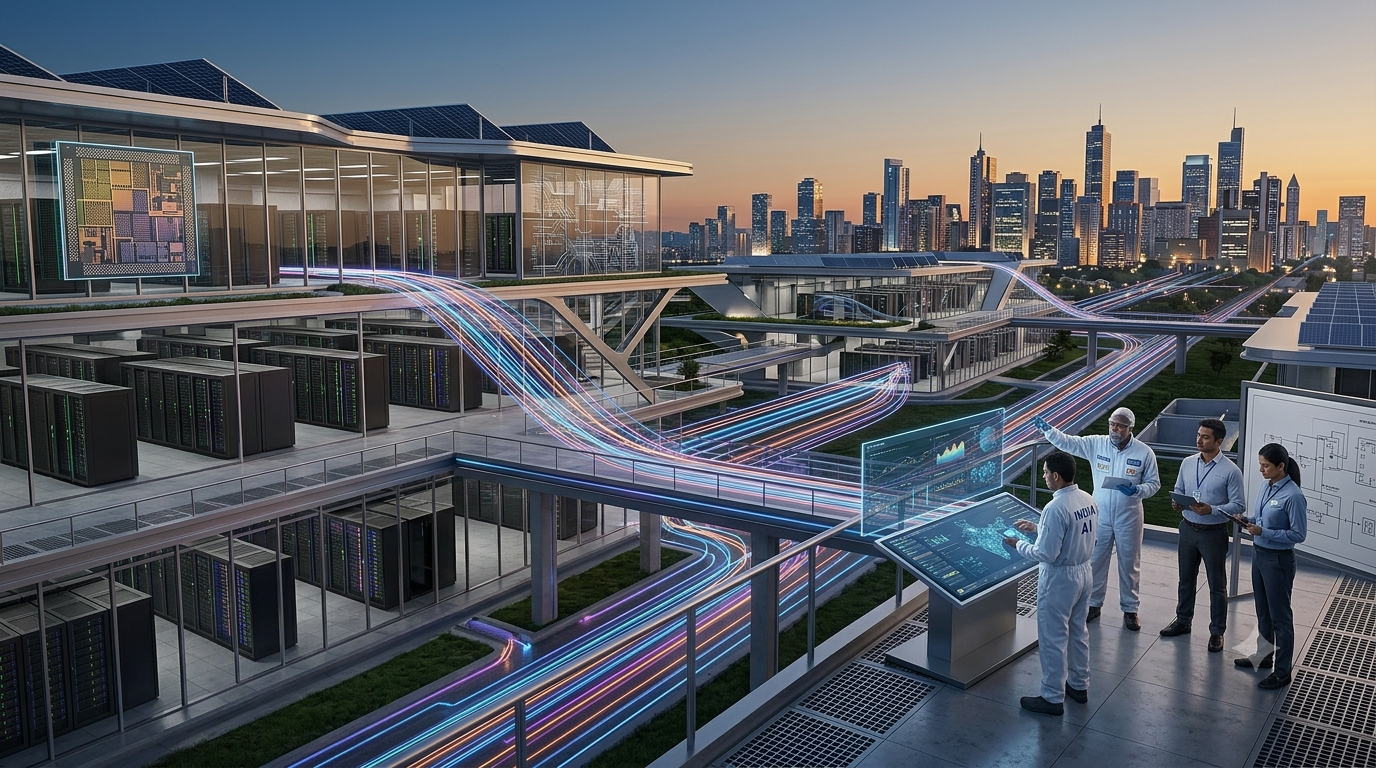
Despite its strengths, India faces a significant challenge in AI infrastructure. Training and deploying advanced AI models requires massive computing resources. The United States benefits from hyperscale cloud operators and semiconductor leaders. China has invested heavily in domestic AI infrastructure and compute capacity. India starts from a smaller base. While data center investment is accelerating rapidly, the country still lacks the scale of GPU infrastructure available in leading AI markets. Industry estimates suggest India’s data center capacity could expand dramatically over the next decade as cloud providers, telecom operators, and infrastructure investors deploy billions of dollars into new facilities. The next phase of India’s AI journey will depend heavily on whether compute infrastructure can grow as quickly as demand.

Hyperscalers Are Betting Big on India
Global technology companies increasingly view India as a strategic AI market rather than simply a large consumer base. Microsoft has announced major cloud and AI investments across the country. Google continues expanding cloud infrastructure and AI initiatives. Amazon Web Services has committed billions of dollars toward cloud capacity expansion, while Oracle and other providers continue increasing their presence. At the same time, domestic conglomerates are entering the AI infrastructure race. Companies including Reliance Industries, Adani Group, Tata Group, and Bharti Airtel have announced initiatives spanning data centers, cloud infrastructure, and digital services. These investments indicate growing confidence in India’s long-term AI demand.
Sovereign AI Is Becoming a National Priority
Many governments now view AI as strategic infrastructure. India is following a similar path through initiatives designed to strengthen domestic AI capabilities. The IndiaAI Mission seeks to support compute access, research, startup development, and public-sector adoption. The objective extends beyond building models. Policymakers increasingly recognize that access to computing infrastructure, datasets, and AI platforms may influence economic competitiveness for decades. Consequently, discussions around sovereign AI are gaining momentum. The focus centers on ensuring that Indian enterprises, researchers, and public institutions have access to AI infrastructure without depending entirely on foreign platforms. This trend mirrors developments in Europe, Japan, South Korea, Saudi Arabia, and the United Arab Emirates.
Can India Compete With the US and China?
The answer depends on how leadership is defined. If the measure is frontier AI model development, the United States and China maintain substantial advantages in compute capacity, semiconductor ecosystems, and research funding. However, AI leadership involves more than creating foundation models. Adoption, deployment, talent development, enterprise integration, and infrastructure expansion all matter. India possesses several structural advantages. It has a large domestic market, strong software expertise, growing cloud adoption, and one of the world’s youngest technology workforces. These factors could enable India to become a major AI economy even if it does not immediately match the compute scale of the United States or China. The opportunity may lie in becoming the world’s largest AI implementation market rather than the world’s largest AI model developer.
The Next Decade Will Decide India’s Position
The AI race is increasingly becoming an infrastructure race. Countries that can build data centers, secure energy supplies, attract investment, develop talent, and expand compute capacity will gain strategic advantages. India has already established itself as a major technology economy. The challenge now is translating that foundation into leadership across the AI stack. JPMorgan’s assessment highlights how far India has progressed. Yet rankings alone do not create superpowers. Infrastructure deployment, policy execution, capital investment, and ecosystem coordination will ultimately determine whether India can transform its AI ambitions into global influence. The coming decade may reveal whether India remains a fast-growing AI market or emerges as one of the defining AI powers of the twenty-first century.