
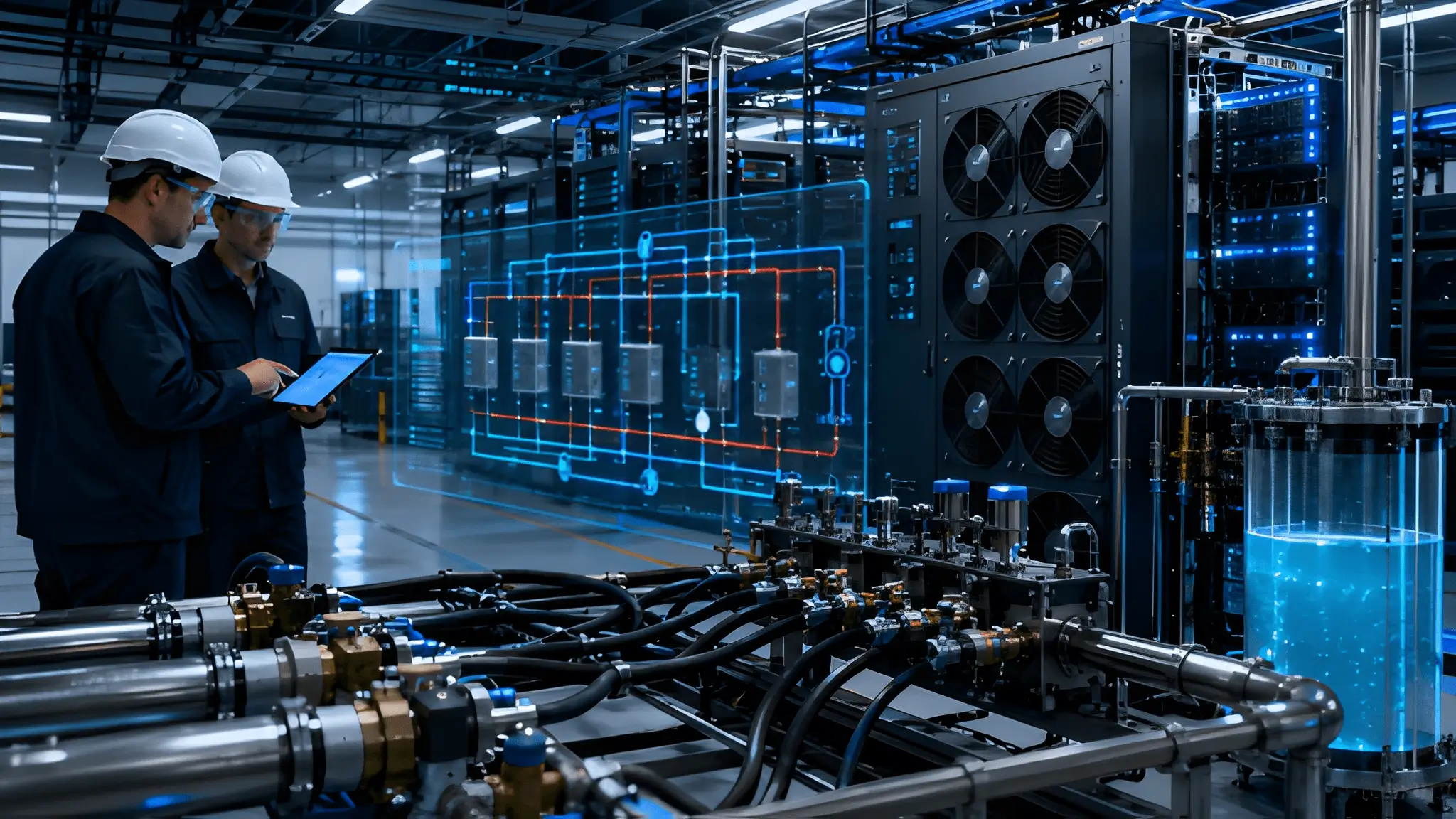
Every major transition in critical infrastructure eventually changes the way engineers define operational proof. Liquid-cooled AI environments have now reached that point because traditional Integrated Systems Testing no longer represents the conditions these facilities will experience after production workloads arrive. The commissioning process therefore faces a different challenge than it did during previous generations of data center construction, where validating electrical resilience and airflow performance provided reasonable confidence before IT equipment entered the building. That confidence weakens once heat leaves servers primarily through liquid instead of air because thermal behavior shifts into components that legacy commissioning rarely exercised under realistic operating conditions. Modern AI halls now depend on continuous interaction between pumps, coolant distribution units, secondary cooling loops, manifolds, controls, valves, sensors, and limited air systems, creating an operating environment that only exists when those systems function together under dynamic thermal conditions.

Mechanical infrastructure has gradually shifted from supporting computation to becoming an active participant in compute reliability itself. Thermal stability now depends less on individual equipment performance and more on how every cooling component reacts collectively during changing operating conditions, maintenance events, equipment failures, and fluctuating computational demand. Engineers therefore cannot rely solely on component acceptance tests because production AI workloads create interactions that never appear when systems operate independently. Commissioning consequently becomes an exercise in validating an interconnected thermal ecosystem rather than confirming isolated equipment performance, especially where liquid and air cooling continuously exchange operational responsibilities. That distinction changes what successful Level 5 IST must demonstrate because proving operational readiness now requires verification across the complete facility-to-chip cooling chain instead of only the building infrastructure.
Why Air-Only Load Banks Fail the Liquid Factory Test
Air-cooled commissioning methods evolved around a straightforward assumption because nearly all server heat ultimately entered the room environment before leaving through mechanical cooling systems. That assumption shaped decades of Integrated Systems Testing procedures, equipment selection, acceptance criteria, and operational documentation across traditional data centers. Liquid-cooled AI facilities reverse that thermal pathway because most generated heat transfers directly into circulating coolant before interacting with room air, fundamentally changing how thermal energy moves throughout the building. Conventional resistive load banks therefore continue reproducing electrical demand while no longer recreating the dominant thermal behavior expected during actual AI operations. Engineers consequently face an important validation gap because infrastructure appears operational without demonstrating the conditions that production hardware will actually create. Closing that gap requires commissioning strategies capable of reproducing simultaneous liquid and air heat transfer throughout the entire cooling architecture rather than validating only one thermal domain.
Legacy Integrated Systems Testing Was Built Around Air-Dominant Thermal Physics
The distinction becomes more significant when operators evaluate integrated performance rather than individual equipment operation. Cooling equipment may satisfy every factory acceptance criterion while still encountering operational behavior that commissioning never reproduced because the dominant heat transfer path remained absent throughout testing. Control systems similarly appear stable despite never responding to realistic coolant temperatures, changing liquid flow rates, or dynamic thermal loads distributed through secondary loops instead of open room air. Mechanical engineers consequently receive confirmation that equipment performs according to specification without equivalent confidence that the entire thermal chain behaves correctly during realistic operating scenarios. The completed building therefore reflects an artificial thermal environment created by the testing methodology rather than the one expected during sustained AI production workloads. That difference explains why conventional IST increasingly struggles to provide meaningful operational assurance for modern liquid-cooled AI facilities.

A second limitation emerges during failure simulations because traditional air-based thermal loading exercises only one portion of the infrastructure expected to manage production heat. Pump transitions, CDU responses, manifold balancing, coolant temperature recovery, and secondary loop stability remain largely unchallenged despite representing essential operating functions within liquid-cooled environments. Air systems consequently compensate for thermal conditions they will rarely experience during normal production while liquid infrastructure receives comparatively limited dynamic validation before handover. Operators therefore inherit mechanical systems whose individual components passed acceptance testing without proving coordinated thermal behavior across the complete cooling ecosystem. Modern commissioning increasingly addresses this imbalance by introducing thermal load banks capable of reproducing simultaneous liquid and residual air heat, allowing engineers to observe infrastructure performance under conditions that closely resemble future AI operations. That evolution reflects changing infrastructure physics rather than changing commissioning preferences.
Dual-Domain Thermal Emulation Redefines What Operational Readiness Actually Means
Dual-domain thermal emulation introduces a commissioning philosophy that treats liquid and air as interconnected thermal transport mechanisms instead of independent mechanical systems. Rather than injecting all simulated heat into surrounding room air, advanced thermal load equipment distributes energy through coolant circuits while maintaining representative residual air loads across supporting infrastructure. Engineers therefore observe the interaction between heat exchangers, CDUs, pumps, valves, cooling towers, dry coolers, computer room air handlers, and environmental controls during conditions that more closely resemble production AI operations. That broader validation approach allows commissioning teams to evaluate coordinated system behavior instead of confirming isolated equipment performance under simplified thermal assumptions. Every response becomes relevant because infrastructure components continuously influence one another once liquid cooling carries the majority of generated heat.
Thermal interactions become especially important during transient operating events because AI workloads rarely maintain perfectly stable computational demand throughout normal production cycles. Coolant temperatures change, flow rates adjust, pump speeds respond, valves reposition, and control algorithms continuously seek equilibrium across interconnected mechanical systems supporting high-density compute infrastructure. Conventional air-only heat generation cannot reproduce those interactions because the dominant thermal transport path remains disconnected from the commissioning environment despite representing primary operational reality after deployment. Dual-domain thermal emulation instead allows engineers to observe how infrastructure reacts while heat simultaneously moves through liquid networks and supporting air systems under changing operating conditions. The resulting data supports commissioning decisions based on integrated thermal performance rather than isolated subsystem acceptance. Operational readiness therefore becomes measurable across the complete cooling chain instead of only within traditional air distribution infrastructure.
The CDU-to-Manifold Handshake No Checklist Captures
Every liquid-cooled AI environment depends on a point of interaction that receives far less commissioning attention than electrical distribution or chilled water generation. That interaction exists where the Coolant Distribution Unit transfers thermal energy between the facility cooling network and the secondary liquid loop serving compute racks. Although each system may independently satisfy factory acceptance criteria, their operational relationship determines whether coolant reaches every server under stable hydraulic conditions throughout changing production demand. Minor instability at this interface often propagates across downstream manifolds, pressure control devices, rack distribution assemblies, and cold plates long before environmental alarms indicate abnormal operating conditions. Conventional Integrated Systems Testing rarely recreates these combined hydraulic responses because historical commissioning emphasized equipment availability rather than continuous thermal coordination across multiple liquid domains.
The practical objective extends beyond proving that coolant reaches every rack because operational reliability depends upon maintaining stable hydraulic behavior while infrastructure experiences realistic disturbances. Pump transitions, variable computational loading, temporary valve adjustments, partial rack utilization, maintenance isolation, and control interventions all influence the interface between the CDU and downstream distribution network. Each event alters pressure relationships differently even when average coolant temperatures remain within acceptable operating ranges. Level 5 IST must therefore observe how the CDU responds while the complete hydraulic network changes dynamically instead of assuming stable operating conditions throughout every commissioning sequence. That broader validation approach transforms one overlooked mechanical interface into one of the most valuable indicators of operational readiness before AI hardware enters production.
Stable Flow Requires More Than Passing Pump Acceptance Tests
Pump acceptance testing confirms that mechanical equipment performs according to design specifications, yet it rarely demonstrates how hydraulic performance changes once multiple racks begin sharing the same secondary cooling circuit. The CDU continuously regulates coolant delivery while simultaneously responding to changing inlet temperatures, downstream pressure variations, valve positions, and thermal demand distributed throughout connected manifolds. Every adjustment influences another component because liquid cooling behaves as an interconnected hydraulic network rather than a collection of independent mechanical devices. Commissioning therefore cannot assume that successful pump startup automatically guarantees stable flow distribution during changing operating conditions. Level 5 IST instead evaluates how hydraulic equilibrium develops while several interconnected systems continuously influence one another through normal operating responses. That distinction separates equipment verification from genuine operational validation across the secondary cooling network.
Operational confidence also depends upon demonstrating that recovery occurs predictably after temporary disturbances rather than merely confirming acceptable steady-state operation. Pump transitions should stabilize without excessive oscillation, pressure regulation should recover without persistent hunting, and flow should return consistently across every connected rack after temporary demand changes. Small hydraulic instabilities often remain unnoticed during conventional testing because average system temperatures continue appearing acceptable despite localized flow disruption developing within downstream branches. Level 5 IST therefore evaluates response quality instead of measuring only endpoint conditions because transient hydraulic performance frequently predicts long-term operational reliability more accurately than steady-state measurements alone. Modern liquid-cooled AI factories increasingly require this broader perspective because continuous computational availability depends upon stable hydraulic interaction throughout the complete secondary cooling architecture.
Pump Failover and Partial Rack Loading Reveal Hidden Hydraulic Dependencies
Redundant pumping systems protect cooling continuity only when hydraulic transitions occur without disrupting downstream coolant delivery across shared secondary loops. Conventional commissioning generally confirms successful pump transfer while paying comparatively little attention to how manifold pressure, branch flow, and rack-level distribution evolve during the transition itself. Production AI environments rarely experience isolated equipment changes because multiple control systems respond simultaneously as operating conditions shift throughout the cooling network. Level 5 IST therefore introduces controlled disturbances while thermal load banks maintain representative heat transfer, allowing engineers to observe hydraulic recovery under realistic operating conditions. This approach demonstrates whether redundancy protects thermal continuity rather than simply verifying that standby equipment starts successfully.
Partial rack loading presents another hydraulic condition that conventional commissioning often underrepresents despite occurring frequently throughout staged infrastructure deployment. Newly commissioned AI halls commonly enter production gradually, leaving some racks operating under significant thermal demand while adjacent infrastructure remains lightly utilized during deployment phases. These uneven loading conditions alter coolant distribution because flow naturally follows paths presenting lower hydraulic resistance unless balancing mechanisms perform as intended. Engineers therefore need commissioning scenarios that intentionally vary rack demand while monitoring CDU response, manifold stability, and downstream pressure distribution across the complete cooling network. Thermal emulation enables these operating conditions without requiring installed GPU clusters, making realistic hydraulic validation possible before production deployment begins.
Secondary Loop Contamination Starts During Commissioning
Thermal performance often dominates commissioning discussions, yet coolant quality frequently determines whether that performance remains sustainable after production begins. Secondary liquid loops enter service with new piping, fabricated manifolds, flexible hoses, heat exchangers, valves, pumps, fittings, and instrumentation that have each experienced manufacturing, storage, transportation, installation, and assembly before coolant ever circulates through the completed system. Every one of those activities introduces opportunities for particulate matter, trapped air, residual fabrication debris, corrosion byproducts, sealing compounds, or installation contaminants to enter the liquid circuit. Commissioning therefore becomes the first operational phase during which the complete hydraulic network actively transports these materials toward increasingly sensitive cooling components. Modern AI servers using micro-channel cold plates present extremely small internal flow passages that tolerate far less contamination than legacy cooling equipment designed around larger hydraulic geometries.
The objective extends beyond protecting commissioning outcomes because coolant contamination often creates delayed operational consequences that emerge only after production workloads begin stressing the cooling system continuously. Small particulates may gradually accumulate inside restrictive cooling passages while entrained air interferes with heat transfer efficiency long before conventional environmental alarms detect abnormal operating conditions. Chemical instability can also develop if commissioning overlooks coolant composition, filtration effectiveness, or material compatibility during initial acceptance testing. Level 5 IST therefore increasingly incorporates fluid quality verification into operational readiness because thermal stability depends upon hydraulic cleanliness throughout the complete cooling circuit. This broader commissioning philosophy recognizes that the condition of the coolant deserves the same engineering attention as the performance of the equipment carrying it.
Flushing Alone Does Not Guarantee Long-Term Hydraulic Integrity
System flushing represents an essential commissioning activity, yet it should not be interpreted as final confirmation that the secondary cooling loop has achieved acceptable operational cleanliness. Construction activities inevitably introduce welding residue, metallic particles, machining debris, gasket fragments, protective coatings, packaging material, dust, and installation contaminants into piping networks before coolant enters service. Initial flushing removes much of this material, although additional particulates frequently become suspended once pumps establish continuous circulation under representative operating conditions. Thermal expansion, changing flow velocity, valve movement, and pressure variation all influence how residual contaminants migrate through the hydraulic system during early commissioning stages.
Entrained air presents an equally significant challenge because hydraulic systems rarely achieve complete deaeration immediately after filling operations conclude. Small air pockets frequently remain trapped within elevated piping sections, manifold branches, heat exchangers, flexible hose assemblies, and localized geometric transitions until sustained circulation gradually transports them toward designated air removal devices. These trapped gases alter local flow conditions, reduce effective heat transfer, influence pressure stability, and occasionally create misleading sensor readings despite overall system temperatures remaining apparently acceptable. Engineers therefore need commissioning sequences that intentionally maintain realistic operating temperatures while observing whether air removal mechanisms achieve stable hydraulic behavior throughout the complete secondary loop.
Fluid Quality Acceptance Becomes Part of Operational Readiness
Commissioning documentation traditionally emphasizes mechanical functionality, electrical resilience, and environmental performance, yet liquid-first AI infrastructure increasingly requires equivalent attention toward coolant condition before operational handover occurs. Fluid quality acceptance establishes a measurable baseline describing coolant cleanliness, filtration status, chemical composition, dissolved gases, and hydraulic stability at the moment the facility enters production service. This baseline enables future maintenance teams to distinguish operational degradation from original commissioning conditions whenever cooling performance changes during long-term operation. Engineers therefore gain an objective reference for evaluating hydraulic health instead of relying exclusively on equipment alarms or temperature deviations after production begins. Level 5 IST consequently transforms coolant quality into an operational acceptance criterion rather than an informal maintenance consideration. The completed facility enters service with a documented understanding of both thermal capability and hydraulic condition.
The same principle applies to coolant chemistry because incompatible fluid composition may introduce corrosion, material degradation, biological growth, or reduced thermal performance despite apparently successful commissioning temperatures. Engineers therefore establish baseline chemical characteristics before production deployment to support future maintenance decisions and long-term system reliability. This documentation also confirms compatibility between coolant formulation and installed materials throughout the secondary cooling network, reducing uncertainty during subsequent operational maintenance activities. Level 5 IST increasingly incorporates these hydraulic acceptance practices because commissioning now prepares an active liquid ecosystem rather than validating static mechanical equipment alone. Secondary loop contamination therefore becomes an engineering consideration addressed proactively during commissioning instead of reactively after production hardware begins experiencing cooling performance degradation.
When Air Is The Support Act, How Do You Prove Room Stability?
The adoption of direct liquid cooling changes the purpose of room air without eliminating its operational importance. Air no longer carries the majority of server heat, yet it continues supporting network equipment, storage platforms, power conversion assemblies, cabling infrastructure, lighting systems, monitoring hardware, and numerous components that remain outside the liquid cooling circuit. This redistribution of thermal responsibility creates a room environment where airflow patterns behave differently from those found in conventional air-cooled computing spaces. Mechanical engineers therefore cannot apply historical acceptance criteria without considering how dramatically the thermal balance inside the hall has changed. Level 5 IST must demonstrate that room stability remains consistent even after liquid systems assume primary responsibility for heat removal from computational equipment. Commissioning consequently shifts from validating maximum cooling capacity toward validating coordinated environmental stability under a fundamentally different thermal architecture.
Environmental stability also influences maintenance, fault recovery, and operational resilience because room conditions continue affecting personnel access, electrical equipment, monitoring systems, and supporting mechanical infrastructure. Temporary disturbances within the liquid cooling network may alter residual room temperatures while changes in air handling can influence localized operating conditions surrounding CDU equipment and associated controls. These interactions rarely become visible during conventional commissioning because air systems often experience unrealistic thermal loading that masks their true production responsibilities. Level 5 IST therefore evaluates room behavior under representative liquid-first operating conditions where air performs its intended supporting role rather than compensating for artificially generated heat. This approach provides operators with greater confidence that environmental stability will remain predictable throughout the facility’s operational life.
Residual Air Cooling Must Demonstrate Predictable Environmental Control
Residual air cooling succeeds only when it maintains consistent environmental conditions despite carrying substantially less thermal energy than in conventional computing facilities. Air handling units continue regulating humidity, supporting equipment cooling, maintaining circulation, and preventing localized thermal accumulation around infrastructure that remains outside liquid cooling networks. Their operating profiles therefore change considerably because airflow responds to a different distribution of heat sources throughout the room. Commissioning cannot assume these altered operating conditions automatically produce acceptable environmental stability simply because total cooling demand has decreased. Level 5 IST instead validates how air systems perform while liquid infrastructure removes the majority of computational heat under representative operating conditions. That broader validation ensures the supporting environmental systems function according to their revised operational responsibilities.
Reduced air heat loads also influence airflow behavior in ways that conventional commissioning procedures seldom evaluate. Lower return air temperatures alter control responses while modified airflow distribution changes how temperature gradients develop around electrical cabinets, cable pathways, monitoring equipment, and supporting mechanical infrastructure. These differences may appear subtle during initial operation, yet they significantly affect long-term environmental consistency across the complete AI hall. Engineers therefore benefit from thermal testing that reproduces realistic liquid cooling conditions while simultaneously observing room temperature uniformity, airflow stability, and environmental control response throughout occupied equipment spaces. Thermal load banks capable of combining liquid and residual air heat provide practical operating conditions for these evaluations without requiring production hardware. Commissioning consequently verifies actual room behavior rather than confirming theoretical cooling capacity.
Inverted Airflow Dynamics Require A Different Commissioning Philosophy
Liquid-first AI environments introduce an inverted airflow relationship where room air supports thermal management instead of defining it. Conventional commissioning methodologies developed around maximizing airflow efficiency because air represented the primary transport mechanism for nearly all server-generated heat. Modern AI halls fundamentally reverse that relationship as liquid systems intercept thermal energy directly within compute equipment before substantial heat enters the surrounding environment. Mechanical infrastructure consequently behaves differently despite appearing similar when viewed through conventional commissioning procedures. Engineers therefore require validation strategies focused on how supporting air systems integrate with dominant liquid cooling rather than attempting to recreate historical airflow conditions. Level 5 IST reflects this architectural shift by treating air as one coordinated element within a broader thermal ecosystem.
Airflow patterns also become more dependent upon equipment arrangement than overall thermal output because localized non-liquid components continue generating heat independently from liquid-cooled compute racks. Network switches, power conversion assemblies, monitoring systems, edge equipment, and distribution hardware each contribute distinct thermal profiles that air systems must accommodate consistently throughout the operational environment. These distributed heat sources demand stable environmental management even though they represent only a portion of the total facility heat load. Commissioning therefore evaluates airflow quality across occupied equipment zones instead of concentrating exclusively on bulk room cooling performance. Thermal load banks help reproduce representative environmental conditions while preserving the hydraulic behavior already established within the liquid cooling network. Integrated Systems Testing thereby validates the interaction between complementary cooling domains instead of emphasizing only one thermal transport mechanism.
Flow Imbalance: The Failure Mode You Only See at Full Hall Load
Hydraulic balance often appears satisfactory during commissioning when only a limited number of racks participate in thermal testing. That apparent stability can change once additional racks begin drawing coolant through the same secondary distribution network because every new hydraulic path influences pressure relationships across the complete manifold. Flow distribution therefore becomes increasingly dynamic as liquid demand expands beyond isolated commissioning scenarios into realistic production operation. Small differences in branch resistance, valve position, hose routing, quick disconnect assemblies, and manifold geometry gradually influence how coolant reaches individual racks throughout the hall. These interactions rarely become visible when Integrated Systems Testing focuses on single-row validation or limited thermal loading. Level 5 IST must therefore evaluate hydraulic balance under representative hall-wide operating conditions before production AI hardware depends upon consistent coolant delivery across every connected rack.
Hydraulic imbalance also affects operational flexibility because future expansion frequently introduces new cooling demand into infrastructure originally commissioned under lower utilization conditions. AI facilities rarely begin operation with every rack populated immediately, making staged deployment a common characteristic of modern compute environments. The cooling network must therefore remain stable while accommodating changing hydraulic demand throughout successive deployment phases instead of only under a single commissioning configuration. Level 5 IST increasingly validates this adaptability by recreating representative hall-wide thermal conditions before infrastructure handover occurs. Commissioning consequently evolves into demonstrating sustained hydraulic consistency across both present and future operational states rather than verifying isolated design assumptions.
Single-Row Validation Cannot Predict Shared Manifold Behavior
Testing one row of liquid-cooled racks provides valuable equipment verification, yet it cannot accurately represent hydraulic conditions that emerge once multiple rows operate simultaneously through shared secondary infrastructure. Every additional branch connected to the manifold changes pressure relationships, coolant distribution, and flow resistance across the entire hydraulic network. These changes remain relatively small during limited commissioning scenarios but become increasingly influential as production deployment expands throughout the hall. Engineers therefore cannot assume that acceptable flow observed within one commissioning zone automatically predicts equivalent performance across every connected rack after full deployment. Level 5 IST instead introduces thermal demand across representative sections of the cooling network to evaluate how shared infrastructure behaves under distributed operating conditions. Hydraulic performance consequently reflects system-wide interaction rather than isolated equipment operation.
This broader perspective also supports future operational planning because balanced hydraulic performance remains essential throughout infrastructure expansion, maintenance activities, and evolving computational demand. Engineers gain greater confidence when commissioning demonstrates that manifold performance remains stable despite changing operating conditions rather than proving only one static configuration. Small hydraulic irregularities discovered during thermal emulation frequently reveal adjustment opportunities involving balancing valves, control strategies, or distribution geometry before production deployment begins. Addressing these conditions during commissioning reduces operational uncertainty while avoiding corrective intervention after sensitive AI hardware occupies the facility. Level 5 IST thereby transforms manifold validation into a predictive assessment of long-term hydraulic resilience rather than a simple acceptance milestone.
Valve Hunting and QDC Pressure Loss Only Emerge Under Dynamic Demand
Hydraulic control devices respond continuously to changing operating conditions, making their behavior difficult to evaluate through static commissioning procedures. Control valves adjust position to maintain target operating parameters while quick disconnect couplings introduce localized pressure characteristics that vary according to flow demand throughout the secondary cooling network. These components generally perform predictably under limited commissioning loads, yet their combined interaction becomes significantly more complex once simultaneous thermal demand develops across multiple connected racks. Engineers therefore need Integrated Systems Testing that deliberately creates changing hydraulic conditions instead of maintaining constant operating profiles throughout validation activities. Thermal load banks provide repeatable demand variation capable of exercising these responses before production equipment relies upon them. Commissioning consequently evaluates hydraulic control quality rather than merely confirming equipment installation.
Quick disconnect assemblies also deserve careful evaluation because every connection contributes incremental hydraulic resistance throughout extended rack distribution networks. Individual pressure losses may appear insignificant when viewed independently, yet their cumulative influence becomes increasingly relevant as coolant travels through multiple interconnected branches serving high-density AI infrastructure. Engineers therefore assess pressure distribution under representative simultaneous loading to confirm that downstream racks continue receiving balanced coolant flow despite cumulative hydraulic effects. Thermal emulation across multiple rack positions provides realistic operating conditions for these observations without requiring installed GPU clusters. Level 5 IST ultimately demonstrates that hydraulic balance remains dependable across the complete cooling network instead of relying upon assumptions derived from limited commissioning scenarios.
Controls Collision: BMS vs CDU Controller During IST
Control architecture has become one of the defining engineering challenges within liquid-cooled AI environments because thermal stability now depends as much on coordinated decision-making as on mechanical performance. Modern facilities contain multiple control layers that continuously interpret temperatures, pressures, flow rates, equipment status, valve positions, pump operation, and alarm conditions before issuing independent responses across the cooling network. Each controller performs according to its own operating logic, yet the complete facility only remains stable when those individual decisions reinforce rather than oppose one another. Conventional commissioning frequently verifies each control platform independently without fully exercising the interactions that occur once the Building Management System, CDU controllers, plant automation, and supporting mechanical equipment respond simultaneously. Level 5 IST therefore expands beyond functional controls testing to validate coordinated operational behavior across the complete thermal ecosystem before production AI hardware depends upon it.
Operational resilience increasingly depends upon clear ownership of every control action because uncertainty between independent automation platforms can introduce instability without triggering obvious equipment failures. Valve commands, pump speed adjustments, alarm acknowledgements, pressure regulation, and cooling prioritization should follow consistent operational logic regardless of which controller initiates the response. Small inconsistencies in sequencing may gradually influence hydraulic stability despite every individual component remaining technically operational. Level 5 IST therefore evaluates the quality of control coordination alongside traditional mechanical acceptance criteria because modern liquid-cooled AI infrastructure functions as a unified operational system rather than a collection of autonomous devices. This evolution places integrated controls validation among the most valuable commissioning activities before computational hardware enters production service.
Independent Control Logic Can Produce Unintended Operational Conflict
Every automated control platform operates according to predefined objectives that optimize the equipment or systems under its direct responsibility. The Building Management System may prioritize overall plant efficiency while the CDU controller focuses on maintaining precise hydraulic stability across the secondary cooling circuit serving compute racks. These objectives frequently complement one another, yet changing operating conditions occasionally create situations where separate controllers attempt to correct the same condition through different control strategies. Engineers therefore cannot assume compatible operation solely because each controller independently satisfies its functional acceptance criteria during conventional commissioning. Level 5 IST deliberately introduces representative disturbances that require multiple automation systems to respond simultaneously while thermal load banks maintain realistic operating demand. This integrated approach reveals whether automation platforms cooperate consistently under production-like conditions.
Valve authority illustrates one common example because multiple controllers may possess legitimate operational reasons for adjusting coolant flow during changing thermal demand. The Building Management System may request increased circulation to satisfy plant-level operating objectives while the CDU controller attempts to stabilize secondary loop pressure by limiting hydraulic changes. Both actions appear technically correct when viewed independently, yet their combined interaction can create unnecessary oscillation, delayed stabilization, or inconsistent hydraulic response throughout connected rack infrastructure. Commissioning therefore benefits from observing these interactions directly instead of relying exclusively on software review or isolated equipment testing. Engineers gain valuable insight into actual operational behavior before sensitive computational hardware becomes dependent upon coordinated automation performance. Level 5 IST thereby validates system intelligence alongside mechanical capability.
Unified Alarm Ownership Defines Modern White-Tag Operational Readiness
Alarm management has evolved from simple fault notification into an operational discipline that influences response quality throughout liquid-cooled AI environments. Multiple automation platforms frequently detect the same developing condition, although each may classify, prioritize, or present the event differently according to its own operating logic. Without clearly defined ownership, operators risk receiving duplicate notifications, contradictory guidance, delayed escalation, or uncertainty regarding which system should initiate corrective action. Engineers therefore include alarm sequencing within Level 5 IST because effective operational response depends upon consistent information as much as accurate detection. Thermal load banks creating representative hydraulic disturbances allow commissioning teams to observe how integrated automation platforms communicate during realistic operating scenarios. This process transforms alarm verification into an assessment of operational coordination rather than simple notification capability.
White-tag readiness increasingly reflects the maturity of integrated operational behavior instead of documenting only successful equipment completion. Mechanical infrastructure may satisfy every individual acceptance criterion while still requiring refinement in alarm ownership, control hierarchy, or automation sequencing before entering dependable production service. Level 5 IST therefore confirms that every significant operational event follows a clearly defined decision pathway supported by coordinated responses across the complete thermal ecosystem. The resulting documentation demonstrates that automation platforms behave predictably under representative hydraulic conditions instead of merely functioning independently according to manufacturer specifications. Commissioning ultimately concludes with validated operational intelligence that matches the complexity of modern liquid-cooled AI infrastructure.
What White-Tag Sign-Off Looks Like for a Liquid-First Hall
White-tag completion has traditionally represented the point where commissioning confirms that installed infrastructure satisfies design intent and demonstrates operational functionality before handover. Liquid-cooled AI environments expand that expectation because operational readiness now depends upon documented understanding of hydraulic behavior, thermal interaction, control coordination, coolant condition, and secondary loop performance alongside conventional mechanical acceptance. The final commissioning package therefore becomes more than a collection of completed checklists because it establishes the engineering baseline that future operations teams will depend upon throughout the facility lifecycle. Every verified condition recorded during Level 5 IST influences future maintenance decisions, fault investigation, capacity planning, and system optimization after production hardware begins operating continuously. Engineers consequently approach white-tag documentation as an operational reference rather than simply evidence that construction activities have concluded. This shift reflects the growing importance of commissioning as the bridge between successful installation and dependable long-term AI infrastructure operation.
Liquid-first facilities introduce operating characteristics that cannot be adequately represented through conventional commissioning documentation focused primarily on electrical resilience and mechanical equipment availability. Secondary cooling circuits require detailed hydraulic records, coolant chemistry baselines, filtration status, balancing verification, and thermal performance observations that remain valuable long after project completion. These records provide future engineering teams with a reliable operational reference whenever equipment modifications, maintenance interventions, or performance investigations become necessary. Commissioning therefore captures the facility in its verified operating state before gradual operational changes naturally occur over time. Thermal load bank results supporting both liquid and residual air domains contribute additional evidence that the completed infrastructure has been validated under representative operating conditions instead of simplified acceptance scenarios. White-tag sign-off consequently becomes an engineering handover founded on measurable operational understanding.
Operational Documentation Must Extend Beyond Mechanical Completion
Mechanical completion confirms that equipment has been installed correctly, yet operational documentation establishes how that equipment behaves when functioning as part of an integrated thermal ecosystem. Liquid-cooled AI facilities require detailed records describing secondary loop routing, manifold configuration, balancing settings, control logic relationships, filtration status, coolant composition, and verified operating conditions observed during commissioning. These documents provide engineers with an accurate reference whenever future maintenance activities, equipment replacement, or performance investigations require comparison against original operating behavior. Level 5 IST therefore records dynamic system performance rather than preserving only installation details because long-term reliability depends upon understanding operational interaction across interconnected cooling infrastructure. Every validated hydraulic characteristic becomes part of the facility’s engineering knowledge rather than remaining an undocumented commissioning observation. This broader documentation philosophy strengthens operational continuity throughout the infrastructure lifecycle.
As-built process and instrumentation diagrams gain particular importance because liquid cooling introduces additional hydraulic complexity beyond conventional chilled water distribution. Engineers rely upon accurate representation of valves, pumps, manifolds, secondary piping, instrumentation, balancing devices, filtration assemblies, and control interfaces whenever operational adjustments become necessary. Minor undocumented changes may complicate future maintenance activities while increasing uncertainty during troubleshooting or capacity expansion. Commissioning therefore verifies that final documentation accurately reflects installed operating conditions instead of simply reproducing original design intent. This attention to engineering accuracy enables operational teams to make informed decisions using verified infrastructure information developed during Level 5 IST. Documentation consequently becomes an active operational resource rather than archived project material.
White-Tag Acceptance Now Includes Thermal Readiness
Thermal readiness has become a defining characteristic of modern commissioning because liquid-first AI facilities cannot rely solely on equipment availability to demonstrate operational preparedness. Engineers increasingly evaluate whether the complete facility-to-chip cooling pathway has been exercised under representative thermal demand before computational hardware occupies the environment. Thermal load bank results documenting both liquid and supporting air performance therefore become integral elements of final commissioning evidence rather than supplemental engineering records. This information confirms that cooling infrastructure responds predictably across realistic operating scenarios while preserving documented reference conditions for future operational comparison. Level 5 IST consequently demonstrates not only that systems function but also that they function together according to their intended thermal responsibilities. White-tag acceptance evolves into confirmation of integrated operational capability.
Coolant chemistry documentation also forms part of thermal readiness because hydraulic reliability depends upon maintaining stable fluid characteristics from the first day of production operation. Engineers establish verified baselines describing coolant condition, filtration performance, and secondary loop cleanliness before computational equipment begins continuous service. These records support predictive maintenance while helping future operational teams identify changes that develop gradually throughout the infrastructure lifecycle. Commissioning therefore concludes with measurable understanding of the liquid medium responsible for transporting thermal energy rather than focusing exclusively on the mechanical equipment surrounding it. The cooling circuit enters production with both verified performance and documented hydraulic integrity.
Without Liquid-Aware IST, You Commission Risk
Liquid cooling has fundamentally changed the engineering assumptions that once shaped Integrated Systems Testing, making historical commissioning methodologies increasingly incomplete for AI infrastructure designed around secondary coolant loops instead of room air. The transition does not diminish the importance of electrical resilience, mechanical redundancy, or operational discipline, yet it expands the definition of what must be proven before computational hardware enters production service. Level 5 IST now extends across hydraulic stability, thermal interaction, coolant quality, integrated controls, manifold behavior, environmental consistency, and documented operational readiness because these elements collectively determine how reliably a liquid-first AI hall performs after commissioning concludes. Thermal load banks supporting both liquid and residual air domains provide the practical mechanism for validating those conditions before production GPUs become the first meaningful thermal load the infrastructure has ever experienced.











