
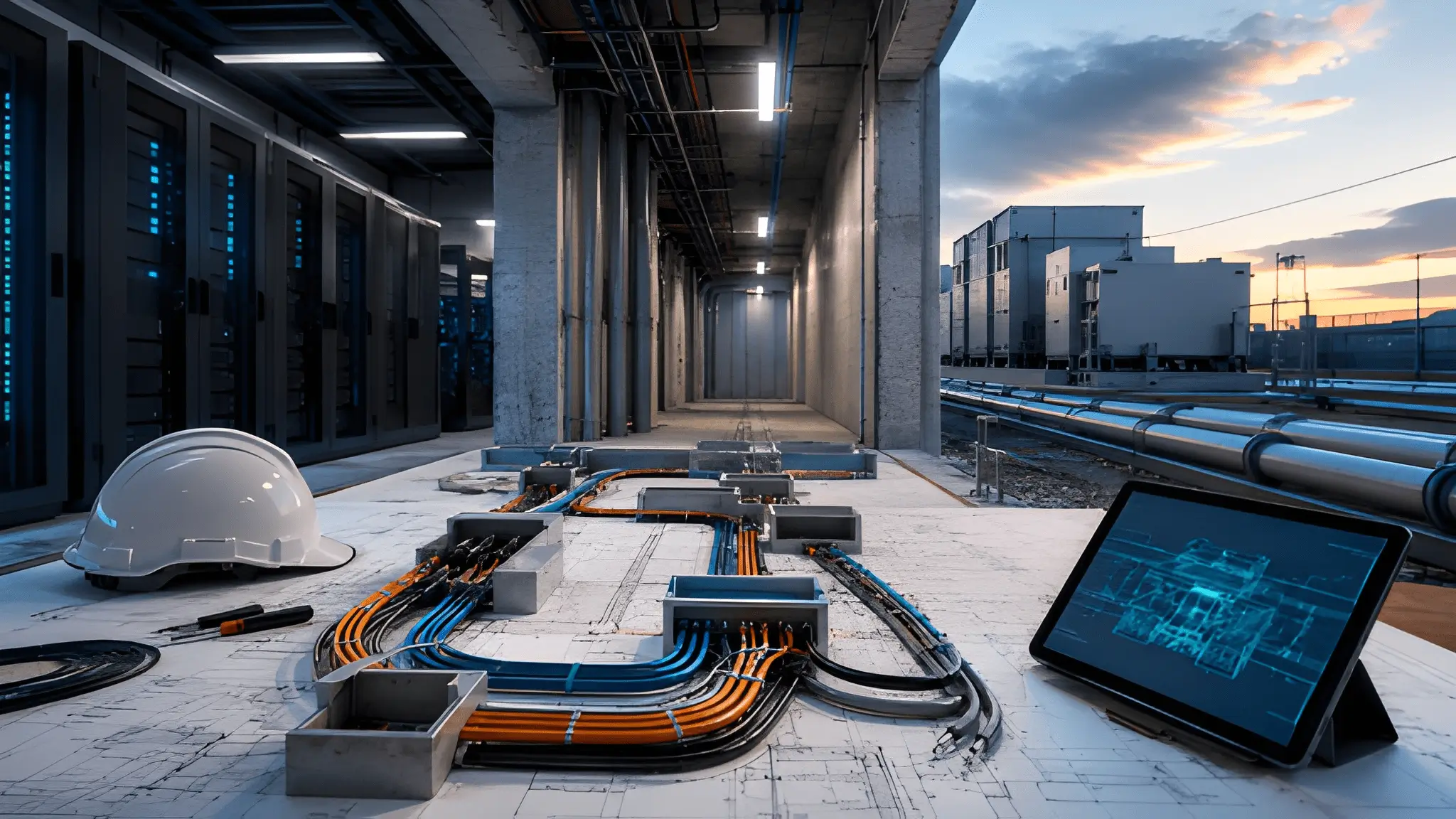
A campus may receive sufficient electrical capacity, advanced cooling architecture, and abundant fiber resources, yet still struggle with operational resilience because those systems never shared a unified spatial strategy during design. The long-term resilience and maintainability of modern digital infrastructure increasingly depend on how power, cooling, and communications pathways are physically coordinated across the entire property rather than being designed independently. The physical relationship between substations, underground utility corridors, equipment halls, splice locations, and distribution routes increasingly determines whether future expansion remains practical or becomes prohibitively complex. This integrated planning approach reflects that reality by treating power distribution, cooling infrastructure, and optical connectivity as coordinated engineering systems during the earliest stages of campus design rather than developing them independently.

Power infrastructure illustrates this shift particularly well because electrical redundancy cannot remain isolated from communication redundancy anymore. Protective relays, automation systems, environmental monitoring platforms, operational telemetry, synchronization services, and management networks all depend on carefully engineered optical routes that survive the same failure scenarios affecting electrical distribution. Cooling infrastructure introduces another layer because chilled water corridors, utility tunnels, maintenance access, and structural clearances frequently compete with telecommunications pathways beneath the same surface. Campus planning therefore begins to resemble systems engineering instead of conventional site development where every physical decision influences several independent operational domains simultaneously. That broader perspective explains why modern projects increasingly begin with infrastructure relationships before architectural expression rather than treating connectivity as a service installed after construction reaches completion.
Civil First, Systems Second Is No Longer Viable
Civil drawings once established underground corridors primarily around excavation efficiency and structural practicality. Modern campus planning increasingly treats every trench alignment as a long-term infrastructure decision because underground utility corridors become substantially more difficult to modify after construction is complete. Fiber routes cannot simply relocate after roads, retaining walls, stormwater systems, utility crossings, and reinforced foundations occupy available underground space. Engineers therefore examine underground geometry with the same strategic attention previously reserved for electrical distribution because communication diversity depends directly upon physical separation rather than logical configuration alone. Infrastructure resilience increasingly originates from excavation planning instead of post-construction network architecture. Designing those relationships during initial site engineering avoids irreversible constraints that later limit expansion, redundancy, and maintenance flexibility.
Underground Geometry Has Become Permanent Infrastructure
The practical challenge appears whenever telecommunications designers inherit corridors already constrained by electrical duct banks, storm drainage, chilled water distribution, fuel infrastructure, or structural foundations. Available pathways often force multiple communication routes into identical underground alignments despite drawings identifying them as separate systems. That compromise creates physical convergence long before optical equipment reaches production service because independent cables ultimately occupy adjacent conduits or common excavation zones. Future maintenance also becomes considerably more difficult because additional conduits cannot pass through areas whose structural or environmental conditions have already become fixed. Campus resilience consequently depends less upon cable quantity than upon preserving genuine physical independence throughout the underground environment.

Early coordination also reduces uncertainty surrounding future campus expansion because every additional building eventually depends upon infrastructure established during the first construction phase. Designers who reserve independent utility corridors before concrete placement preserve routing flexibility that later projects inherit without disruptive reconstruction. Underground pathways become scalable assets rather than obstacles requiring expensive engineering compromises during each expansion cycle. Planning therefore shifts from serving the first operational phase toward enabling infrastructure that accommodates future topology changes without altering completed civil works. Modern campuses increasingly treat trench alignment as strategic infrastructure whose value extends well beyond the initial construction schedule.
Duct Banks Now Shape Long-Term Network Topology
Conventional duct bank planning frequently emphasized construction efficiency because communication systems rarely dictated overall site geometry during earlier generations of campus development. Modern infrastructure planning reverses that relationship by recognizing that underground conduit architecture directly influences long-term optical distribution, maintenance accessibility, and physical route diversity. Every conduit allocation affects future cable placement because additional pathways become increasingly difficult to introduce after structural elements, utility crossings, and finished surfaces occupy the surrounding ground. Design teams therefore evaluate duct banks as permanent network infrastructure rather than passive civil assets supporting later installation work. Optical connectivity now begins with underground geometry instead of terminating within equipment rooms after construction concludes. That shift establishes a foundation where future expansion remains practical without repeatedly reopening completed sections of the campus.
Well-designed duct banks preserve optionality because independent conduit groups allow future network growth without disturbing operational services already occupying adjacent infrastructure. Separate conduit systems also improve maintenance planning because repair work can proceed within isolated pathways rather than exposing multiple communication routes to the same excavation activity. Underground congestion becomes significantly easier to manage when engineers reserve expansion corridors before the first cable installation rather than relying upon spare capacity whose location may no longer support evolving distribution strategies. Civil planning therefore extends beyond determining where conduits physically fit because it also determines whether future routing decisions remain technically feasible. Infrastructure resilience develops through preserved routing flexibility instead of simply installing additional conduits within identical excavation boundaries. Modern campuses increasingly recognize that unused underground space possesses strategic engineering value when reserved for future independent distribution requirements.
Designing Independent Fibre Entry as Core Infrastructure
Independent fiber entry once appeared relatively late in project documentation because designers viewed carrier access as an extension of telecommunications engineering rather than a defining element of campus architecture. Current infrastructure planning increasingly coordinates carrier entry locations with primary utility corridors, electrical distribution planning, and cooling infrastructure because those locations establish the physical origin of downstream communication pathways. The precise location where optical cables penetrate the campus boundary influences route diversity long before equipment installation begins inside individual buildings. Engineers therefore coordinate carrier entrances with site circulation, underground utilities, maintenance access, and future expansion corridors instead of treating them as isolated wall penetrations. Physical separation at the campus perimeter frequently determines whether logical redundancy survives construction reality. Inside-out planning therefore begins by validating that independent external routes remain physically independent throughout their complete journey toward operational spaces.
Carrier Entry Must Begin Outside the Building
Carrier diversity loses much of its intended resilience when independent providers ultimately converge within the same underground trench, maintenance corridor, utility tunnel, or structural penetration before reaching network equipment. Drawings may continue identifying separate communication paths even though excavation constraints have already eliminated meaningful physical independence. That condition often remains unnoticed until maintenance work, accidental excavation, flooding, or localized structural damage simultaneously affects routes expected to remain isolated from one another. Design validation therefore extends beyond reviewing network diagrams because physical inspections and coordinated civil modeling reveal whether independent routes genuinely remain separated throughout their complete path. Infrastructure resilience depends upon continuous physical independence instead of administrative separation between communication services. Modern planning increasingly verifies route integrity through the entire campus rather than accepting diversity based solely upon provider documentation.
Locating carrier entries also affects future operational flexibility because additional service providers, replacement cables, and infrastructure modernization projects require sufficient physical access long after the original construction concludes. Designers therefore preserve approach corridors, maintenance clearances, and independent conduit systems capable of accommodating future growth without disrupting existing production services. Entry locations become enduring infrastructure decisions whose influence extends throughout the operational lifetime of the campus rather than ending after initial commissioning. Physical planning consequently emphasizes accessibility alongside redundancy because resilient infrastructure must remain serviceable as technology evolves. Independent entry architecture therefore supports operational continuity by preserving options instead of exhausting them during the first construction phase. Inside-out methodology recognizes that communication infrastructure begins at the property boundary rather than inside telecommunications rooms.
Splice Vaults Have Become Permanent Distribution Nodes
Splice vault placement now influences far more than the protection of optical joints because every vault effectively becomes a decision point within the campus distribution fabric. Engineers evaluate accessibility, structural loading, drainage characteristics, maintenance clearances, and future route expansion before selecting locations that will remain operational for decades. A poorly positioned vault may complicate cable replacement, restrict new route additions, or force unnecessary bends that affect downstream routing efficiency. Infrastructure teams therefore coordinate vault placement alongside road alignments, utility corridors, electrical distribution paths, and cooling networks instead of treating it as a telecommunications detail. That level of coordination reduces operational conflicts that frequently emerge years after construction has concluded. Inside-out design recognizes that splice infrastructure represents permanent operational architecture rather than temporary installation support.
Pull chambers receive similar attention because cable installation depends upon manageable pulling distances, controlled directional changes, and safe access throughout the distribution network. Engineers align these structures with realistic installation practices instead of assuming future construction teams will overcome difficult geometry through field adjustments. Consistent spacing between pull chambers also improves maintenance because replacement activities can occur without exposing excessive cable lengths or disturbing unrelated distribution segments. Underground communication systems consequently become easier to expand while preserving the integrity of existing production infrastructure. Design decisions therefore anticipate operational maintenance requirements instead of focusing exclusively on initial installation efficiency. Physical accessibility ultimately becomes an essential resilience characteristic rather than a secondary maintenance consideration.
When Distribution Density Outgrows the Meet-Me Room
Meet-me rooms traditionally concentrated external carrier connections before distributing services toward operational spaces through structured cabling and internal backbone infrastructure. That approach worked effectively when communication growth followed relatively predictable expansion patterns and optical termination density remained manageable within conventional telecommunications layouts. Modern campuses now experience sustained increases in fiber counts because every operational domain relies upon dedicated optical connectivity rather than shared communication pathways. Engineers increasingly evaluate optical distribution frame capacity during master planning so distribution infrastructure can accommodate both initial deployment requirements and anticipated future expansion. Distribution infrastructure increasingly determines spatial requirements throughout adjacent telecommunications areas because termination growth directly influences equipment arrangement, maintenance access, and future expansion possibilities. Inside-out design consequently treats optical distribution frames as foundational infrastructure instead of passive cable termination equipment.
Optical Distribution Frames Have Become Capacity Infrastructure
Frame density influences much more than rack utilization because every additional termination introduces corresponding patching requirements, cable management considerations, identification practices, and maintenance activities. Engineers therefore reserve circulation space around distribution frames that accommodates operational work instead of maximizing equipment density at the expense of accessibility. Cable routing pathways likewise expand because increasing fiber counts require larger overhead management systems and carefully controlled bend geometries throughout telecommunications spaces. Distribution rooms gradually evolve into infrastructure hubs whose physical organization directly affects long-term operational efficiency. Design decisions consequently emphasize serviceability alongside capacity because accessible infrastructure remains significantly easier to modify without introducing unnecessary operational risk. Spatial planning therefore reflects the operational realities associated with sustained optical growth rather than only the initial installation footprint.
Campus architecture increasingly responds to these distribution requirements because optical infrastructure no longer occupies negligible portions of technical space. Equipment rooms expand vertically and horizontally to preserve orderly cable management while allowing future additions without compromising existing installations. Engineers also coordinate adjacent risers, overhead containment, and equipment access routes so distribution growth remains achievable without extensive reconstruction. Communication density therefore influences building planning much earlier than it previously did because termination infrastructure requires physical flexibility throughout the operational lifecycle. Modern campuses increasingly acknowledge that optical scalability depends as much upon architectural planning as network engineering. Inside-out methodology therefore integrates distribution infrastructure into the earliest stages of building configuration rather than adapting available space after construction.
Growth Planning Begins Before the First Cross-Connect
Cross-connect growth rarely follows a straight or predictable path because operational requirements evolve alongside changes in network architecture, building utilization, and infrastructure modernization. Engineers therefore avoid designing telecommunications spaces around the first operational configuration since that arrangement represents only the beginning of the distribution lifecycle. Every future optical circuit introduces additional routing decisions that influence cable organization, maintenance accessibility, and long-term operational clarity. Distribution planning increasingly assumes continuous adaptation rather than isolated expansion events because modern campuses rarely remain architecturally static after commissioning. Physical infrastructure must therefore accommodate evolving connection patterns without forcing repeated reconstruction of cable pathways or equipment layouts. Inside-out methodology treats future cross-connect density as an expected operational condition rather than an unforeseen consequence of successful growth.
Cable management becomes progressively more important as optical distribution expands because organizational discipline directly affects restoration speed, maintenance quality, and operational reliability. Engineers establish routing hierarchy, labeling conventions, pathway segregation, and equipment spacing during design instead of relying upon installation teams to introduce consistency after production systems become active. Orderly cable management preserves visibility throughout complex distribution environments where technicians must identify individual connections without disturbing adjacent infrastructure. That approach also reduces the likelihood of accidental service interruption during future modifications because clearly organized pathways simplify every maintenance activity. Distribution density therefore remains manageable through deliberate engineering rather than repeated corrective interventions. Infrastructure quality ultimately reflects planning discipline more than installation speed once communication systems mature over time.
Logical Diversity Versus Built Diversity
Network documentation frequently presents redundant communication routes as completely independent because logical topology diagrams naturally emphasize connectivity instead of physical geography. Construction reality can produce a very different outcome when independent routes gradually converge through shared corridors, common duct banks, identical wall penetrations, or neighboring underground structures created during civil engineering. Engineers increasingly recognize that logical redundancy provides limited operational value whenever physically distinct services ultimately depend upon the same structural pathway. True resilience therefore requires continuous validation of infrastructure separation throughout every stage of design instead of relying solely upon network documentation. Physical diversity must remain observable within the built environment rather than existing only as an administrative description. Inside-out design bridges that gap by evaluating infrastructure through both engineering drawings and physical routing analysis simultaneously.
Separate Drawings Do Not Guarantee Separate Infrastructure
Wall penetrations often illustrate this challenge because multiple communication systems may enter a building through separate conduits before ultimately passing through the same structural opening into interior distribution areas. Engineers may correctly identify those services as independent during network planning even though physical convergence has already created a common vulnerability. Similar situations arise within utility corridors where different pathways occupy adjacent cable trays despite originating from separate external routes. Shared infrastructure gradually accumulates through individually reasonable design decisions that collectively reduce overall resilience without attracting immediate attention. Careful coordination therefore examines every transition point where routing decisions may unintentionally eliminate physical independence. Infrastructure validation increasingly follows the entire communication path instead of reviewing isolated design segments independently.
Modern campus planning addresses these risks by integrating civil engineering, architectural coordination, telecommunications routing, and operational review into a unified validation process before construction begins. Designers compare logical redundancy against physical infrastructure to confirm that independent routes remain continuously separated throughout their complete journey across the campus. Review processes therefore focus equally upon drawings, three-dimensional coordination models, and practical installation constraints because resilience depends upon their collective consistency. Potential convergence points become engineering issues rather than construction surprises requiring compromise during installation. Infrastructure quality consequently improves because diversity receives continuous verification instead of retrospective correction. Inside-out methodology transforms redundancy from a documented objective into a physically demonstrable characteristic of the completed campus.
Physical Validation Has Become a Design Discipline
Three-dimensional coordination has become increasingly valuable because conventional plan drawings do not always reveal how multiple infrastructure systems converge within limited physical space. Independent utility routes may appear well separated when reviewed individually, yet vertical stacking, structural penetrations, or shared utility corridors can introduce hidden points of convergence once all engineering disciplines combine their models. Engineers therefore validate communication pathways within the complete campus environment rather than evaluating telecommunications drawings in isolation. Physical verification extends beyond checking dimensional accuracy because it confirms that redundancy survives every architectural transition encountered between the property boundary and the destination equipment. Design quality increasingly reflects spatial awareness instead of documentation completeness alone. Inside-out methodology uses physical validation to ensure that resilience exists in the built environment rather than remaining an assumption within engineering documentation.
Construction sequencing also influences diversity because temporary access decisions sometimes become permanent routing solutions when unexpected field conditions emerge during installation. Utility conflicts, excavation limitations, structural reinforcement, or environmental constraints may encourage contractors to consolidate pathways for practical reasons unless design intent clearly establishes acceptable routing boundaries. Engineers therefore define protected separation requirements before construction begins so that field adjustments preserve physical independence instead of gradually eroding it. Continuous multidisciplinary coordination allows project teams to identify emerging conflicts before completed work restricts future alternatives. Infrastructure resilience consequently depends upon maintaining engineering intent throughout construction rather than assuming approved drawings alone guarantee the final outcome. Inside-out planning therefore extends design responsibility into project execution by protecting the physical integrity of every independent communication path.
Optical Loss Budget as a Design Parameter
Optical performance often receives attention during commissioning because testing naturally occurs after cables, connectors, and equipment become operational. Contemporary infrastructure planning increasingly shifts that focus toward the earliest design stages because physical routing decisions directly influence attenuation long before technicians perform the first measurement. Every planned bend, connector interface, splice enclosure, transition point, and distribution pathway contributes to the cumulative optical characteristics of the completed network. Engineers therefore evaluate optical continuity while designing physical infrastructure instead of treating acceptable performance as a product of installation quality alone. Infrastructure planning consequently integrates optical engineering with civil coordination, architectural layout, and telecommunications design from the beginning of the project. Inside-out methodology recognizes that optical performance originates with physical design rather than post-construction testing.
Optical Performance Begins Long Before Cable Installation
Connector placement illustrates this relationship because every interface introduces another point requiring inspection, maintenance, and long-term operational management throughout the communication lifecycle. Engineers carefully evaluate where patching flexibility genuinely improves maintainability and where unnecessary connection points simply increase complexity without meaningful operational benefit. Distribution architecture therefore balances accessibility with optical simplicity by minimizing avoidable transitions while preserving practical serviceability across the campus. Physical routing decisions consequently become inseparable from long-term network performance because every additional interface influences future operational characteristics. Design quality depends upon disciplined engineering choices instead of assuming field installation will compensate for avoidable complexity. Modern campuses increasingly treat connection management as an architectural consideration rather than a purely telecommunications activity.
Routing geometry also deserves careful attention because optical cable performs most reliably when engineers preserve gradual transitions throughout underground pathways, telecommunications rooms, vertical risers, and equipment distribution areas. Abrupt directional changes, unnecessary pathway congestion, and constrained cable management increase the likelihood of maintenance challenges even when installation initially satisfies specification requirements. Engineers therefore coordinate pathway design across every discipline so communication infrastructure remains mechanically protected while preserving favorable optical characteristics throughout its operational life. Civil engineering, architectural planning, and telecommunications routing consequently become interdependent contributors to optical quality instead of isolated design responsibilities. Physical simplicity often produces stronger long-term operational stability than elaborate routing created solely to accommodate late-stage construction constraints. Inside-out design therefore establishes optical performance through coordinated infrastructure planning before installation activities begin.
Every Splice and Bend Influences Long-Term Capacity
Optical distribution rarely remains unchanged after commissioning because expansion projects, additional services, and evolving operational requirements continually introduce new connections throughout the campus. Every intermediate splice, directional transition, patch location, and distribution modification contributes to the overall optical path and influences the cumulative optical loss budget and available system margin for future services. Engineers therefore evaluate cumulative routing decisions during design instead of considering each alteration as an isolated implementation detail. Long-term infrastructure quality depends upon preserving disciplined optical architecture despite ongoing operational growth. Distribution planning consequently emphasizes sustainable simplicity rather than incremental accommodation of every new requirement. Inside-out methodology encourages engineers to protect optical continuity throughout the entire lifecycle instead of optimizing only for initial deployment.
Long-term optical capacity ultimately depends upon preserving engineering discipline across every modification introduced after commissioning because communication infrastructure continuously evolves throughout the operational lifecycle. Engineers document routing decisions, splice architecture, pathway allocation, and distribution changes so future projects inherit complete visibility into existing optical topology before introducing additional services. Coordinated documentation reduces unnecessary pathway duplication while protecting the organizational integrity established during the original design process. Infrastructure quality therefore reflects sustained engineering governance rather than isolated construction excellence because operational continuity depends upon cumulative decisions made over many years. Inside-out methodology provides a structured framework that protects optical performance despite ongoing infrastructure evolution. The result is a communication environment capable of adapting without gradually sacrificing the coherence established during initial campus planning.
From Connected Buildings to Interconnection Fabric
Campus planning traditionally began by determining building locations according to land availability, structural considerations, access roads, grading requirements, and utility service before telecommunications engineers connected completed structures through available pathways. Modern digital campus planning increasingly incorporates optical distribution requirements during early site planning because communication pathways influence how buildings can be efficiently interconnected across the property. Engineers evaluate communication corridors alongside electrical distribution and cooling routes before finalizing building orientation because every structural decision affects future routing efficiency. Infrastructure therefore develops around an integrated distribution strategy rather than treating fiber as an independent utility installed after architectural planning concludes. Physical relationships between buildings become engineering decisions supporting operational continuity instead of purely architectural composition. Inside-out methodology consequently establishes the campus as a unified interconnection environment instead of a collection of independently connected structures.
Campus Geometry Now Follows Distribution Strategy
Building orientation increasingly reflects the need to preserve efficient underground routing because communication pathways benefit from predictable geometry that supports maintenance, future expansion, and physical diversity throughout the campus. Engineers coordinate entrances, service corridors, utility alignments, and distribution rooms so optical infrastructure reaches each structure without unnecessary crossings or constrained routing conditions. Early planning also reduces the number of intermediate transitions required between external distribution networks and internal telecommunications spaces. Campus infrastructure consequently becomes easier to understand, maintain, and expand because physical routing follows deliberate engineering logic instead of adapting to architectural compromises introduced later. Communication systems therefore benefit from cleaner pathway organization across every operational phase. Modern campuses increasingly recognize that thoughtful building placement simplifies infrastructure for decades beyond the completion of construction.
Distribution strategy likewise influences future flexibility because buildings positioned around coherent communication corridors accommodate additional infrastructure with considerably less disruption than campuses assembled through isolated development phases. Engineers preserve expansion pathways, independent route options, and accessible distribution nodes before subsequent construction gradually reduces available routing space. Every new structure therefore integrates naturally into the broader communication fabric instead of requiring increasingly complex underground modifications to reach existing infrastructure. Campus planning evolves toward maintaining continuous connectivity rather than repeatedly extending isolated point-to-point links between buildings. Physical organization consequently supports long-term operational adaptability without sacrificing clarity throughout the distribution network. Inside-out design demonstrates that resilient campuses emerge from coherent infrastructure relationships established before architectural boundaries become permanent.
Interconnection Has Become the Primary Planning Objective
Infrastructure planning increasingly views every new building as another node within an expanding optical ecosystem instead of an isolated destination requiring independent communication services. Engineers coordinate backbone pathways, distribution nodes, carrier entry locations, electrical corridors, and cooling routes so each addition strengthens the overall network rather than introducing another disconnected branch. That philosophy preserves architectural consistency because future development naturally follows an established distribution framework instead of creating multiple incompatible routing patterns across the property. Communication infrastructure therefore grows through deliberate extension of an existing fabric rather than through repeated point-to-point construction responding only to immediate project needs. Operational continuity benefits because every expansion inherits predictable routing principles already embedded within the campus. Inside-out methodology transforms interconnection from a supporting function into the organizing framework governing long-term infrastructure development.
The transition toward an interconnection-first strategy also simplifies operational governance because engineers maintain a consistent understanding of how communication infrastructure evolves across successive construction phases. Distribution pathways remain identifiable, expansion corridors stay protected, and maintenance activities occur within a coherent physical framework instead of a patchwork assembled over many independent projects. Engineering disciplines likewise coordinate more effectively because electrical distribution, cooling infrastructure, and optical routing follow compatible spatial logic established during master planning. Every future modification therefore reinforces the original engineering strategy rather than gradually weakening it through isolated design compromises. Infrastructure resilience emerges from organizational consistency that extends across decades of development rather than depending upon periodic corrective projects. Modern campuses increasingly demonstrate that coherent planning provides greater long-term value than repeatedly optimizing individual construction phases in isolation.
Proving the Path Before Production
Traditional commissioning concentrated on verifying whether installed systems operated according to their respective design specifications before production activities began. Electrical distribution, cooling infrastructure, communications equipment, and building services typically underwent separate validation processes managed by different engineering disciplines. Modern digital campuses increasingly require a broader commissioning philosophy because operational resilience depends upon how these systems perform together rather than individually. Engineers therefore validate complete infrastructure pathways extending from external carrier entries through underground distribution, telecommunications spaces, backbone routing, and operational equipment before declaring the campus ready for production. Physical connectivity receives the same level of engineering scrutiny as electrical continuity and mechanical performance. Inside-out methodology expands commissioning into a comprehensive verification of integrated infrastructure rather than isolated technical acceptance.
Commissioning Now Extends Beyond Infrastructure Activation
Optical commissioning increasingly incorporates end-to-end validation because communication quality depends upon the complete pathway instead of individual cable segments passing isolated acceptance tests. Engineers verify installed routes against design documentation to confirm that physical infrastructure accurately reflects intended topology before operational traffic begins using the network. Testing procedures also evaluate connector integrity, splice continuity, pathway documentation, and cable identification so future maintenance activities inherit reliable engineering records from the beginning. Infrastructure quality therefore depends upon confirming both technical performance and physical implementation instead of limiting acceptance to equipment functionality alone. Comprehensive verification reduces uncertainty because engineers identify discrepancies before production systems depend upon completed communication pathways. Modern campuses increasingly regard integrated commissioning as a design extension rather than the final construction milestone.
Design intent also receives practical confirmation during commissioning because field conditions occasionally introduce subtle routing changes that remain unnoticed throughout installation. Engineers compare completed infrastructure against coordinated models, distribution drawings, and physical inspections to verify that route diversity, accessibility, and organizational principles remain intact after construction. Any deviations receive evaluation before production operations depend upon infrastructure whose physical characteristics no longer match original engineering assumptions. Documentation therefore evolves into an accurate operational reference rather than preserving outdated construction information. Commissioning ultimately confirms that the campus reflects coordinated engineering decisions instead of accumulated field adjustments. Inside-out planning consequently views verification as the final stage of design rather than the first stage of operations.
Operational Validation Must Mirror Real Failure Conditions
Engineers increasingly validate communication infrastructure by observing how complete distribution paths respond when planned operating conditions deliberately change during commissioning. Controlled route failover confirms that physical diversity functions as intended and that communication services continue operating across independent pathways without unexpected interruption. Those exercises frequently expose documentation inconsistencies, routing assumptions, or operational dependencies that remain invisible while every component continues operating normally. Design verification therefore extends beyond confirming connectivity because resilient infrastructure must also demonstrate predictable behavior during controlled transitions between independent paths. Operational confidence develops through observed performance instead of relying solely upon engineering intent documented during earlier project phases. Inside-out planning consequently establishes failover validation as a fundamental engineering activity before production infrastructure enters continuous service.
Testing teams also evaluate whether maintenance activities can occur without introducing unintended operational exposure across unrelated communication systems. Engineers review pathway accessibility, documentation accuracy, cable identification, splice records, and distribution organization while infrastructure remains under controlled commissioning conditions rather than waiting until operational maintenance becomes necessary. That approach allows corrective actions to occur before production traffic depends upon every installed communication route. Operational readiness therefore reflects the quality of engineering documentation and physical organization alongside technical performance because long-term resilience requires both characteristics to remain aligned. Commissioning evolves into a comprehensive assessment of infrastructure usability instead of a narrow confirmation that equipment operates according to specification. Modern campuses increasingly recognize that maintainability deserves validation before infrastructure begins supporting critical operational workloads.
Coherence Cannot Be Retrofitted
Modern campus infrastructure increasingly demonstrates that resilience originates from coordinated engineering decisions established before excavation begins rather than corrective improvements introduced after construction. Every relationship between substations, cooling corridors, telecommunications pathways, underground distribution, splice locations, and building geometry contributes to a single operational framework whose effectiveness depends upon continuous physical coherence. Engineers therefore achieve greater long-term flexibility when every infrastructure discipline develops through shared planning instead of sequential design completed within independent technical boundaries. Physical coordination eliminates many constraints that later projects struggle to overcome because routing opportunities remain available before permanent construction defines the limits of the site. Infrastructure quality consequently reflects the consistency of integrated planning more than the sophistication of any individual system. Inside-out methodology illustrates that operational resilience emerges from engineering coherence extending across the entire campus instead of isolated excellence within separate infrastructure domains.
Integrated Engineering Creates Enduring Operational Resilience
Power distribution, cooling architecture, and optical connectivity increasingly function as mutually dependent systems because every operational process relies upon their combined performance rather than their independent availability. Engineers therefore evaluate physical infrastructure through relationships instead of individual components, recognizing that route diversity, maintenance accessibility, distribution flexibility, and future expansion all originate from coordinated spatial planning. Underground geometry, telecommunications spaces, carrier entry locations, splice architecture, and vertical distribution become interconnected engineering decisions whose collective quality determines operational continuity throughout the campus lifecycle. That perspective shifts infrastructure planning away from isolated optimization toward comprehensive systems integration where every discipline contributes directly to long-term resilience. Physical organization consequently becomes an enduring operational asset rather than simply the outcome of successful construction management. Modern campuses demonstrate that integrated engineering during initial design preserves routing flexibility and coordination opportunities that are substantially more difficult to achieve through retrofit after commissioning.
The growing complexity of digital infrastructure reinforces the importance of beginning every project from the inside outward because communication pathways, electrical systems, cooling distribution, and structural planning now evolve together rather than sequentially. Engineers preserve adaptability by protecting physical routing options before permanent construction limits future possibilities, allowing campuses to accommodate changing technologies without abandoning their original infrastructure strategy. Every expansion therefore strengthens the operational framework instead of introducing fragmented distribution patterns that gradually reduce resilience over time. Inside-out planning ultimately establishes a practical foundation for infrastructure capable of evolving while preserving operational clarity throughout its entire service life. The highest level of physical coordination is achieved when integrated engineering begins during the earliest stages of campus planning because many foundational routing, spatial, and infrastructure decisions become significantly more constrained after construction is complete.











