 Skip to content
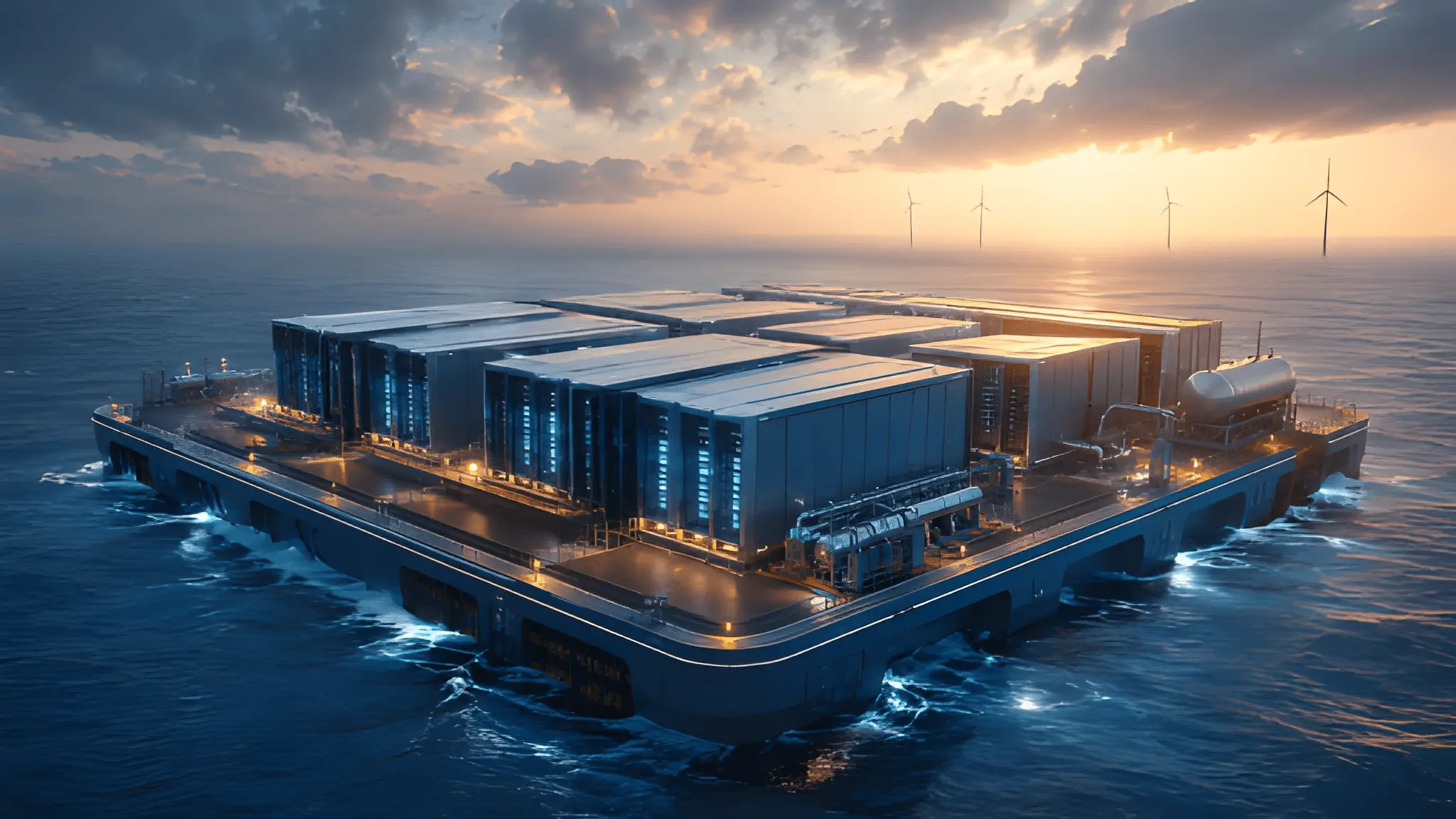
Samsung Heavy Industries (SHI) has now taken its floating data center program into the engineering phase after signing a strategic agreement with Texas-based infrastructure developer Mousterian Corporation. The move marks one of the industry’s clearest indications that floating facilities are progressing from conceptual designs toward deployable infrastructure. For the wider data center market, it also reflects how developers are searching for alternatives as land availability, power access, and cooling limitations become more difficult to overcome.

Samsung and Mousterian Move Floating AI Infrastructure Into Production Engineering
Samsung Heavy Industries announced on August 3 that it has entered an engineering agreement with Mousterian Corporation to jointly complete both the basic and production engineering for floating data center platforms designed specifically for AI workloads. The collaboration shifts the project into detailed engineering, establishing the technical foundation required before fabrication begins. Under the plan, every floating unit will deliver 50MW of critical IT capacity while supporting hyperscale AI deployments. Initial projects are expected to target Texas before expanding into additional US markets.
Unlike conventional construction programs that rely entirely on land-based development schedules, the floating platform introduces a different deployment model. Samsung intends to manufacture these facilities inside shipyards while site preparation progresses simultaneously, reducing project timelines and simplifying infrastructure delivery. The company believes this approach can remove several of the delays associated with permitting, land acquisition, and traditional construction sequencing.
Floating Platforms Target Power, Cooling and Land Constraints
The agreement arrives as AI infrastructure developers continue searching for new ways to secure deployable capacity despite growing resource constraints. Large-scale campuses increasingly face lengthy approval timelines, limited land availability near transmission infrastructure, and mounting pressure on water consumption. Samsung positions its floating platform as an alternative capable of addressing several of those challenges simultaneously. The facilities can operate alongside existing power generation assets while using surrounding water for heat rejection instead of relying on conventional evaporative cooling systems. According to the company, the architecture supports liquid-cooled AI hardware while operating with lower acoustic impact than many traditional data center designs. The platform also eliminates the need for potable water during cooling operations, making it suitable for regions where freshwater availability is becoming a limiting factor.

Shipbuilding Expertise Becomes Part of AI Infrastructure Strategy
Samsung Heavy Industries first introduced the floating data center concept during the Posidonia 2026 exhibition in June, presenting it as a practical response to growing infrastructure constraints affecting hyperscale expansion. Rather than treating floating facilities as experimental technology, the company is positioning them as industrial infrastructure built using established offshore engineering methods. The strategy leverages Samsung’s decades of experience constructing complex offshore platforms and commercial vessels. By adapting proven shipyard manufacturing techniques for digital infrastructure, the company aims to industrialize data center production while reducing deployment uncertainty. Meanwhile, factory construction allows major structural work to progress independently from on-site civil preparation, creating opportunities for faster project completion.
For Mousterian Corporation, the latest agreement represents the transition from strategic planning into engineering execution. “Signing this engineering contract transitions our partnership from intent to execution and gives us a clear path to scaling factory-built critical IT capacity for AI-class facilities,” said Min Suh, CEO of Mousterian. Suh also highlighted one of the project’s operational advantages, noting that constructing facilities under shipyard standards enables fabrication to continue while project sites undergo preparation. He added that the model also allows deployment alongside existing baseload generation assets that conventional land developments often cannot access. Samsung Heavy Industries also emphasized that the floating initiative builds directly on its offshore engineering capabilities. Samsung Heavy Industries Vice Chairman and CEO Sung-an Choi said floating data centers build on the company’s decades of offshore engineering and shipbuilding experience.
Floating Data Centers Gain Industry Momentum
Samsung is no longer exploring this direction alone. Multiple technology developers and infrastructure companies have begun evaluating floating facilities as AI computing demand continues pushing existing deployment models toward their practical limits. As GPU clusters consume larger amounts of electricity while requiring increasingly sophisticated thermal management, floating infrastructure is attracting attention as another option within the broader data center deployment portfolio.
Commercial viability at hyperscale remains unproven, and significant engineering, financing, regulatory, and operational questions still require validation before floating facilities become mainstream. Therefore, Samsung’s latest agreement should be viewed less as proof of market maturity and more as evidence that serious engineering programs are replacing conceptual discussions.












