 Skip to content
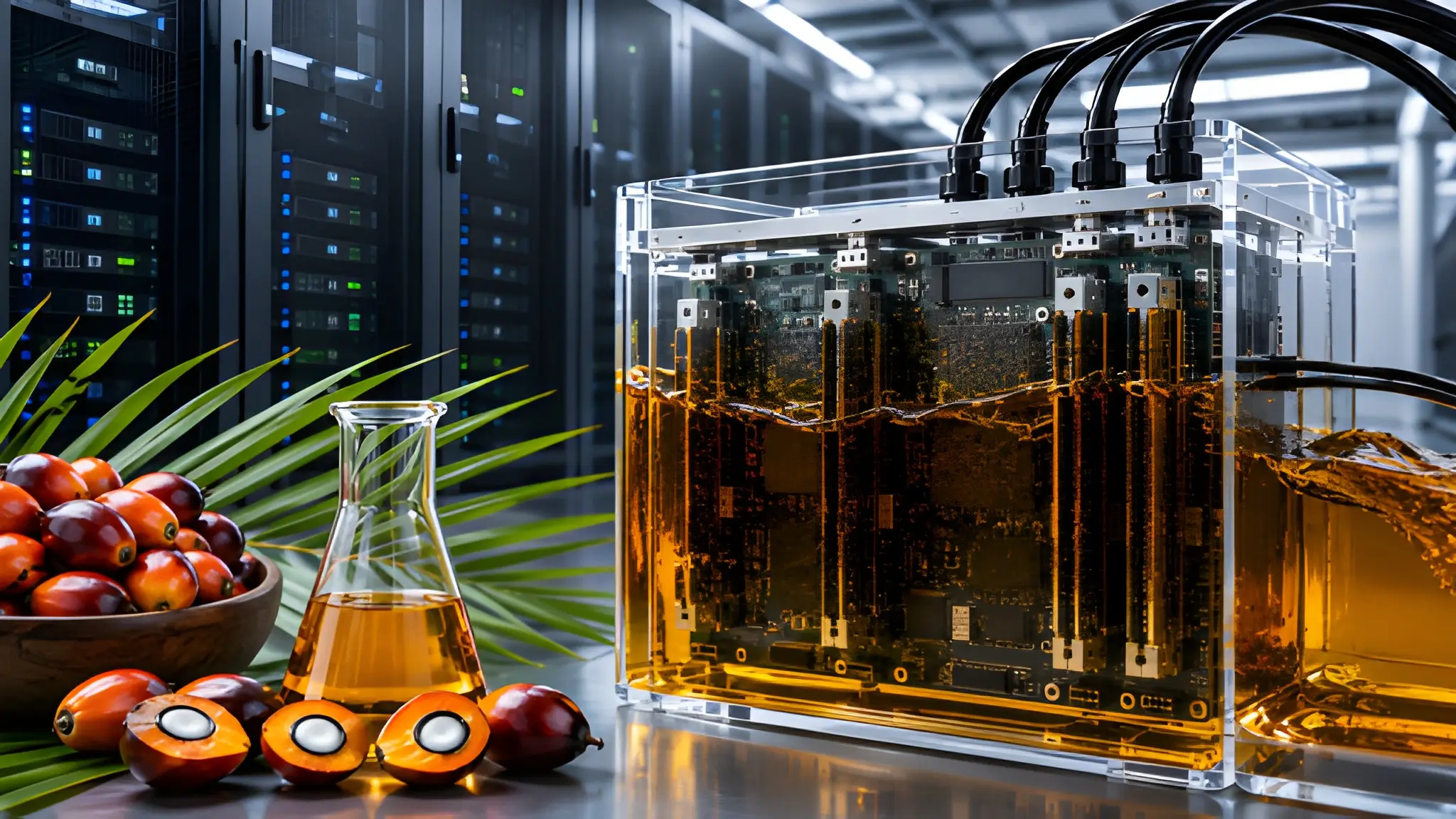
Malaysia is pushing palm oil into data center cooling as AI workloads intensify pressure on water and energy. The Malaysian Palm Oil Board (MPOB) has developed Sawit EcoTherm, a palm-based immersion cooling fluid for high-density computing. The system replaces water-heavy cooling with a closed loop using non-conductive dielectric fluid. For Malaysia, it connects a domestic resource with digital infrastructure.

Sawit EcoTherm Targets Water Use
Dr Noor Khairin Mohd, senior research officer at MPOB Advanced Oleochemical Technology Division, said Sawit EcoTherm could shift cooling away from water-intensive systems. She said traditional water-cooling systems are projected to consume 876 million liters daily in Malaysia, equivalent to the needs of nearly four million people. The estimate makes cooling a strategic issue as AI raises density. The system immerses components in fluid and removes heat through a closed loop. Noor Khairin explained: “This technology replaces conventional air-and water-based cooling systems. Instead of using cooling towers that consume large amounts of water through evaporation, server components are fully immersed in a non-conductive dielectric fluid that continuously removes heat in a closed-loop system. “If widely adopted, immersion cooling with Sawit EcoTherm could significantly reduce the water demand of the data centre industry,” she told Bernama. The approach could reduce evaporative cooling.
Noor Khairin said Sawit EcoTherm combines renewable raw materials with water-free, high-performance cooling. The target market includes AI and hyperscale data centers, where thermal loads rise with compute density. She said AI servers generate three to five times more heat than conventional servers, strengthening the case for immersion cooling. Meanwhile, the palm-derived formulation gives Malaysia a resource advantage. “Sawit EcoTherm stands out because it combines high-performance cooling with sustainability and local resource advantages, using a palm oil-based, non-conductive immersion cooling fluid produced from locally sourced Malaysian palm oil. “AI servers generate three to five times more heat than conventional servers. Therefore, immersion cooling can handle much higher heat loads than conventional air cooling, enabling higher computing density, improved energy efficiency and more reliable operation for next-generation AI infrastructure,” she said. The comments frame cooling as AI architecture, a shift that matters for denser racks.
Malaysia Needs Commercial Validation
MPOB’s sustainability argument extends into power efficiency and emissions. Noor Khairin said direct cooling can eliminate server fans and reduce energy consumption by around 30% to 50%. Lower electricity demand can reduce indirect Scope 2 emissions, while Sawit EcoTherm uses up to 95% renewable, bio-based materials. The formulation reduces reliance on petroleum-based cooling fluids. “The technology improves energy efficiency by cooling server components directly, eliminating server fans and substantially reducing energy consumption by around 30%-50%, contributing to improved power usage effectiveness (PUE). “It also helps reduce carbon emissions, as lower electricity consumption translates directly into lower indirect (Scope 2) greenhouse gas emissions (GHGs),” she said. The pitch addresses water, power and carbon pressures. Those factors influence infrastructure economics.

The larger challenge is moving Sawit EcoTherm into critical infrastructure. Noor Khairin said government support will be instrumental, with collaboration needed across developers, manufacturers and immersion cooling integrators. Pilot projects can establish evidence on performance, reliability and costs before wider adoption. However, the opportunity could grow if Malaysia links its oleochemical capabilities with AI infrastructure demand. “The priority is to build confidence among data centre operators through pilot projects, technical validation and demonstrations of the technology’s performance, reliability and long-term cost benefits. “By combining government support, industrial partnerships, and Malaysia’s strong oleochemical capabilities, Sawit EcoTherm has the potential to position Malaysia as a global leader in sustainable immersion cooling technology for next-generation AI data centres,” she added. The next test is commercial adoption. That decision will shape Malaysia’s AI infrastructure strategy.










