Skip to content
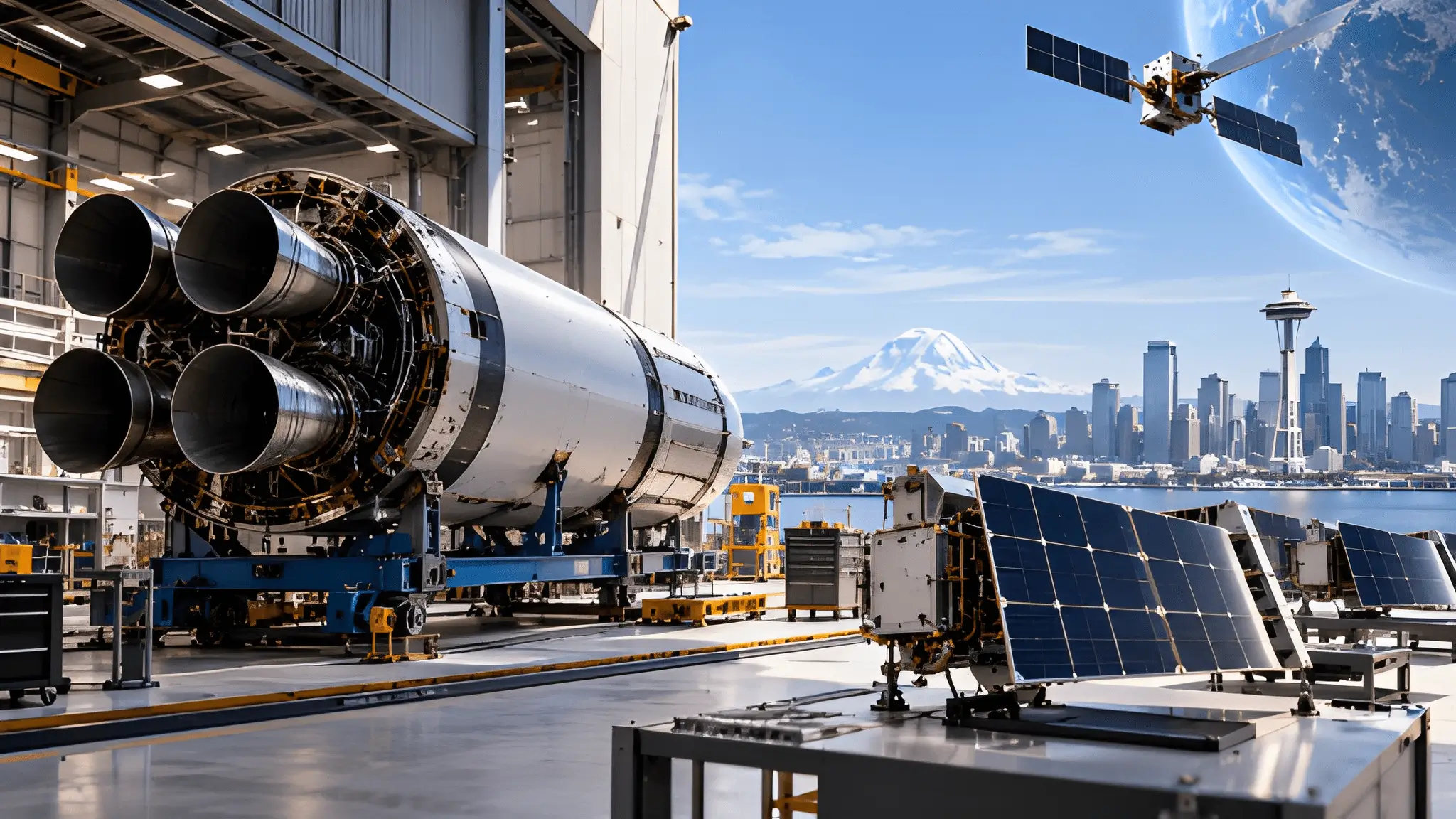
California-based Cowboy Space is taking a step toward manufacturing hardware for its orbital AI infrastructure. The company has leased a 291,035-square-foot industrial facility in Kent, Washington, for production tied to its AI data center satellite constellation, according to Newmark, the transaction broker. Newmark said the lease represents the largest industrial transaction in the Puget Sound region year-to-date, giving Cowboy a substantial production base. The facility’s scale signals that orbital computing may require industrial manufacturing.

Cowboy Space Turns Logistics Facility Into Aerospace Factory
The property at 7650 S. 228th St. previously operated as a Costco distribution and delivery center, which Cowboy plans to convert for space and rocket manufacturing. Newmark represented CenterPoint Properties, Cowboy’s new landlord, in the transaction, and the broker described the redevelopment as a logistics-to-aerospace conversion. “This building was originally designed for large-scale logistics users, but Cowboy Space recognized the opportunity to reimagine it as a highly specialized production facility,” said Taylor Hoff, a vice chairman at Newmark’s office in Bellevue, Wash. The conversion could add about 300 jobs, and Cowboy’s careers database lists 46 Kent positions.
Kent Becomes a Strategic Base for Space Manufacturing
Kent sits about 20 miles south of Seattle and has developed into an important Pacific Northwest cluster for commercial space companies. Boeing’s Kent Space Center remains active more than five decades after the company built NASA’s Apollo moon rovers, and Jeff Bezos’ Blue Origin and Stoke Space, founded by Blue Origin alumni, operate in the city. That concentration gives Cowboy access to an established aerospace labor market. The location matters beyond square footage because orbital data centers require launch, spacecraft manufacturing, power and computing capabilities.
Orbital Data Centers Target AI’s Physical Constraints
Cowboy Space, formerly known as Aetherflux, plans to launch its own rockets into low Earth orbit as early as 2028, with upper stages designed to operate as solar-powered orbital data centers. The Stampede constellation belongs to a broader push to move AI computing away from terrestrial facilities, where access to electricity, water and suitable sites has become increasingly contentious. “We are building what I call the last big clean-sheet launch vehicle in my lifetime, so it’s going to be a very big heavy-lift vehicle, and we’re working every day to bring it to reality,” Warren Lamont, Cowboy Space’s head of launch and propulsion, said this week in a LinkedIn video. Lamont, a former IonQ and Blue Origin executive, is helping lead the company’s Seattle-area engineering hub.

Funding and Nvidia Partnership Push Production Forward
In May, Cowboy Space announced a $275 million Series B funding round to expand production capabilities as it develops satellite and launch hardware. Cowboy is collaborating with Nvidia to deploy the chipmaker’s Nvidia Space-1 Vera Rubin Modules in orbit, connecting the project to accelerating demand for AI compute. Meanwhile, the company secured an agreement to test its propulsion system at NASA’s Stennis Space Center in Mississippi, adding a testing milestone. “We’re really excited to get into first engine hot-fire next year,” Lamont said.
Space Data Center Race Gains New Competitors
Cowboy is entering a field that is rapidly attracting companies with different orbital compute approaches. SpaceX has outlined plans for up to a million AI-processing satellites, and Redmond-based Starcloud is establishing a production facility in Woodinville and seeking authorization for up to 88,000 data center satellites. However, those plans underscore how AI infrastructure economics are pushing companies to explore compute beyond conventional data center campuses. For Cowboy, the Kent facility is more than an industrial lease: it is a physical bet that large launch, spacecraft manufacturing and orbital computing can converge into a scalable infrastructure business.