
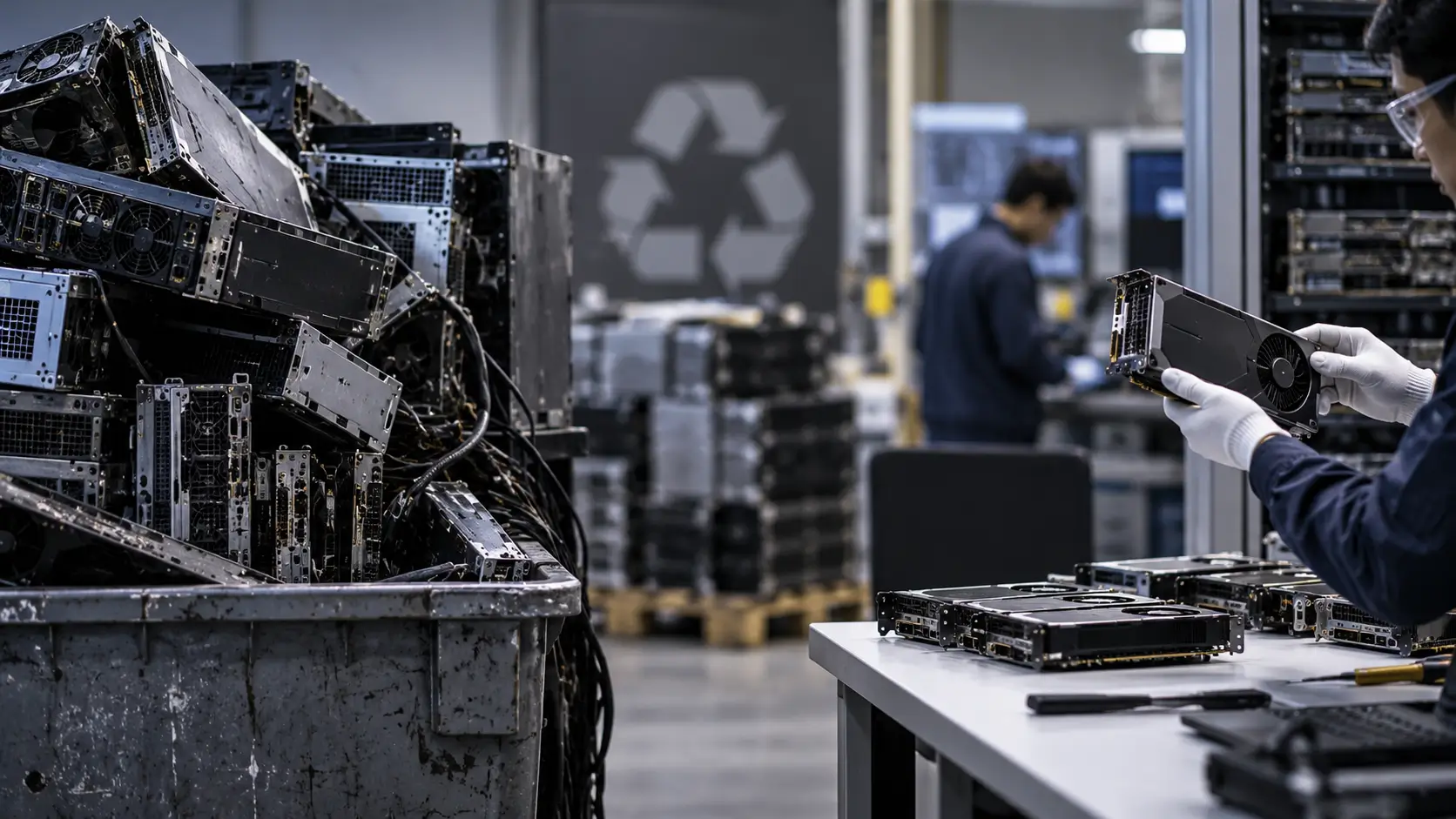
The sustainability conversation around AI infrastructure usually becomes loudest when electricity enters the room. Megawatts, grid constraints, cooling efficiency and carbon intensity remain prominent in AI infrastructure sustainability discussions because they directly shape operational energy use and emissions. A harder question appears when that infrastructure stops running. A GPU server can remain technically functional even after its economics no longer justify its place inside a high-performance cluster. New accelerator generations can change performance, memory, networking and power requirements quickly enough to make replacement attractive before physical failure dictates retirement. That creates an uncomfortable distinction between the operational life of hardware and its economically useful life inside a specific AI environment. End users evaluating the sustainability of their AI capacity therefore have to look beyond what happens while workloads execute. The environmental ledger continues after the final job leaves the machine.

Sustainability accounting cannot stop at the power meter
Energy efficiency creates an intuitive sustainability story because the arithmetic appears straightforward. More computational work from each unit of electricity can reduce the energy required for a defined workload, although actual environmental outcomes still depend on utilization, grid conditions and workload growth. Hardware replacement complicates that equation because every new server carries environmental impacts created before installation. Semiconductor fabrication, server manufacturing, component production and logistics contribute embodied emissions that operational efficiency metrics cannot capture by themselves. Research published in 2026 indicates that embodied emissions can represent a substantial part of the footprint of large AI data centers, making hardware design and lifetime increasingly important sustainability variables. A decision to replace functioning equipment therefore creates both an efficiency opportunity and another manufacturing requirement. End users should ask whether the operational savings from replacement justify the environmental cost of producing the replacement hardware. Without that comparison, a sustainability strategy can reward efficiency while overlooking material turnover.
The problem becomes sharper because AI infrastructure does not retire as a single homogeneous asset. GPUs, CPUs, memory, storage, networking equipment, power systems and cooling components can reach different economic or technical endpoints. A server that no longer makes economic or technical sense for frontier model training may still support inference, development, testing or less demanding computational workloads when its memory capacity, software support, performance and energy efficiency remain suitable. Components within that server may also retain value even when the original configuration loses its economic advantage. That means decommissioning should not automatically mean destruction, recycling or disposal. It can mean redeployment, refurbishment, resale, component harvesting or reassignment to workloads with different performance requirements. The sustainability question shifts from asking when equipment becomes obsolete to asking where its remaining capability still creates useful work. That distinction matters because retiring functioning hardware before the end of its useful life can offset part of the environmental benefit of replacement equipment when additional manufacturing impacts outweigh the operational savings achieved.
The refresh decision is becoming an environmental decision
Performance economics can shorten useful infrastructure life
AI infrastructure buyers face a peculiar form of obsolescence because hardware does not need to fail before it becomes commercially unattractive. New architectures can improve computational throughput or change memory and interconnect capabilities enough to alter the economics of older clusters. Those improvements can make a refresh financially rational even while existing systems continue operating correctly. The environmental decision is less straightforward because replacing hardware introduces another round of manufacturing impacts. Keeping older equipment also has consequences if it consumes substantially more energy for the same useful computational output. Neither “keep everything longer” nor “replace everything faster” provides a credible universal sustainability rule. End users instead need lifecycle comparisons that account for workload suitability, utilization, energy consumption, embodied emissions and realistic secondary uses. The correct retirement point may therefore differ between two clusters purchased at exactly the same time.
This changes how procurement teams should think about hardware at the beginning of its life. A server purchase is not merely an acquisition decision followed several years later by an unrelated disposal exercise. The initial configuration can influence whether components remain reusable, transferable or commercially recoverable when the primary workload moves elsewhere. Hardware that supports modular replacement or practical component harvesting may retain more options after its first deployment. Infrastructure built around tightly coupled configurations may face additional recovery or redeployment constraints when newer generations require substantial changes to power delivery, networking, cooling or system compatibility. End users should consequently treat residual utility as part of infrastructure economics rather than an accidental benefit discovered during retirement. Procurement models that calculate acquisition cost without considering the eventual disposition path leave an important variable outside the investment case. Sustainability becomes more credible when the exit strategy exists before the purchase order.
AI infrastructure needs a second-life strategy
Retirement from one workload should not mean retirement from computing
One of the biggest mistakes end users can make is treating workload obsolescence as hardware obsolescence. Frontier training places unusually demanding requirements on accelerators, memory bandwidth and networking, but not every AI workload needs the newest available architecture. Older accelerators can remain useful where performance requirements, latency targets and economics allow them to operate efficiently. That creates the possibility of cascading hardware through several workload tiers before material recovery becomes the final option. High-performance training equipment might move toward inference, experimentation, internal development or other computational workloads when technical compatibility permits. Such reassignment will not work for every system because software support, power efficiency, maintenance cost and workload characteristics still matter. Yet those constraints should determine retirement rather than an automatic assumption that newer hardware makes the previous generation worthless. A credible sustainability program should measure useful computational life, not simply years since purchase.

Component recovery adds another layer to that strategy. Memory, storage devices, processors and other parts can retain useful life after the original server configuration reaches retirement. Mature reverse-supply-chain programs already demonstrate that decommissioned data center equipment can become a source of reusable components rather than immediately becoming waste. Recovering those components can support repairs, maintenance inventories, resale or redeployment where technical requirements permit. Recycling remains necessary when equipment has exhausted practical reuse options, but recycling and reuse solve different sustainability problems. Recycling attempts to recover materials after a product loses its useful function, while reuse preserves more of the manufacturing value already embedded in functioning equipment. End users should therefore resist treating recycling rates as the sole measure of responsible decommissioning. The stronger question is how much useful hardware avoided becoming waste in the first place.
Decommissioning also creates a data governance problem
AI hardware carries more than residual material value when it leaves production. Depending on system architecture, servers can include data-bearing storage that has handled model artifacts, checkpoints, logs, credentials, training-related information or other sensitive data during operation. Moving equipment into resale, refurbishment or recycling channels therefore creates a security transition alongside the sustainability transition. End users cannot assume that environmental responsibility automatically guarantees appropriate data sanitization. A second-life strategy requires documented processes that determine what data-bearing equipment can leave a controlled environment and under what conditions. Sanitization, chain of custody, asset identification and verification should become explicit parts of the decommissioning workflow. Those controls can also influence reuse options because sanitization requirements, verification procedures and decisions to destroy data-bearing components can affect which assets remain available for redeployment or resale. Sustainability and security consequently need a shared retirement process rather than separate policies that collide after equipment has already been removed.
That governance challenge grows when infrastructure ownership becomes fragmented. An organization may consume AI capacity without owning the physical accelerator, server, rack or facility supporting the workload. In those arrangements, an end user’s visibility into hardware replacement schedules and downstream disposition can vary significantly depending on the provider, contractual terms and lifecycle reporting practices. Sustainability claims based largely on operational electricity can therefore reveal only part of the infrastructure lifecycle. Customers seeking stronger environmental accountability should ask providers how they manage retired hardware, whether they prioritize reuse before recycling and how they verify downstream disposition. They should also understand whether carbon reporting incorporates hardware manufacturing and replacement where relevant to the stated accounting boundary. These questions do not require every customer to become an electronics recycler. They require customers to recognize that outsourced compute does not make the physical lifecycle disappear.
The economics of decommissioning deserve more attention
Residual value can change the refresh calculation
Hardware retirement also has a financial dimension that sustainability discussions often understate. Accelerators and supporting components can retain meaningful economic value after their highest-performance use case has moved to newer systems. Residual values can change as newer generations enter secondary markets, although pricing does not follow a uniform downward path because supply conditions, workload demand, component shortages and continued utility can support older hardware values. Replacing equipment too early, however, can sacrifice useful operating life and trigger unnecessary manufacturing demand. The optimal point therefore sits between performance economics, energy efficiency, residual value and environmental impact. End users should model those variables together rather than allowing technical teams to decide refresh timing solely around benchmark improvements. A newer accelerator may deliver superior performance, but that advantage alone does not establish the lifecycle case for immediate replacement. The relevant question is whether the complete transition creates enough operational, financial and environmental value to justify retiring the existing configuration.
This is where AI infrastructure sustainability becomes more demanding than buying efficient hardware. Efficiency measures what equipment does while operating, while circularity asks how effectively its existing material and manufacturing value remains useful across multiple lives. Research into AI sustainability increasingly points toward longer hardware utilization, reuse and lower-performance components for suitable workloads as potential methods of reducing embodied impacts. Those strategies warrant greater attention as deployments of specialized AI computing equipment expand and more hardware eventually enters reuse, refurbishment, recovery and end-of-life channels. A 2026 study estimating future AI-server electronic waste concluded that significant volumes could emerge by 2030 while also emphasizing substantial uncertainty around server lifetimes and deployment assumptions. That uncertainty should discourage dramatic predictions, but it should not encourage inaction. Infrastructure being installed today will eventually move through refurbishment, resale, harvesting, recycling or disposal channels. Planning those channels after retirement arrives is already too late.
End users should demand a retirement plan before deployment
The next stage of sustainable AI procurement should begin with a deceptively simple question: What happens to this hardware when this workload no longer needs it? The answer should identify potential second-life workloads, component recovery routes, sanitization requirements, resale options, recycling processes and the data needed to verify each outcome. Buyers should also understand whether refresh decisions follow measured workload economics or simply predetermined replacement schedules. Contracts for externally supplied compute can include reporting expectations around equipment lifecycle and disposition where those issues materially affect the customer’s sustainability objectives. Internal infrastructure teams can incorporate remaining useful life and residual value into capacity planning alongside performance and power consumption. None of these practices eliminate the environmental footprint of AI infrastructure. They make that footprint harder to hide behind a narrower operational efficiency metric. Decommissioning becomes part of infrastructure strategy when the retirement path influences decisions made before deployment.
AI infrastructure will keep changing because computational economics reward better performance, denser systems and more efficient architectures. Sustainability cannot realistically demand that every server remain in its original role until physical failure. It can demand something more practical: that functioning equipment does not become waste merely because it no longer represents the fastest option available. The industry already knows how to measure utilization, energy efficiency, performance and availability with remarkable precision. It now needs comparable discipline around asset lifetime, redeployment, component recovery and final disposition. For end users, that means sustainability due diligence should follow the hardware beyond installation and operation. The greenest accelerator is not automatically the newest one, nor is it automatically the oldest machine still drawing power. The better answer depends on how much useful computation the infrastructure can deliver across its entire physical life. AI’s sustainability problem does not end when the servers switch off; that may be where one of its least examined problems begins.











